4 Jun 18

Priorslee Lake and The Flash

Priorslee Lake:  07:35 – 09:40
The Flash:  07:15 – 07:30 // 09:45 – 10:05

c.15.0C > c.16.0°C:  Had been a clear but hazy blue sky at Newport: not here – low cloud yet again. Light N / NE wind. Moderate visibility.

Sunrise: 04:49 BST

Priorslee Lake:  07:35 – 09:40

(68th visit of the year)

One of the anglers told me that the weed will be cut in the water this week. I have rather mixed views about this. Certainly the weed needs management. As the chemicals previously used are now banned by the EU, then cutting seems the only option. Making the water more navigable due to less fouling of the speedboat propellers is something the wildlife could probably do without

Notes from today:
- Buzzard seen circling low over carrying prey – perhaps a rat sp. as it seemed to have a long tail
- just 5 Great Crested Grebes today. Some possibly left due to the weekend disturbance on the water
- juvenile Blue and Great Tits seen and, mainly, heard
- scolding noises from a Common Whitethroat suggested juveniles nearby: not seen
- another new singing location for a Reed Warbler today: some are close-enough that it is hard to establish exactly how many different birds involved
- three Reed Bunting territories with male seen carrying food at one of them
and
- a Painted Lady butterfly warming on the stones of the dam: a species I failed to log here last year
- a Figure of Eighty moth on one of the lamps
- the following moths flushed from the vegetation
- >5 Yellow-barred Longhorn (Nemophora degeerella)
- 1 Straw Dot
- 1 Timothy Tortrix (Aphelia paleana)
- 1 Silver-ground Carpet
- many damselflies with the following species identified
- Common Blue Damselfly
- Blue-tailed Damselfly
- the following hoverfly
- Episyrphus balteatus (Marmalade hoverfly)
- several species of beetle including
- Harlequin Ladybird (Harmonia axyridis)
- Common Red Soldier Beetle (Rhagonycha fulva)
- Red-headed Cardinal Beetle (Pyrochroa serraticornis)
- several species of crane fly
- Common Crane-fly (Tipula oleracea)
- Limonia phragmitidis
- Tiger Cranefly (Nephrotoma flavescens)
- Epiphragma ocellare
with
- 100's of Black Snipe flies (Chrysopilus cristatus)
- a presumed Yellow Dung Fly (Scathophaga stercoraria)
- Bramble Sawfly (Arge cyanocrocea)
- a digger wasp sp
- the usual Common stretch-spiders (Tetragnatha extensa)
- plenty of slugs and snails including a possible Glossy Glass Snail (Oxychilus navarricus)
- a dead Common Carp in the water: a frequent occurrence from natural causes after the exertion of spawning
- too many mosquitoes!!!

New species of flowering plants noted today
- Woody Nightshade or Bittersweet (Solanum dulcamara)
- probable Broad-leaved Willowherb (Epilobium montanum) just opening
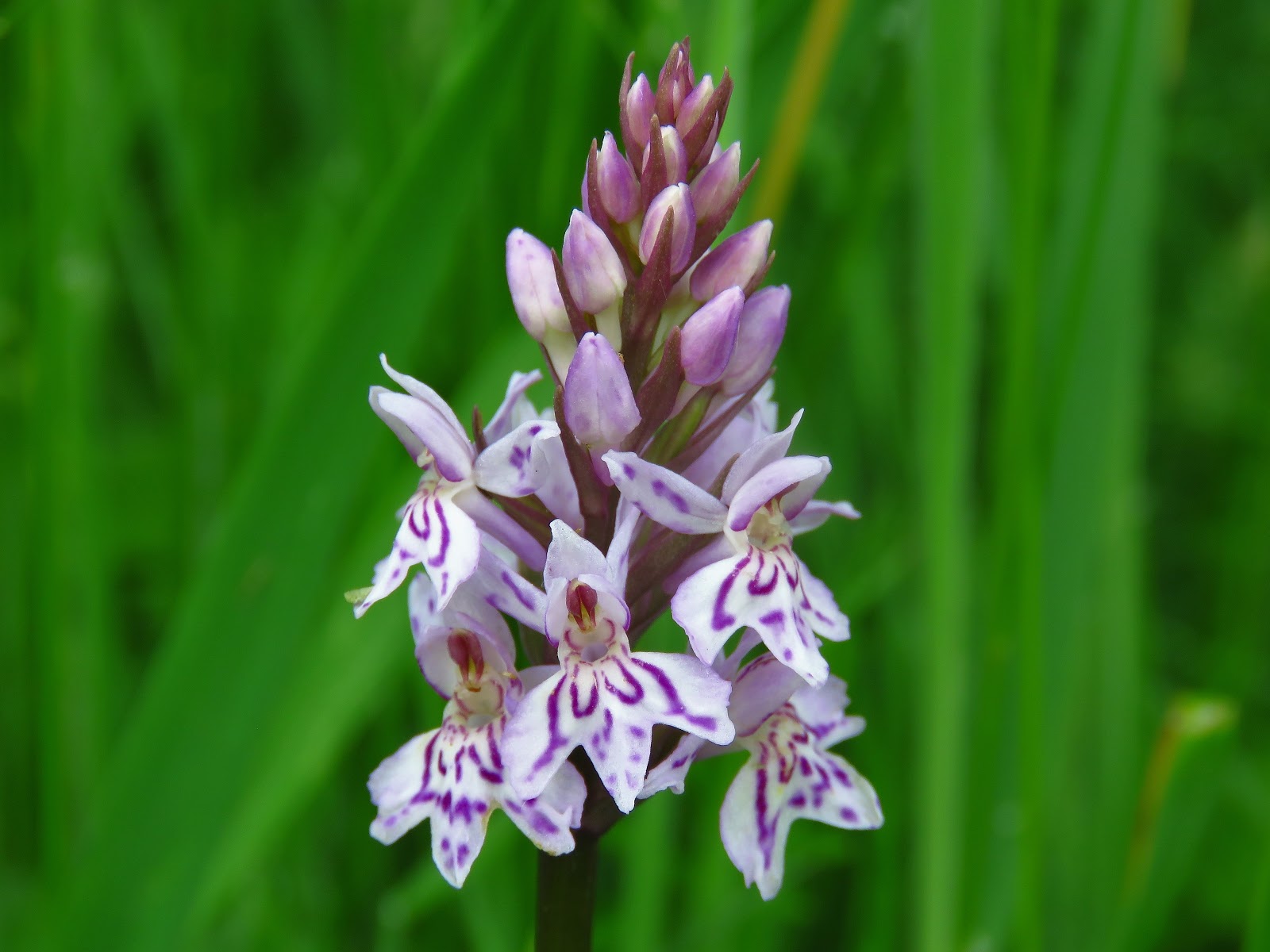
- presumed Southern Marsh Orchid (Dactylorhiza praetermissa)
also worth noting is that while not new Common Hogweed (Heracleum sphondylium) is now taking over as the dominant umbellifer as the flowers of Cow Parsley (Anthriscus sylvestris) fade

Today’s bird totals

Birds noted flying over / near the lake:
- 12 Canada Geese [2 outbound; 10 inbound]
- 1 Herring Gull
- 3 Wood Pigeons
- 2 Starlings

Hirundines seen today
- 3 Common Swifts
- 3 House Martins

Warblers noted: figure in brackets is singing birds (not all the males seen might have been singing)
- 8 (7) Chiffchaffs
- 10 (9) Blackcaps
- 2 (2) Garden Warblers
- 3 (2) (Common) Whitethroats
- 8 (8) Reed Warblers

The counts from the lake area
- 4 + 8 (2) Mute Swans
- 1 Canada Goose
- 8 (8?) Mallard
- 5 Great Crested Grebes
- no Moorhens again
- 19 + 3 (2 broods) Coots

Much under exposed and much over-enlarged but I think we can see that this Buzzard is likely carrying a rat – the tail hanging down seems too long for any sort of vole.

One day it will be bright-enough to get a decent shot: meanwhile another singing Garden Warbler in the gloom.

A Painted Lady butterfly warming itself on a stone.

Here we see the underwing pattern as well – it was not entirely happy with my presence and kept closing its wings.

This is a Figure of Eighty moth on one of the lamps. I recall that in South America there is a genus of butterfly with the generic name ‘88’ after a very similar wing marking. Perhaps a ‘print through’ from a camouflage of the caterpillar?

This is a rather better photo of a more cooperative Straw Dot moth. There are in fact two dots in each wing marking. This species is smaller than many micro moths but is classified with the macro moths and hence has an established vernacular name.

A female Blue-tailed Damselfly

This seems to be the Black Snipe fly (Chrysopilus cristatus). There were 100s of them this morning.

I said there were a lot.

A Harlequin Ladybird (Harmonia axyridis) of the form succinea. This invasive species seems to be dominant almost everywhere these days.

This is a Red-headed Cardinal Beetle (Pyrochroa serraticornis). New species for me that is quite distinctive.

While this is a Common Red Soldier Beetle (Rhagonycha fulva).

With its yellow ‘shoulders’ this is the crane-fly Limonia phragmitidis.

This seems to be a Tiger Cranefly (Nephrotoma flavescens).

This is a not brilliant photo of the crane fly Epiphragma ocellare (no vernacular name). A new species for me.

After some helpful hints, I am now convinced this a Bramble Sawfly (Arge cyanocrocea). I was wondering why so many of the hawthorns look rather moth-eaten – not caterpillars but sawfly larvae.

This may be a Yellow Dung Fly (Scathophaga stercoraria) though I would expect the thorax to be rather more marked than is shown here.

This looks like a digger wasp sp. but with the wings folded over its markings hard to say more. There seems to be a severed head of a nasty-looking fly on the leaf – a prey item?

These flowers just opening are from a willowherb. I think Broad-leaved Willowherb (Epilobium montanum) – must remember to photograph leaves in future!

The first flowers of Woody Nightshade or Bittersweet (Solanum dulcamara). Toxic but not dangerously so.

Not sure I photographed this species earlier this year: all around the lake is Wood Avens (Geum urbanum).

I get very confused with orchids. Most of the spikes around the lake are on orchids with spotted leaves. Close to the S shore are a few of these orchids with plain leaves. I believe them to be Southern Marsh Orchid (Dactylorhiza praetermissa). (Previously I thought them Early Marsh Orchid but the lip of the flower is the wrong shape).

This seems to be a glass snail shell, perhaps the Glossy Glass Snail (Oxychilus navarricus) ....

... but as there is no-one home, identification is hard (my life-line on display for anyone who cares to read it!).

This deformity is caused by a rust fungus though by which species I am unsure.

Dead in the water. A not-infrequent occurrence post-spawning. A Common Carp.

(Ed Wilson)

------------------------------------------------------------------------------------------------------

The Flash:  07:15 – 07:30 // 09:45 – 10:05(51st visit of the year)

notes from today
- when I passed by early there were three pairs of Tufted Duck. When I returned I could find only the 3 drakes and 2 ducks that I have noted for some days. Whether this means that the duck went back to sitting on eggs on the island (as I would hope); or whether there was an extra pair, time might tell
- 5 broods of Coots again this morning: one of these with 5 new juveniles was a newly-hatched brood with Saturday’s newly-hatched brood not located today
also
- a Small Phoenix moth on one of the lamps
- fish, presumably carp sp., were noted fighting and spawning
- I am told that at least two Terrapin sp. have emerged from their hibernation

birds noted flying over
- 3 Feral Pigeons
- 1 Wood Pigeon
- 2 Jackdaws

hirundines etc. seen today
- 2 Swifts to the N again
- 2 Barn Swallows remain on wires to the N
- 4 House Martins

warblers noted: figures in brackets is singing birds (not all the males seen might have been singing)
- 1 (1) Blackcap again

the counts from the water
- 1 Mute Swan
- Greylag Geese heard from inside the island
- 42 Canada Geese seen: other(s) heard from inside the island
- 6 (5?) + 7 (1 brood) Mallard
- 6 (3?) Tufted Ducks (see notes)
- no Great Crested Grebes
- no Moorhens again
- 19 + 15 (5 broods) Coots

Not a great photo of a drake Tufted Duck, included to show that the white flanks are already being sullied with grey as the bird moults out of breeding plumage.

This different drake has less grey on the hind flanks but we see it has pretty much lost its ‘tuft’.

This moth is a Small Phoenix – a common moth whose caterpillars feed on willowherbs. My first here for many years.

Noted between the lake and The Flash
- an adult Moorhen with a well-grown juvenile on the grass by the upper pool
- 1 Blackcap singing above the upper pool
- a clump of fungus sp. alongside the upper part of the Wesley Brook

A fresh batch of fruiting bodies of an unidentified fungus. Well-eaten side-elevation

Plan view. Does not help me identify them.

(Ed Wilson)

------------------------------------------------------------------------------------------------------
On this day..........
2017
Priorslee Lake
Today's Sightings Here

2016
Priorslee Lake
Today's Sightings Here

2015
Priorslee Lake
Today's Sightings Here

2012
Holmer Lake
Black Swan
(Marilyn Morton)

3 Jun 18

No sightings in today.

------------------------------------------------------------------------------------------------------
On this day..........
2017
Priorslee Lake
Today's Sightings Here

2016
Priorslee Lake
Today's Sightings Here

2015
Priorslee Lake
Today's Sightings Here

2014
Priorslee Lake
Today's Sightings Here

2009
Priorslee Lake
Oystercatcher
(Ed Wilson)

2006
Priorslee Lake
Possible Marsh Harrier
11 Reed Warblers
(Ed Wilson)

2 Jun 18

Priorslee Lake and The Flash

Priorslee Lake: 07:35 – 10:10
The Flash: 07:10 – 07:30 // 10:15 – 10:35

c.15.0°C > c.16.0°C: Mainly cloudy at much higher-level than recent days: even a few blue bits early. Drizzle until c.07:45. Light W wind. Very good visibility

Sunrise: 04:51 BST

Neither yesterday’s afternoon thunderstorm that flooded Newport and Telford nor this morning’s heavy shower in Newport had affected Priorslee at all

Priorslee Lake: 07:35 – 10:10

(67th visit of the year)

Notes from today:
- very confused about the number of Great Crested Grebes today. The same two pairs as yesterday throughout. Single birds near the usual nest sites in the NW and N. One bird seen in flight leaving and then returning was in addition. Also two other(?) birds seen in flight and apparently leaving
- two parties of juvenile Coots seen, both new for me. One party with a single well-grown individual; and another with three small juveniles. The better weather encouraged birds to come out of the reeds today
- a party of 5 Black-headed Gulls flew noisily W at 08:20; another 2 were circling high over at 08:50. This is rather early for birds to be moving back from their breeding areas
- a Lesser Whitethroat singing from along the S side. This could be a new arrival but I think more likely the re-establishment of a breeding territory between broods. These birds can be very quiet once paired
- the number of Reed Warblers continues to increase with new territories with singing birds

and
- the following moths flushed from the vegetation
- >5 Yellow-barred Longhorn (Nemophora degeerella)
- >2 Straw Dots (new for the year)
- >5 Timothy Tortrix (Aphelia paleana) (also new for the year)
- 4 Silver-ground Carpets
- 1 Blood-vein
- 1 Burnet Companion
with
- white seemed to be a Silver Y moth wrapped in a spider-web
- many 100s of damselflies with the following species identified
- Common Blue Damselfly
- Blue-tailed Damselfly
- Azure Damselfly
with
- a big hatch of unidentified tenerals
- the following hoverflies
- Episyrphus balteatus (Marmalade hoverfly)
- Volucella pellucens (Pellucid Fly)
- Eristalis sp. (drone fly not specifically identified)
- two species of bumblebee
- Bombus hortorum (Garden Bumblebee)
- Bombus lapidarius (Red-tailed Bumblebee)
- two species of beetle, both new for me
- Cantharis rustica (Sailor Beetle)
- Clytus arietis (Wasp Beetle)
with
- Black Snipe flies (Chrysopilus cristatus)
- Scorpion Fly (Panorpa communis): new for me this year
- the usual Common stretch-spiders (Tetragnatha extensa)
- a crab spider, apparently a completely different morph of Misumena vatia
- several mosquitoes enjoying me again

New species of flowering plants noted today
- Common Spotted Orchid (Orchis (Dactylorhiza) fuchsii)
- Cleavers (Galium aparine)

Today’s bird totals

Birds noted flying over / near the lake:
- 7 Black-headed Gulls
- 3 Wood Pigeons
- 2 Jackdaws

Hirundines seen today
- 2 Common Swifts
- 2 House Martins again

Warblers noted: figure in brackets is singing birds (not all the males seen might have been singing)
- 6 (6) Chiffchaffs
- 13 (11) Blackcaps
- 3 (3) Garden Warblers still
- 1 (1) Lesser Whitethroat
- 1 (1) (Common) Whitethroat
- 10 (8) Reed Warblers

The counts from the lake area
- 4 + 8 (2) Mute Swans again
- 10 (10♂) Mallard
- >7 Great Crested Grebes (see notes)
- no Moorhens
- 22 + 4 (2 broods) Coots

A family portrait of the new brood of three cygnets with a foot-waving adult.

As noted in the narrative several Great Crested Grebes went a-flying. Here is one of them.

A Mistle Thrush collecting food – left side.

And the right side!

Another view of a Yellow-barred Longhorn (Nemophora degeerella) moth. Not quite sure why this shows ‘cow horn’ antenna.

A plain moth with a yellow suffusion around the ‘shoulders’ identifies Timothy Tortrix (Aphelia paleana): new for the year.

One of the Straw Dot moths in the vegetation: also new for the year.

This is a Burnet Companion moth so-called because this day-flying moth flies at a similar date to burnet moths. It is several years since I have see burnet moths here. Only my second record here.

Hard to be sure but this seems to be a Silver Y moth having been wrapped up by a Common stretch-spider (Tetragnatha extensa). Its a jungle out there.

A male Common Blue Damselfly: just one line on the side of the thorax is the easiest ID feature in this view.

A male Azure Damselfly. We can just about make out two lines on the side of the thorax but the easier ID feature from this angle is the U-shape mark on segment 2.

Here is a male Blue-tailed Damselfly. Obviously smaller and weaker in flight than the two previous species. Also just visible here is the two-coloured pterostigma (the mark in one of the outer forewing segments).

And a female.

A mating pair.

One of the emergent damselflies this morning. Still in teneral stage and I cannot ID it.

A different specimen with pronounced green wings. Enough breeze to make photography difficult I persuaded this on to my finger and then shielded it from the wind.

A portrait gallery of the Episyrphus balteatus (Marmalade hoverfly) today. Here is one hovering at a buttercup flower.

And (a different specimen) settled.

When they close their wings the body markings are not often as easy to see as here and separation from similar species can be hard.

Another specimen on Cow Parsley.

And a side-elevation of the same specimen.

Not a bee this is the hoverfly Volucella pellucens (or Pellucid Fly).

Another buttercup visitor: this bumblebee sp. is likely Bombus lapidarius. Sometimes called Red-tailed Bumblebee, though there are several other candidates to use that name.

This bumblebee is likely Bombus hortorum and has been visiting the Yellow Flag (Iris pseudacorus) flowers. It is emerging covered in pollen. This bumble bee is often called the Garden Bumblebee.

A Black Snipe Fly (Chrysopilus cristatus).

My first Scorpion Fly (Panorpa communis) of the year.

This beetle looks like Cantharis rustica, sometimes called a Sailor Beetle – to separate it from the similar Soldier Beetle (Cantharis livida). New for me here.

Another new beetle for me. This is Clytus arietis or Wasp Beetle.

Not easy to see for two reasons: its not as sharp and I would have liked and the legs of this crab spider are well camouflaged. I think this a very differently-marked specimen of Misumena vatia from the almost all-white individual seen yesterday.

Another plant with inconspicuous flowers is Cleavers (Galium aparine). We see the spines all over the leaves that makes this plant so ‘sticky’ – one way it reproduces is to get attached to passing creatures and then dropped elsewhere where it will freely root.

When I last photographed Common Bird's-foot Trefoil (Lotus corniculatus) it was hardly open. Here it is again.

Looks good in close-up even if it is only Red Clover (Trifolium pratense).

The orchids are just opening. This specimen was identified by the spots on its leaves and is therefore a Common Spotted Orchid (Orchis (Dactylorhiza) fuchsii).

This is the next group of leaves of Giant Hogweed (Heracleum mantegazzianum) ....

In a few days it will look like this. Last year one grew alongside the Wesley Brook bridge and was chopped by the anglers as it was impeding their access. This year there are at least three growing here. It is said that contact with the leaves can produce a prolonged and painful burning rash – whether this means just the touching the leaves or from the sap from broken leaves I am unsure. I do not intend to find out!

(Ed Wilson)

------------------------------------------------------------------------------------------------------

The Flash: 07:10 – 07:30 // 10:15 – 10:35

(50th visit of the year)

A Grey Wagtail seen flying off the E side was my first here this year (they have been scarce at the lake as well). Brings my 2018 site bird total to 63

Notes from today
- 34 Canada Geese on the water when I passed en route to the lake. A group of 19 more came in from the N, circled around and left again. Perhaps some of these came back later and boosted the number on the water to 51 by the time I passed the other way
- just one group of Mallard ducklings located today
- the better weather seemed to encourage the Coots to bring all their juveniles on the water. There are still adults sitting on three other nests
- the 2 Barn Swallows on wires in Ashley Road again
also
- yesterday’s ‘clump of orchids’ seen in passing turned out to be a clump of Red Clover – oops!

Birds noted flying over
- 19 Canada Geese (see notes)
- 3 Cormorants together
- 2 Wood Pigeons
- 3 Jackdaws

Hirundines etc. seen today
- 2 Swifts to the N
- 2 Barn Swallows still to the N
- 1 House Martin

Warblers noted: figures in brackets is singing birds (not all the males seen might have been singing)
- 1 (1) Blackcap

The counts from the water
- 1 Mute Swan
- 3 Greylag Geese
- 34 > 51 Canada Geese (see notes)
- 11 (9♂) + 7 (1 brood) Mallard
- 5 (3♂) Tufted Ducks still
- 2 Great Crested Grebes
- no Moorhens
- 20 + 16 (5 broods) Coots

Noted between the lake and The Flash
- a Beautiful Demoiselle near the lower pool: surprisingly this is my first-ever record in the Priorslee area

(Ed Wilson)

------------------------------------------------------------------------------------------------------
On this day..........
2015
Priorslee Lake
Today's Sightings Here

2014
Priorslee Lake
Today's Sightings Here

2006
Priorslee Lake
Cuckoo

1 Jun 18

Priorslee Lake and The Flash

Priorslee Lake: 07:30 – 09:20
The Flash: 07:10 – 07:25 // 09:25 – 09:40
same times as yesterday

c.16.0°C: Yes: another visit with a very low overcast. Drizzle until c.07:45. Light E wind. Poor visibility, becoming moderate after drizzle ceased.

Sunrise: 04:52 BST again

With the start of June there is a small but perceptible reduction in the volume and frequency of bird-song

Priorslee Lake: 07:30 – 09:20

(66th visit of the year)

Notes from today:
- the non-breeding pair of Mute Swans has gone. Meanwhile the cob of the long-term resident pair was sitting on the N-side bank: could he be injured after seeing off the others?
- the small group of Tufted Ducks present throughout
- 1 immature Cormorant seen leaving as I arrived
- 4 Great Crested Grebes as two pairs today. Initially both asleep well away from the usual breeding sites. Later both pairs seen displaying. No confirmed sightings of any other bird
- juvenile Coots heard calling along the N side but nothing seen
- the Swifts and hirundines were mostly lost in the low cloud
- single Sand Martin flying E at 08:30 was unusual for the date
- I was premature in suggesting that the local Starlings had left. At least 11 had transferred from the ‘football field’ and moved on to the academy playing field. There were also at least another 9 seen flying out of their breeding sites in the estate

and
- an identified yellow-legged fly on one of the lamps
- another Silver-ground Carpet moth flushed
- many Yellow-barred Longhorn (Nemophora degeerella) moths flushed
- a Plum Tortrix (Hedya pruniana) moth flushed
- two Yellow-faced Bell (Notocelia cynosbatella) moths also flushed
- usual Common stretch-spiders (Tetragnatha extensa
- a more-or-less all-white spider – likely the crab spider Misumena vatia
- another Red-and-Black Froghopper (Cercopis vulnerata)
- a dagger fly, probably Empis opaca
- lots of slugs and snails enjoying the damp
- several mosquitoes enjoying me

Two new species of flowering plants noted today
- Water Forget-me-not (Myositis palustris)
- Goat's-beard or Jack-go-to-bed-at-noon or Meadow Salsify (Tragopogon pratensis)

Today’s bird totals

Birds noted flying over / near the lake:
- 3 Lesser Black-backed Gull
- 1 Herring Gull
- 1 Wood Pigeon only
- 9 Starlings
- 5 Jackdaws

Hirundines seen today
- 3 Common Swifts
- 1 Sand Martin
- 2 House Martins

Warblers noted: figure in brackets is singing birds (not all the males seen might have been singing)
- 6 (5) Chiffchaffs
- 9 (9) Blackcaps
- 3 (3) Garden Warblers
- 2 (2) (Common) Whitethroat
- 8 (5) Reed Warblers

The counts from the lake area
- 4 + 8 (2) Mute Swans
- 6 (4♂) Mallard
- 4 (3♂) Tufted Ducks
- 1 Cormorant
- 4? Great Crested Grebes
- 2 Moorhens
- 19 + ? (1 brood) Coots

This is a Plum Tortrix (Hedya pruniana) moth.

This Tortrix moths is hiding its key ID feature – its yellow ‘face’ (actually palps). Otherwise the photo shows rather better the wing markings of Yellow-faced Bell (Notocelia cynosbatella).

This is an easier moth to ID: a Yellow-barred Longhorn (Nemophora degeerella) moth. Seems an appropriate vernacular name!

A view of a different specimen of this amazing little moth. There were a number of these dancing around today.

Yet another specimen also keen to show off its long horns.

I think this is the dagger fly Empis opaca.

This yellow-legged fly ought to be easy to ID, but ... I have failed.

This seems to be the crab spider Misumena vatia. It can change colour to match its background – though it is not doing too well here.

The very last flowers of Lady's Smock / Cuckooplant / Milkmaid (Cardamine pratensis).

With the edge of the petals slightly notched this suggests these are Water Forget-me-not (Myositis palustris) flowers.

This is Goat's-beard or Jack-go-to-bed-at-noon or Meadow Salsify (Tragopogon sp. Tragopogon pratensis). It has a very distinctive ‘clock’ after the flowers have finished.

More damp weather means more slugs and snails: here is a White-lipped snail.

This White-lipped Snail seems to gripping a small stick tightly to avoid falling / sliding off.

(Ed Wilson)

------------------------------------------------------------------------------------------------------

The Flash: 07:10 – 07:25 // 09:25 – 09:40

(49th visit of the year)

Notes from today
- now two duck Mallards ducklings: the original group of 7 still doing well; a newer group under the vegetation that seemed to have 6 ducklings
- the 2 Barn Swallows on wires in Ashley Road again
also
- a Figure of Eighty moth on one of the lamps. Last year I recorded my first here on 18 June
- a clump of orchids seen in flower: my bus called and I’ll ID them tomorrow

Birds noted flying over
None

Hirundines etc. seen today
- 2 Barn Swallows to N once more
- 4 House Martins

Warblers noted: figures in brackets is singing birds (not all the males seen might have been singing)
- 2 (2) Blackcaps again

The counts from the water
- 1 Mute Swan still
- 28 Canada Geese
- 10 (8♂) + 13? (2 broods) Mallard
- 5 (3♂) Tufted Ducks remain
- 1 Great Crested Grebe
- 1 Moorhen
- 20 + 6 (4 broods) Coots

A Figure of Eighty moth, clearly named from the wing marks. 

Near The Flash

5657E A slightly better view of one of the Barn Swallows on the wire: if we ever get some sun I may get a better-lit shot. On the other hand the bird might well be feeding on all the insects flying!

Noted between the lake and The Flash
- a Moorhen calling from the lower pool

(Ed Wilson)

------------------------------------------------------------------------------------------------------
On this day..........
2017
Priorslee Lake
Today's Sightings Here

2015
Priorslee Lake
Today's Sightings Here

2014
Priorslee Lake
Today's Sightings Here

2007
Priorslee Lake
Common Tern
(Martin Adlam)

2006
Priorslee Lake
2 Ruddy Ducks
Peregrine
(Ed Wilson)