6 May 22

Priorslee Lake and The Flash

8.0°C > 14.0°C: Started off calm with slight mist over the lake and some thin high cloud. After 08:00 lower cloud from the N and W presaged a general clouding over by 10:00. Light W breeze developing. Very good visibility.

Sunrise: 05:29 BST

* = a photo today

Priorslee Lake: 04:55 – 06:00 // 07:00 – 10:00

(104th visit of the year)

Back to a more usual count at this time of year – just seven species of warbler.

Bird notes:
- When I arrived the local Canada Geese were with three goslings on the SW grass. When I returned from The Flash the cob Mute Swan was chasing a pair of Canada Geese and there were no goslings in sight. I feared the worse. Somehow the parents had managed to get themselves and their goslings on to the relative safety of the dam and the swan was chasing another pair of geese.
- The three (single and pair) Greylag Geese that arrived were likely to be the birds that flew over some minutes before-hand. The cob Mute Swan chased them away from the nest area but seemed sanguine about their presence otherwise.
- Two of the seven Great Crested Grebes went for a protracted fly around but returned.
- Only one juvenile Coot seen. With little sun and slightly more wind I expect they were staying inside the reeds.
- An adult Lesser Black-backed Gull was happy to be in the safety of the now enclosed football field at 05:45. After 08:45 two adults spent 10 minutes at the lake.
- A Grey Heron flew low out of the estate (raiding the ponds?) and in to the Wesley Brook. Later one flew high S well to the E of the lake.
- A Sedge Warbler was singing along the S side where a pair bred last year. The bird I noted quietly singing from the Ricoh hedge yesterday was not heard today. The other two birds I noted yesterday were still present though rather less vocal.
- Now nine singing Reed Warblers. Two of these were in relatively unsuitable habitat and these may well move on.
- Only single singing Garden Warbler and Common Whitethroat at the moment. There were four singing Garden Warblers and three singing Common Whitethroats last year.

Birds noted flying over here:
- 4 Canada Geese: two pairs outbound
- 3 Greylag Geese: single and pair outbound
- 1 Feral Pigeon
- 1 Stock Dove
- 10 Wood Pigeons
- 1 Herring Gull: immature again
- 1 Grey Heron
- 4 Jackdaws
- 1 Rook again

Hirundines etc. noted:
- 2 Barn Swallows

Warblers noted (figures in brackets relate to singing birds):
- 1 (1) Cetti's Warbler still
- no Willow Warblers
- 16 (14) Chiffchaffs
- 3 (3) Sedge Warblers again
- 9 (9) Reed Warblers
- 19 (15) Blackcaps
- 1 (1) Garden Warbler still
- no Lesser Whitethroats
- 1 (1) Common Whitethroat still

Counts from the lake area:
- *4 + 3 (1 brood) Canada Geese: a pair arrived and were again chased away by the Mute Swan
- 3 Greylag Geese: pair and then a single arrived
- 2 Mute Swans: pen on nest
- 6 (5♂) Mallard
- 1 (1♂) Tufted Duck: arrived
- 3 Moorhens
- 19 + 1 (1 brood) Coots: see notes
- *7 Great Crested Grebes again
- *3 Lesser Black-backed Gulls: see notes
- 1 Grey Heron

Noted on / around the street lamp poles pre-dawn:
- 3 Tetragnatha sp. stretch spiders

Noted later:

Butterflies:
- Orange-tip (Anthocharis cardamines)
- Green-veined White (Pieris napi)
- *Speckled Wood (Pararge aegeria)

Moths
- *Common Roller (Ancylis badiana)
- *Common Nettle-tap (Anthophila fabriciana)

Bees / wasps etc.:
- Buff-tailed Bumblebee (Bombus terrestris)
- Common Wasp (Paravespula vulgaris)
- ichneumon sp.

Hoverflies
- *Gossamer Hoverfly (Baccha elongata)
- Chequered Hoverfly (Melanostoma scalare)
- *Spotted Meliscaeva (Meliscaeva auricollis)
- *Pellucid Fly (Volucella pellucens) [Pied Plumehorn]

Other things:
- Alder Fly (Sialis lutaria)
- *Dark-edged Bee-fly (Bombilius major)
- Scorpion Fly (Panorpa sp.)
- St Mark's Fly or Hawthorn Fly (Bibio marci)
- Red-and-Black Froghopper (Cercopis vulnerata)
- *pollen beetles, perhaps Epuraea aestiva
- *7 Spot Ladybird (Coccinella 7-punctata)
- *14 Spot Ladybird (Propylea quattuordecimpunctata)
- Common European Earwig (Forficula dentata)
- *Crab spider Misumena vatia
- * an unidentified spider
- Tetragnatha sp. stretch spider

If you were not awake at 05:00 this is what you missed.

 A longer view across the still waters of the lake.

The parent Canada Goose hisses a warning at me as I pass by the brood of three goslings.

Cute or what? Funny little stubby wings.
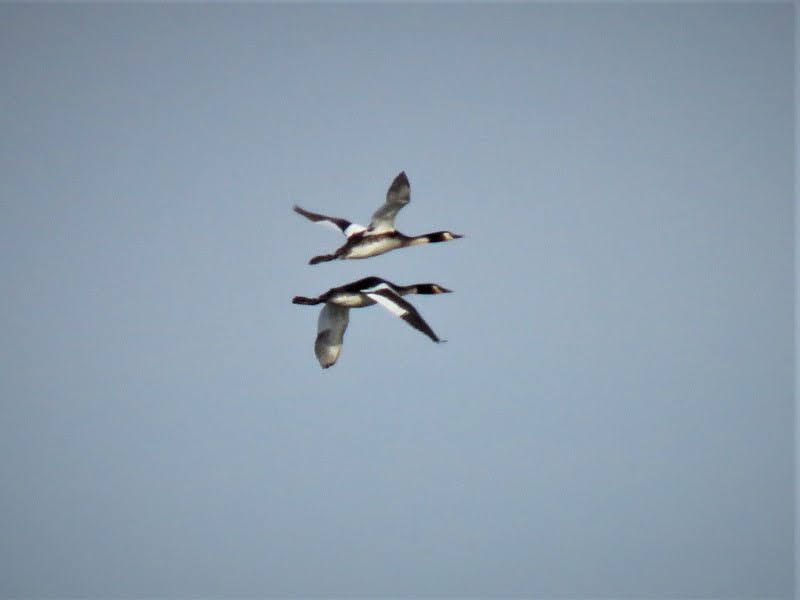
Two of the Great Crested Grebes go for a fly-about. They look unexpected in flight – both the elongated shape and the amount of white showing.

Happy to be on the enclosed grass of the erstwhile football field was this adult Lesser Black-backed Gull.

Another one that was on one the piers later.

Not my best-ever photo of a male Blackbird. This very blotchy partly albino bird only ever seems to appear at dawn when the light is 'challenging'.

Today's Long-tailed Tit photo.

I have not see Grey Wagtails on the dam for some while. There were two today, probably a pair. With a dark throat this is a male. So where has the ringed male first seen in November 2020 gone?

It is not often a Bullfinch will sit in the open and pose. I cannot explain why the colour looks washed-out. In reality it was a splendidly red male.

My first Speckled Wood butterfly (Pararge aegeria) this year. Butterfly species #7 which is unusual: it is often the first I record.

A pretty little moth: a Common Roller (Ancylis badiana). The larvae roll a leaf up and spin a web inside while they pupate.

Another small moth: it is a Common Nettle-tap (Anthophila fabriciana). I am sure there will be many more of these as they are abundant wherever nettles grow. They are multi-brooded and will be flying until at least October.

A very small and distinctively-shaped hoverfly though you need a side-view to be sure. It is a Gossamer Hoverfly (Baccha elongata).

Only my second-ever record of this hoverfly and one that was a challenge to photograph as it almost always closed its wings as soon as it landed, hiding the markings. It is a Spotted Meliscaeva (Meliscaeva auricollis). This was taken just as it landed.

My first record this year of a very common and easily recognised hoverfly – a Pellucid Fly (Volucella pellucens), also known as Pied Plumehorn. The broad white band and dark wing cloud are unique.

This Dark-edged Bee-fly (Bombilius major) was still beating its wings even as it sat on a leaf. The proboscis is for nectar feeding and they are a cuddly and harmless insect.

Not sure what these unidentified flies were doing. Perhaps a territorial dispute? Perhaps attempted mating?

Two for the price of one. On this Ribwort Plantain (Plantago lanceolata), my first of the year here, there is a 7 Spot Ladybird (Coccinella 7-punctata).

One of my favourite ladybirds is the 14 Spot Ladybird (Propylea quattuordecimpunctata). They don't always have 14 spots. It is a good job they do not have to wear a name tag with their scientific name.

A mass of pollen beetles feeding on a buttercup. They look a bit like Epuraea aestiva but I cannot find any reference to this species frequenting buttercups.

This is the crab spider Misumena vatia. The literature notes how they can change colour from white to green or yellow in order to match their surroundings as they wait to pounce on a passing insect. Quite why this one was bright yellow when it was amongst the white flowers of Cow Parsley (Anthriscus sylvestris) is hard to say!

An exciting looking spider. Not sure why the front two pairs of legs are being held together – could it be eating prey? One for Nigel to help me with.

(Ed Wilson)

------------------------------------------------------------------------------------------------------

The Flash: 06:05 – 06:55

(101st visit of the year)

A more 'normal' morning.

Bird notes:
- *A third Canada Geese brood of five goslings noted.
- Two Great Crested Grebes were very visible out on the water or attempting to hide under overhanging branches at their traditional nest site.
- A Common Sandpiper was on the island: rather a late date as most have passed through by now.
- I did not hear the Lesser Whitethroat. As I expected it was a passing bird – there is not really any suitable dense scrubby habitat for it.
- The Nuthatch was seen around its nesting area. It is likely getting on with the parenting duties and has been quiet for some days.

Birds noted flying over here:
None

Hirundines etc. noted:
None

Warblers noted (figures in brackets relate to singing birds):
- 6 (6) Chiffchaffs
- 10 (8) Blackcaps
Blackcaps seemed to be everywhere this morning.

Noted on / around the water:
- *36 + 9 (3 broods) Canada Geese
- 3 Greylag Geese: one of these departed
- 3 Mute Swans
- 23 (10♂) Mallard: no ducklings noted
- 1 (1♂) all-white duck (Aylesbury Duck)
- 6 (2♂) Tufted Duck
- 9 Moorhens
- 24 Coots: no juveniles seen but probably being brooded on nests
- 2 Great Crested Grebes
- 1 Common Sandpiper

Noted on / around the street lamp poles
- *1 Swallow Prominent moth (Pheosia tremula)
- 1 plumed midge (Chironomus plumosus)
- 1 Tetragnatha sp. stretch spider

Elsewhere:
Nothing of note

More cuteness: the latest brood of five Canada Goose goslings. Without the aggressive cob Mute Swan around these might have a chance of survival.

This morning's Swallow Prominent moth (Pheosia tremula). It was on a lamp pole where I cannot recall ever having seen a moth previously. From this angle you can see the protrusion created by the folded wings that gives a group of moths the vernacular name of 'prominent'.

(Ed Wilson)

------------------------------------------------------------------------------------------------------

Between the lake and The Flash

- Moorhen(s) calling at the upper pool.
- 1 Chiffchaff singing at the upper pool again.
- 1 Blackcap singing beside the lower pool.

(Ed Wilson)

------------------------------------------------------------------------------------------------------

In the Priorslee Avenue tunnel

- many plumed and other midges including *a long-legged species.
- *1 millipede sp.
- *1 spider sp.

Among all the usual midges on the wall of the tunnel I found this example with very long and two-toned front legs.

This looks very like the Striped Millipede (Ommatoiulus sabulosus) I photographed at the lake a few days ago except it does not have a stripe. I cannot provide an identity

Another spider for Nigel to help me with. 

(Ed Wilson)

------------------------------------------------------------------------------------------------------
On this day can be found via the yearly links in the right-hand column.

Sightings from previous years without links are below

2012
Priorslee Lake
1 Common Sandpiper
(John Isherwood)

Nedge Hill
10 Wheatear
(John Isherwood)

2008
Nedge Hill
5 Wheatear
Yellow Wagtail
(Ed Wilson)

2006
Priorslee Lake
Hobby
1 Common Sandpiper 
1 Cuckoo
2 Ruddy Ducks
(Ed Wilson / Martin Adlam)

Nedge Hill
1 Ring Ouzel
4 Wheatear
(Arthur Harper)

5 May 22

Priorslee Lake and The Flash

10.0°C > 13.0°C: The few early breaks in the medium cloud became more extensive for a while. Then fair weather puffy clouds developed, still with a few sunny intervals. Light WNW wind. Very good visibility.

Sunrise: 05:31 BST

* = a photo today

Priorslee Lake: 04:55 – 06:00 // 07:15 – 09:35

(103rd visit of the year)

Another day with nine species of warblers. A bit of shuffling about has taken place:
- today's Willow Warbler was singing from the N side: Monday's was in the SE area.
- one of today's Sedge Warblers was in the scrub behind the sailing club shelter: Monday's second bird was in the NE area. What was probably the first to arrive was in the W / NW area both days. There was a third today, singing quietly from the Ricoh hedge where Monday's Lesser Whitethroat was.
- the Sedge Warbler by the shelter seems to have displaced the Common Whitethroat to the area around the sailing club's containers.
- today's Lesser Whitethroat was singing from the S side hedge and not the Ricoh hedge.

Other bird notes:
- Now seven Great Crested Grebes: I suspect an eighth may be sitting on a nest. Two new pairs of birds were sitting together throughout, staying in almost the same place.
- Two of the Barn Swallows flew off towards the farms to the E: the other was over the academy.

Birds noted flying over here:
- 3 Canada Geese: trio outbound
- 2 Greylag Geese: pair outbound
- 12 Wood Pigeons
- 1 Herring Gull: immature
- 2 Lesser Black-backed Gulls: immatures
- 7 Jackdaws
- 1 Rook

Hirundines etc. noted:
- 3 Barn Swallows

Warblers noted (figures in brackets relate to singing birds):
- 1 (1) Cetti's Warbler still
- 1 (1) Willow Warbler again
- 14 (14) Chiffchaffs
- 3 (3) Sedge Warblers
- 8 (7) Reed Warblers
- 20 (15) Blackcaps
- *1 (1) Garden Warbler again
- 1 (1) Lesser Whitethroat again
- 1 (1) Common Whitethroat again

Counts from the lake area:
- 3 Canada Geese: a pair arrived and were eventually chased away by the Mute Swan
- 2 Mute Swans: pen on nest
- 8 (6♂) Mallard
- 2 (1♂) Tufted Duck
- 4 Moorhens
- 18 + 11 (3 broods) Coots
- 7 Great Crested Grebes
- 1 Common Sandpiper
- no gulls

Noted on / around the street lamp poles pre-dawn:
- 1 springtail sp.
- *1 weevil sp., perhaps Nedyus quadrimaculatus

Noted later:

Butterflies:
- *Orange-tip (Anthocharis cardamines)
- Large White (Pieris brassicae)
- Green-veined White (Pieris napi)
- *Small Tortoiseshell (Aglais urticae)

Bees:
- Common Carder Bee (Bombus pascuorum)
- Buff-tailed Bumblebee (Bombus terrestris)

Hoverflies
- *Cheilosia albitarsus agg. (C. ranunculi (Early Buttercup Cheilosia) or C. albitarsis (Late Buttercup Cheilosia))
- Marmalade Hoverfly (Episyrphus balteatus)
- Chequered Hoverfly (Melanostoma scalare)
- Platycheirus sp. hoverfly

Other things:
- St Mark's Fly or Hawthorn Fly (Bibio marci)
- *Greenbottle type fly, possibly Lucilia ampullacea or L. sericata
- *Tetragnatha sp. stretch spider

Just a touch of early colour.

A Long-tailed Tit flies off with a morsel for the nest.

The Garden Warbler singing away.

A distinct lack of features. Here the all-dark and rather stout bill shows.

Open wide...

 ...really wide!!

A male Orange-tip butterfly (Anthocharis cardamines). The females lack the orange tip and are most easily separated from other 'white' butterflies by the underwing mottling. This male is feeding on nectar from Lady's Smock / Cuckooplant / Milkmaid (Cardamine pratensis). This is the larval food-plant so the female is likely to lay her eggs here.

A slightly battered and worn Small Tortoiseshell butterfly (Aglais urticae).

I thought this would be a female plumed midge. Looking closer the head-shape looks all wrong, the head being well separated from the thorax. I cannot offer any better ID.

This hoverfly is either an Early Buttercup Cheilosia (Cheilosia ranunculi) or a Late Buttercup Cheilosia (C. albitarsis). Visual separation is not possible so they are often recorded as Cheilosia albitarsus agg. (for aggregate). It is on the correct plant!

One of many 'greenbottle' flies I noted. It is likely Lucilia ampullacea or L. sericata. Separation requires examination of the arrangement of the bristles on their legs so I will let that pass.

I found this small weevil on a lamp pole. The white spot on each elytra suggest it might be Nedyus quadrimaculatus. The species is noted as active from early Spring and favouring nettles that are plentiful in the area. However.... there are an awful lot of species of weevil.

 Here is a male (large pedipalps) Tetragnatha sp. stretch spider waiting for a meal to pass by.

Not immediately obvious but here is another with breakfast. The spider is facing us with the body towards 11:30 on the clock-face. The banded body hanging down to 5:00 on the clock face is a plumed midge that it has caught.

(Ed Wilson)

------------------------------------------------------------------------------------------------------

The Flash: 06:05 – 06:50

(100th visit of the year)

Three new species of bird for my 2022 log at this site.
In order:
- A Lesser Whitethroat was heard singing from the scrub alongside the mini football pitch at the top end. A few minutes later it, or another, was heard singing along the E side and mixing with all the nesting House Sparrows. And a few minutes after that what was likely the second bird was singing from the small wooded area between the water and the houses along the E side. It may be my first-ever record of this species here – certainly my first since 2012 when my easily accessed computerised records commence.
- Two Barn Swallows were then seen flying around before five birds were noted heading off W.
- Finally as I was walking down squirrel alley I heard a Lesser Redpoll trilling away. I could not tell whether it was a fly-over or whether it was sitting in a tree somewhere. This species had been unusually scarce in the area over the winter period.
My 2022 species total moved to 65.

Other bird notes:
- Four Canada Geese goslings again, today as duos with different parents.
- The long-term cob Mute Swan was found dead yesterday and taken away by DEFRA for analysis. He had sometimes been behaving strangely for several weeks and it may just be old age. No-one seems to know where the pen went – she was last seen by me on 20 April. I had it confirmed today that when Cuan were called out around that time to a swan with a fish-hook problem the bird was released back on the water and declared fit.
- A duck Mallard with a very new brood of just five ducklings.
- The pair of Coots with two juveniles was noted again. No other juvenile was seen or heard.
- No gulls this morning.
- I did not hear anything of the Reed Warbler.

Birds noted flying over here:
- 2 Cormorants
- 1 Lesser Redpoll: see highlight

Hirundines etc. noted:
- 7 Barn Swallows

Warblers noted (figures in brackets relate to singing birds):
- 5 (5) Chiffchaffs
- 6 (4) Blackcaps
- 1 or 2 (1 or 2) Lesser Whitethroats: as highlighted

Noted on / around the water:
- 36 + 4 (2 broods) Canada Geese: 11 of these flew off
- 4 Greylag Geese again
- 3 Mute Swans only
- *19 (15♂) + 5 (1 new brood) Mallard
- 1 (1♂) all-white duck (Aylesbury Duck)
- 4 (2♂) Tufted Duck
- 8 Moorhens
- 24 + 2 (1 brood) Coots: see notes
- 1 Great Crested Grebe

Noted on / around the street lamp poles
- *1 Alder Fly (Sialis lutaria)
- 1 presumed grasshopper

Elsewhere:
Nothing of note

You have to look closely: there are five baby ducklings with their duck Mallard mother.

An Alder Fly (Sialis lutaria). Superficially similar to caddis flies in shape but it has dark wings with very prominent veins.

I cannot quite make this out. It seems to have the shape of a grasshopper. Is that one of its back legs that is sticking out? Sadly it jumped off as soon as I had taken this photo and I could not get any more detail. It strikes me as rather early in the year for a grasshopper and what was it doing ten feet up a lamp pole?

(Ed Wilson)

------------------------------------------------------------------------------------------------------

Between the lake and The Flash

- 1 Chiffchaff singing at the upper pool.

(Ed Wilson)

------------------------------------------------------------------------------------------------------

In the Priorslee Avenue tunnel

- *2 owl midges sp.
- many plumed midges

I think it is time for another Owl Midge photo.

Or two. I think they are cute but you have probably guessed that.

(Ed Wilson)

------------------------------------------------------------------------------------------------------
On this day can be found via the yearly links in the right-hand column.

Sightings from previous years without links are below

2012
Wrekin
Several Pied Flycatchers
2 male Common Redstarts
2 Wood Warbler
3 male Tree Pipits
(Glenn Bishton)

2011
Priorslee Lake
2 Common Sandpiper
(John Isherwood)

Nedge Hill
1 Wheatear
(John Isherwood)

2007
Nedge Hill
2 Wheatears
(John Isherwood)

2006
Priorslee Lake
1 drake Ruddy Duck
(Ed Wilson)

4 May 22

No Sightings in today.

------------------------------------------------------------------------------------------------------
On this day can be found via the yearly links in the right-hand column.

Sightings from previous years without links are below

2007
Priorslee Lake
1 Gadwall
(John Isherwood)

2006
Priorslee Lake
4 Ruddy Ducks
1 Common Sandpiper
(Ed Wilson)

3 May 22

No Sightings in today.

------------------------------------------------------------------------------------------------------
On this day can be found via the yearly links in the right-hand column.

Sightings from previous years without links are below

2013
Nedge Hill
7 Wheatear
2 Fieldfare
(John Isherwood)

Wrekin
2 Wood Warbler
2 Tree Pipit
Pied Flycatchers
Common Redstarts
(Jim Almond)

2012
Nedge Hill
4 Wheatear
Hobby
(Martin Grant / Arthur Harper)

2010
Nedge Hill
20 Wheatear
(John Isherwood)

2006
Priorslee Lake
2 Common Sandpipers
2 Ruddy Ducks

2 May 22

Priorslee Lake and The Flash

9.0°C > 11.0°C: Low / medium overcast. Calm start with very light W breeze. Moderate visibility with some murk initially: becoming very good.

Sunrise: 05:37 BST

* = a photo today

Priorslee Lake: 05:10 – 05:55 // 06:55 – 09:00

(102nd visit of the year)

The full-house of warblers for here this year with a Lesser Whitethroat singing from the densest area of the Ricoh hedge. Bird species #87 here in 2022 for me. Another nine warbler species day. Probably too much to hope that another Grasshopper Warbler might turn up and make it ten.

Bird notes:
- Of the 10 Barn Swallows groups of three and six flew through N. The lone bird may have come from the Priorslee Village area where they sometimes nest.
- A second Sedge Warbler singing this morning from the NE area. The bird in the NW / W area was very mobile (or just perhaps there is a third).
- More Reed Warblers now arrived and singing: seven noted.
- Just one Garden Warbler noted.
- Also just one Common Whitethroat which was most reluctant to sing. Perhaps he has seen his rival off?

Birds noted flying over here:
- 2 Canada Geese: pair outbound
- 3 Greylag Geese: single outbound; pair inbound
- 2 Stock Doves: together
- 3 Wood Pigeons only
- 1 Cormorant
- no Jackdaws or Rooks

Hirundines etc. noted:
- 10 Barn Swallows

Warblers noted (figures in brackets relate to singing birds):
- 1 (1) Cetti's Warbler
- 1 (1) Willow Warbler
- 15 (14) Chiffchaffs
- 2 (2) Sedge Warblers
- 7 (7) Reed Warblers
- 21 (15) Blackcaps
- 1 (1) Garden Warbler
- 1 (1) Lesser Whitethroat
- *1 (1) Common Whitethroat

Counts from the lake area:
- 3 Canada Geese: a pair arrived and were soon chased away by the resident
- 2 Mute Swans: pen on nest
- 6 (5♂) Mallard
- 3 Moorhens
- 16 + 4 (1 brood) Coots
- 4 Great Crested Grebes
- 2 Common Sandpipers
- *2 Herring Gulls: adults together briefly for a wash and drink
- 1 Grey Heron: departed?

Noted on / around the street lamp poles pre-dawn:
- *several flies, some likely to be St Mark's or Hawthorn Flies (Bibio marci)
- *1 ichneumon sp., just possibly Tromatobia lineatoria
- *1 Striped Millipede (Ommatoiulus sabulosus)
- 1 Clubiona sp. spider

Noted later in cloudy conditions:
- Buff-tailed Bumblebee (Bombus terrestris)
- Chequered Hoverfly (Melanostoma scalare)
- *Platycheirus sp. hoverfly
- *a fly of the genus Hilara
- Alder Fly (Sialis lutaria)
- *Caddis fly sp.
- *Scorpion Fly (Panorpa sp.)
- Fox on the edge of the football field.

These two Herring Gulls dropped in for a drink...

 ... and bathe.

Not quite adults with the left-hand bird showing much black on the lower mandible (and a hint on the upper mandible); also a small amount of brown in the folded wing. The right-hand bird could pass as an adult though there is a small amount of black on the bill.

Not much light or contrast today but at least this male Common Whitethroat sat up and stayed still.

And showed how it got its name!

Not 100% about this but it may well be a male St Mark's Fly or Hawthorn Fly (Bibio marci). These appear remarkably regularly on St. Mark's Day (25 April) for about four weeks. They are easy to tell in flight as they dangle their legs.

Rather similar though the antennae are slightly longer and the wing veins less obvious.

This fly is one of the genus Hilara. In this group the males have swollen front tarsi which they use to produce silk to wrap prey as a courtship gift for the female. The fly equivalent of a bunch of roses? These flies are closely related to dagger flies (Empis sp.)

I found this hoverfly at rest and could not get a better angle on it. I am sure it is one of the Platycheirus group. To have any chance of a specific identity I would have needed to see the abdomen markings from above.

Caddis flies are hard to identify. This illustrates the general shape of this group with slightly curved and forward-pointing long antennae; and a characteristic shape to the rear of the folded wings. The arrangement and number of spurs on each pair of legs helps with identification – a bit!

My first Scorpion Fly (Panorpa sp.) of the year. The 'sting' is the male genitalia. Note the mouthparts – these flies feed on dead insects that they frequently steal from spiders' webs. There are three species in the UK, the wing pattern is no longer thought to be a definitive identification feature. For males "P. germanica has thickened parallel hypo-valves on the male genital capsule, which are calliper shaped in P. communis". Show me your hypo-valves!

I have not recorded one of these previously. It seems to be a Striped Millipede (Ommatoiulus sabulosus). The stripe is in reality brown: it is the camera flash that is being reflected to make it look like a dotted white line.

This ichneumon is rather unusual in having yellow at the back of the head and striping on the thorax. There is a Natural History Museum Beginner’s guide to identifying British ichneumonids on the web that covers some 40 of 2500(!) UK species. My reading of that suggests this might be Tromatobia lineatoria. But then again there may be many that look similar.

(Ed Wilson)

------------------------------------------------------------------------------------------------------

The Flash: 06:00 – 06:50

(99th visit of the year)

Bird notes:
- Four Canada Geese goslings were presumed to be from the same brood though they were among a gaggle of six adults.
- *A pair of Mallard with just two ducklings.
- A low count of Tufted Duck again. The drake Pochard from last week, not surprisingly, gone.
- One pair of Coots was noted with two juveniles – one with one parent out on the water; the other was being brooded by the other parent in the nest where there could have been more. Begging juveniles were heard elsewhere from a hidden nest.
- The two Lesser Black-backed Gulls flew low through together: one a (near) adult and one an immature.
- No Willow Warblers seen or heard.
- No Sedge Warbler but now a Reed Warbler singing in the small patch of reeds alongside Derwent Drive. A bird held territory here in 2020 and may have bred as I saw two birds on several occasions. One arrived and sang for two days last year but was probably disturbed by fishermen before it established its territory: it was not seen or heard subsequently. Bird species #62 here so far in 2022.
- There seems to be at least three Goldcrest territories in the area.

Birds noted flying over here:
- 2 Lesser Black-backed Gulls
- 1 Starling

Warblers noted (figures in brackets relate to singing birds):
- no Willow Warblers
- 6 (6) Chiffchaffs
- 1 (1) Reed Warbler
- 7 (6) Blackcaps

Noted on / around the water:
- 47 + 4 (1 brood) Canada Geese: of these a pair departed
- 4 Greylag Geese
- 4 Mute Swans
- *20 (16♂) + 2 (1 brood) Mallard
- 1 (1♂) all-white duck (Aylesbury Duck)
- 6 (4♂) Tufted Duck
- 9 Moorhens
- 24 + >2 (2 broods) Coots: see notes
- no Great Crested Grebe

Noted on / around the street lamp poles
- *1 Swallow Prominent moth (Pheosia tremula): moth species #6 here in 2022.
- 1 owl midge sp.

Elsewhere.
Nothing of note

A grab shot for which I had to use flash as an approaching Magpie caused the Mallard to wisely move their remaining brood in to the water and swim off.

This is a Swallow Prominent moth (Pheosia tremula). This species is double-brooded and I missed the early brood last year with my first specimen turning up in August. In 2020 I logged one from this early brood on 01 May. I record it almost every year though this specimen was unusually on a lamp pole by the medical centre. I normally see them resting on lamp poles in the wooded area at the top left.

(Ed Wilson)

------------------------------------------------------------------------------------------------------

Between the lake and The Flash

- At least two Mallard heard fighting and then flying from the lower pool.
- 1 Chiffchaff singing between the pools.

(Ed Wilson)

------------------------------------------------------------------------------------------------------

In the Priorslee Avenue tunnel

- nothing noted

(Ed Wilson)

------------------------------------------------------------------------------------------------------
On this day can be found via the yearly links in the right-hand column.

Sightings from previous years without links are below

2013
Wrekin
6 Tree Pipits 
1 Wheatear 
5 Pied Flycatchers 
2 Common Redstarts 
3 Wood Warblers 
(Ed Wilson)

2012
Priorslee Lake
Whimbrel
Grasshopper
5 Common Sandpiper
Wheatear
(John Isherwood)

Wrekin
1 Wood Warbler
1 Common Redstart
3 Tree Pipit
2 Pied Flycatcher
(J Reeves)

2006
Priorslee Lake
3 Common Sandpipers 
2 Ruddy Ducks
(Ed Wilson)

1 May 22

No Sightings in today.

------------------------------------------------------------------------------------------------------
On this day can be found via the yearly links in the right-hand column.

Sightings from previous years without links are below

2013
Priorslee Lake
3 Great Crested Grebes 
6 Cormorants
3 Reed Warblers 
2 Common Whitethroat 
8 Blackcaps 
9 Chiffchaffs 
3 Willow Warblers 
(Ed Wilson)

The Flash
2 Greylag Geese 
1 Richardson's / Cackling-type Canada Goose 
17 Tufted Duck 
2 Song Thrushes 
3 Blackcaps 
4 Chiffchaffs 
3 Willow Warblers
(Ed Wilson)

Nedge Hill
16 Wheatears
1 Lesser Whitethroat 
3 Common Whitethroats 
1 Blackcaps 
2 Chiffchaffs 
3 Fieldfare
5 Linnets 
4 Yellowhammers
1 Raven
(Ed Wilson)

Long Lane, Wellington
2 Whimbrel
(JW Reeves)

2011
Priorslee Lake
2 Common Sandpiper
1 Sedge Warbler
2 Raven
(John Isherwood)

Priorslee Flash
1 Common Sandpiper
(John Isherwood)

Nedge Hill
1 Whinchat
4 Wheatear
2 Garden Warbler
(John Isherwood)

2010
Priorslee Lake
5 Reed Warbler
(John Isherwood)

Nedge Hill
1 Whinchat 
1 Lesser Whitethroat
22 Wheatear
(John Isherwood)

2009
Priorslee Lake
7 Swans
3 Common Sandpipers
Sedge Warbler
Garden Warbler
9 Reed Warblers
Common Whitethroat
Lesser Whitethroat
(Ed Wilson)

Lanes to the E / SE of the lake 
2 Lesser Whitethroats
3 Whitethroats
(Ed Wilson)

The Flash
8 Tufted Duck
2 Willow Warblers
1 Chiffchaff
2 Blackcaps
(Ed Wilson)

Nedge Hill
Lesser Whitethroat
Common Whitethroat
Garden Warbler
Blackcap
Chiffchaff
Willow Warbler
2 Linnets
2 Yellowhammers
5 Wheatears
4 Sky Larks
2 Jays
(Ed Wilson)

The Wrekin
5+ Tree Pipit
3 Redstart
Wood Warbler
Garden Warbler
Wheatear
7 Meadow Pipits
(Ed Wilson)

2008
Priorslee Lake
13 Mute Swans
(Martin Adlam)

2007
Priorslee Lake
Whimbrel
4 Great Crested Grebes
3 Tufted Ducks
Sparrowhawk
Kestrel
1 Common Sandpiper
2 Stock Doves
2 Grey Wagtails
2 Sedge Warblers
4 Reed Warblers
Chiffchaff
Willow Warbler
Lesser Whitethroat
Jay
119 Jackdaw
3 House Sparrows
(Ed Wilson)

2006
Priorslee Lake
4 Great Crested Grebes
1 Heron
1 Tufted Duck
2 Ruddy Ducks
1 Dunlin
1 Whimbrel
5 Common Sandpipers
8 Swifts
1 Sky Lark
97 Sand Martins
31 Swallows
3 House Martins
2 Grey Wagtails
1 Sedge Warbler
1 Reed Warbler
2 Lesser Whitethroats
1 Garden Warbler
10 Blackcaps
6 Chiffchaffs
2 Willow Warblers
6 Greenfinches
1 Linnet
4 Reed Bunting

Lanes to the east of the Lake
3 Mallards
1 Lesser Whitethroat
5 Whitethroats
3 Jay
3 Sky Larks
2 Blackcaps
2 Chiffchaffs
1 Willow Warbler
4 Greenfinches
3 Linnets
4 Bullfinches
8 Yellowhammers.
(Ed Wilson)