7 Jul 22

Priorslee Lake and The Flash

13.0°C > 14.0°C: Low cloud and light drizzle. Moderate / fresh NNW wind. Moderate visibility.

Sunrise: 04:55 BST

* = a photo today

Poor light, drizzle and brisk wind drove me away early.

Priorslee Lake: 04:40 – 05:40 // 06:40 – 07:55

(154th visit of the year)

Bird
notes:
- Some Coots were likely hiding from the breezy conditions.
- There were certainly eight Great Crested Grebes: I suspect nine though I could only ever find seven thereafter.
- A Common Sandpiper was the most interesting record from today.

Birds noted flying over here:
- 22 Wood Pigeons
- 1 Herring Gull
- 1 Lesser Black-backed Gull
- 1 Common Buzzard
- 3 Jackdaws
- 2 Rooks again

Hirundines etc. noted:
- 1 Barn Swallow flew through

Another very poor showing

Warblers noted (figures in brackets relate to singing birds):
- 9 (8) Chiffchaffs
- 1 (0) Sedge Warbler
- 5 (4) Reed Warblers
- 10 (9) Blackcaps

Counts from the lake area:
- 2 + 4 (1 brood) Mute Swans
- 15 (?♂) Mallard again
- 5 Moorhens
- 68 adult and juvenile Coots
- 8 Great Crested Grebes
- 1 Common Sandpiper
- 8 Black-headed Gulls: all adults; 10 on the football field at 05:30 comprised at least some additional birds
- 1 Herring Gull: adult, briefly
- 3 Lesser Black-backed Gull: all (near) adults; four on the football field at 05:30 were all immatures
- 1 Cormorant, briefly
- 1 Grey Heron

Noted on / around the street lamp poles pre-dawn:
- 1 Bridge Orb-web Spider (Larinioides sclopetarius)

Noted later: cloudy, drizzly and breezy:

New for this year:

Plants:
- *Giant Hogweed (Heracleum mantegazzianum)

Repeat sightings:

Beetles:
- pollen beetles as usual.

Snails / Slugs etc.
- White-lipped Snail (Cepaea hortensis)

"One that got away". This is a flowering Giant Hogweed (Heracleum mantegazzianum). Most plants of this invasive species, whose sap causes very nasty skin burns, were dealt with many months ago. A few were missed and this is one of them.

(Ed Wilson)

------------------------------------------------------------------------------------------------------

The Flash: 05:45 – 06:35

(150th visit of the year)

Bird notes:
- Several Canada Geese flew low across the water to access proffered food. One decided it could fly well-enough to leave.
- I suppose the missing Mallard were lurking inside the island. They cannot all be moulting and have lost their ability to fly as one was on the roof of one of the houses. I did manage to see the two fast-growing ducklings with their mother.

Birds noted flying over here:
None

Hirundines etc. noted:
None

Warblers noted (figures in brackets relate to singing birds):
- 7 (4) Chiffchaffs
- 3 (3) Blackcap

Noted on / around the water:
- 212 Canada Geese
- 1 Canada x Greylag Goose
- 76 Greylag Geese again
- 5 + 4 (1 brood) Mute Swans again
- 16 (?♂) + 2 (1 brood) Mallard
- 1 all-white duck (Aylesbury Duck)
- 14 (?♂) Tufted Duck
- 5 + 5 (4 broods) Moorhens
- ? + 11 (5 broods) Coots
- 2 Great Crested Grebes

Noted on / around the street lamp poles or elsewhere
- *1 Common European Earwig (Forficula auricularia)
- *1 Common Candy-striped Spider (Enoplognatha ovata)
- *1 Bridge Orb-web Spider (Larinioides sclopetarius)
- *1 Walnut Orb Weaver (Nuctenea umbratica)

Noted elsewhere:
- *Mugwort (Artemisia vulgaris)

Not easy to photograph this plant as it waved in the wind. A 'flower' that I do not recall seeing around the lake is this Mugwort (Artemisia vulgaris).

Breakfast time. What I think is a Common Candy-striped Spider (Enoplognatha ovata) has a Common European Earwig (Forficula auricularia) in its jaws.

More spiders. These were at the very top of the highest lamp pole in squirrel alley rather too high for the camera flash to reach. The closest one is a Bridge Orb-web Spider (Larinioides sclopetarius), perhaps the first I have seen here. The smaller dark spider hiding at the top is possibly a Walnut Orb Weaver (Nuctenea umbratica).

(Ed Wilson)

------------------------------------------------------------------------------------------------------

Between the lake and The Flash:

- Moorhen(s) heard only at the upper pool.
- One adult and four juvenile Moorhens at the lower pool.

(Ed Wilson)

------------------------------------------------------------------------------------------------------

In the Priorslee Avenue tunnel:

- Nothing of note

(Ed Wilson)

------------------------------------------------------------------------------------------------------
On this day can be found via the yearly links in the right-hand column.

Sightings from previous years without links are below

2011
Priorslee Lake
Lesser Whitethroat
(John Isherwood)

2010
Priorslee Lake
2 Common Sandpipers
3 Common Terns
Kingfisher
50+ Swifts
(Ed Wilson)

2007
Priorslee Lake
1 drake Ruddy Duck
(Martin Adlam)

6 Jul 22

Priorslee Lake and The Flash

15.0°C > 16.0°C: Low / medium overcast. Light rain 'in the air' at times. Moderate West wind. Very good visibility.

Sunrise: 04:54 BST

* = a photo today

Very poor light much of the time and generally quiet.

Priorslee Lake: 04:40 – 05:40 // 06:40 – 09:05

(153rd visit of the year)

Bird notes:
- Many juvenile Coots not readily separable from adults: all birds in a single total from now/
- A single Barn Swallow that briefly stopped to drink was the only hirundine I saw today.
- I did not hear any song from a Garden Warbler.
- I saw no Pied Wagtails on the football field at 05:30: just gulls – two Black-headed and one Lesser Black-backed – among the usual Wood Pigeons and Magpies.

Birds noted flying over here:
- 2 Feral Pigeons: together
- 2 Stock Doves: duo
- 47 Wood Pigeons
- 5 Lesser Black-backed Gulls
- 1 Sparrowhawk: female on size
- 2 Common Buzzards
- 49 Jackdaws
- 2 Rooks

Hirundines etc. noted:
- 1 Barn Swallow

A very poor showing

Warblers noted (figures in brackets relate to singing birds):
- 11 (9) Chiffchaffs
- 1 (1) Sedge Warblers
- 6 (6) Reed Warblers
- 10 (8) Blackcaps
- no Garden Warblers

Counts from the lake area:
- 2 + 4 (1 brood) Mute Swans
- 15 (?♂) Mallard
- 2 Moorhens
- 76 adult and juvenile Coots
- *7 Great Crested Grebes again
- 4 Black-headed Gulls: all adults; two on the football field at 05:30 may or may not have been additional birds
- 1 Lesser Black-backed Gull: adult; one on the football field at 05:30 may or may not have been an additional bird
- 1 Grey Heron
- 1 Kingfisher: heard only again

Noted on / around the street lamp poles post-dawn:

Moths:
- *3 Garden Grass-veneers (Chrysoteuchia culmella)
- *1 Riband Wave (Idaea aversata)
- *1 Round-winged Muslin (Thumatha senex)

Also:
- *1 soldier beetle either Malthodes marginatus or perhaps M. minimus
- 1 Bridge Orb-web Spider (Larinioides sclopetarius)

Noted later: it stayed cloudy and it was breezy except where sheltered from West wind:

New for this year:

Moths:
- *Latticed Heath (Chiasmia clathrata)

Flies
- *unknown caddis fly sp.

Beetles:
- *Common Red Soldier Beetle (Rhagonycha fulva)

Plants:
- *barley (Hordeum sp.)
- *Bistort (Polygonum bistorta)
- *Bread Wheat (Triticum aestivum)
- *Common Oats (Avena sativa)
- *Rosebay Willowherb or Fireweed (Chamerion angustifolium)

Repeat sightings:

Butterflies:
- Ringlet (Aphantopus hyperantus)
'brown' butterflies will fly in cloudy conditions if warm-enough (>c.12°C)

Moths:
- *Common Marble (Celypha lacunana)
- Garden Grass-veneer (Chrysoteuchia culmella)

Bees, wasps etc.:
- Honey Bee (Apis mellifera)
- Common Carder Bee (Bombus pascuorum)
- Buff-tailed Bumblebee (Bombus terrestris)
- Common Wasp (Paravespula vulgaris)

Hoverflies:
- Marmalade Hoverfly (Episyrphus balteatus)
- Chequered Hoverfly (Melanostoma scalare)
- Common Twist-tail (Sphaerophoria scripta) [was Long Hoverfly]
- Pellucid Fly (Volucella pellucens) [Pied Plumehorn]

Dragon/Damselflies
- Common Blue Damselfly (Enallagma cyathigerum)

Other flies:
- Black Snipefly (Chrysopilus cristatus)
- semaphore fly Poecilobothrus nobilitatus

Beetles:
- *pollen beetles as usual.

Snails / Slugs etc.
- White-lipped Snail (Cepaea hortensis)

It looks as if one of the Great Crested Grebes has at last decided to nest. Most unusually the nest is outside the reeds. I am not sure this will be able to survive the wash from the water-skiing.

At 05:30 this adult Common Buzzard was standing on one of the lamp poles in Teece Drive. I am sure this species is nesting in the adjacent copse as I hear the juvenile's begging call on some days.

A particularly cleanly marked example of the Common Marble moth (Celypha lacunana).

A rather poor shot of a Riband Wave moth (Idaea aversata), this specimen with the solid area between the cross-lines is the so-called ribband form.

Compare with the so-called remutata form of the moth where the area between the cross-lines is unshaded. I see this form more frequently. This individual was at The Flash.

A fortuitous shot. The moth on the left is, as I expected when I took the photo to check, a Garden Grass-veneer (Chrysoteuchia culmella). Only when I looked at the photo back home did I notice the other moth: my first Round-winged Muslin (Thumatha senex) of the year.

It was a struggle to get this photo of a Latticed Heath moth (Chiasmia clathrata). It had buried itself deep in the long grass. I hope to do better on a sunny day when it might be more disposed to fly and settle with its wings open. My moth species total for here this year is now 55.

I found this caddis fly in the sailing club shelter. I have inverted it for easier viewing. I cannot identify it.

My first Common Red Soldier Beetle (Rhagonycha fulva) of the year. The back right foot of this one is standing on one of the hundreds of pollen beetles that are around at the moment. The soldier beetles were numerous today and...

...showing why they have been given the alternative vernacular name of Hogweed Bonking Beetle.

Another rather poor shot of a small beetle a long way up a lamp pole pre-dawn. It is a soldier beetle of the genus Malthodes. It is hard to judge its size. It is either M. marginatus or perhaps M. minimus.

Alongside Castle Farm Way where the verge has been disturbed and probably repaired with soil from the surrounding building site I found this. It looks rather like Common Oats (Avena sativa). It could possibly have escaped naturally from the fields to the East of the road and germinated on the disturbed ground.

Right alongside was perhaps a species of barley (Hordeum sp.). I cannot go further and there are several species of wild grasses that look similar. Which is not surprising as barley, oats and wheat are all cultivated from of grasses.

To complete the trio and only feet away I found a few stems of what seems to be Bread Wheat (Triticum aestivum).

This is the first flower of Bistort (Polygonum bistorta) I have seen this year. It likes damp ground and will become especially abundant along the South side of the lake.

The spikes of Rosebay Willowherb or Fireweed (Chamerion angustifolium) are now opening. There are hundreds of plants at the West end of the lake where the scrub was cut by the sailing club. They did this to ensure that there was wind to fill their sails is they manoeuvred near the launch area.

(Ed Wilson)

------------------------------------------------------------------------------------------------------

The Flash: 05:45 – 06:35

(149th visit of the year)

The light-level was too low to be able to reliably sex the ducks as they enter their eclipse (moult) plumage. It was also too dull to find all the adult Coots huddled along the edge of the island. Juveniles Coots have white breasts and bellies and are easier to find.

Bird notes:
- Two of the adult Mute Swans seem to have departed.

Birds noted flying over here:
- 1 Lesser Black-backed Gull
- 4 Jackdaws: singles

Hirundines etc. noted:
None

Warblers noted (figures in brackets relate to singing birds):
- 3 (3) Chiffchaffs
- 1 (1) Blackcap

Noted on / around the water:
- 207 Canada Geese
- 1 Canada x Greylag Goose
- 78 Greylag Geese again
- 5 + 4 (1 brood) Mute Swans
- 25 (?♂) Mallard: no ducklings seen
- 1 all-white duck (Aylesbury Duck)
- 11 (?♂) Tufted Duck
- 3 + 5 (3 broods) Moorhens
- ? + 8 (4 broods) Coots
- 2 Great Crested Grebes
- 1 Grey Heron

Noted on / around the street lamp poles or elsewhere
- *1 Riband Wave moth (Idaea aversata)
- 1 Tetragnatha sp. stretch spider

(Ed Wilson)

------------------------------------------------------------------------------------------------------

Between the lake and The Flash:

- Moorhen(s) heard only at both pools/
- No warblers seen or heard.

(Ed Wilson)

------------------------------------------------------------------------------------------------------

In the Priorslee Avenue tunnel:

- *1 Double-striped Pug moth (Gymnoscelis rufifasciata)
- The usual few midges of various sizes.

This Double-striped Pug moth (Gymnoscelis rufifasciata) was on one wall of the tunnel. Members of the pug moth group seem to like it here as this is the third species I have found in the tunnel this year.

(Ed Wilson)

------------------------------------------------------------------------------------------------------
On this day can be found via the yearly links in the right-hand column.

Sightings from previous years without links are below

2010
Priorslee Lake
2 Common Sandpiper
(Ed Wilson)

5 Jul 22

No Sightings in so far today................

------------------------------------------------------------------------------------------------------
On this day can be found via the yearly links in the right-hand column.

Sightings from previous years without links are below

2012
Priorslee Lake
Kingfisher
Grasshopper Warbler singing
(Ed Wilson)

2010
Priorslee Lake
2 Green Sandpipers seen flying from the lake towards Priorslee Flash: these were my first here for c.10 years 
1 Common Sandpiper
House Sparrow unusual here
(Ed Wilson)

2005
Priorslee Lake
Possible Crossbills close-by
(Ed Wilson)

4 Jul 22

No Sightings in so far today................

------------------------------------------------------------------------------------------------------
On this day can be found via the yearly links in the right-hand column.

Sightings from previous years without links are below

2012
Priorslee Lake
Kingfisher
(Ed Wilson)

2011
Priorslee Lake
A female Ruddy Duck. First site record since January 2009 - formerly semi resident in the district, with several breeding records from both the Lake and Flash.
(John Isherwood / Ed Wilson)

2010
Priorslee Lake
Common Sandpiper
(Ed Wilson)

2006
Priorslee Lake
Common Tern
Kingfisher
2 drake Ruddy Duck
(Ed Wilson)

3 Jul 22

No Sightings in so far today................


------------------------------------------------------------------------------------------------------
On this day can be found via the yearly links in the right-hand column.

Sightings from previous years without links are below

2012
Priorslee Lake
Grasshopper Warbler reeling
(Ed Wilson)

2006
Priorslee Lake
2 Common Sandpipers
2 drake Ruddy ducks
(Ed Wilson)

2 Jul 22

No Sightings in so far today.........


------------------------------------------------------------------------------------------------------
On this day can be found via the yearly links in the right-hand column.

Sightings from previous years without links are below

2013
Priorslee Lake
Hobby
(Ed Wilson)

2012
Priorslee Lake
3 Redshank
Hobby
(Ed Wilson)

2010
Priorslee Lake
Common Sandpiper
(Ed Wilson)

1 Jul 22

Priorslee Lake and The Flash

11.0°C > 15.0°C: Mainly medium level overcast with showers in the vicinity. A brief sunny spell c.09:00. Almost calm. Very good visibility.

Sunrise: 04:50 BST

* = a photo today

There will be no report for the next couple of days while I am busy doing other things.

Priorslee Lake: 04:40 – 05:40 // 06:55 – 09:25

(152nd visit of the year)

Some numbers affected as birds recover from last evening's deluge.

Bird notes:
- A Great Crested Grebe was noted standing on and then lying on the SW grass. I am not sure I have ever seen a grebe do this.
- House Martins were heard high over the estate at 05:30 but I could not find them. At 08:30 there were eight over the lake and North side trees – a high number by recent standards. There should be first-brood juveniles on the wing by now, boosting numbers.
- The long-term singing Garden Warbler was in full voice at 05:00 in its usual location near the Sailing Club HQ. At c.08:30 what seemed to be the other long-term songster was where it usually sang from the SW copse. I could not hear or see any bird near the HQ at this time. So were there one or two today?
- At least 15 Pied Wagtails were on what I shall continue to call the football field at 05:30. It was back in 2019 that I last noted large dawn gatherings here. Then there were up to 80 birds, though it was somewhat later in the year before the largest numbers were counted.

Birds noted flying over here:
- 3 Stock Doves: a single and a duo
- 28 Wood Pigeons
- 2 Collared Doves: together
- 1 Herring Gull
- 1 Lesser Black-backed Gull
- 1 Cormorant
- 5 Jackdaws
- 4 Rooks again

Hirundines etc. noted:
- 7 Swifts
- 8 House Martin

Warblers noted (figures in brackets relate to singing birds):
- 11 (11) Chiffchaffs
- *3 (1) Sedge Warblers
- 10 (9) Reed Warblers
- 7 (6) Blackcaps
- 1? (1?) Garden Warbler: see notes

Counts from the lake area:
- 2 + 4 (1 brood) Mute Swans
- 12 (?♂) Mallard
- 3 Moorhens
- 45 + 26 juvenile Coots
- 7 Great Crested Grebes
- 2 Black-headed Gulls: one adult and one first-year
- 1 Herring Gull: adult, briefly
- 3 Lesser Black-backed Gulls: all adult, briefly
- 1 Kingfisher: heard only

Noted on / around the street lamp poles post-dawn:

Moths:
- *1 Little Grey moth (Eudonia lacustrata)
- 1 Opilio canestrinii harvestman

Noted later

Stayed mostly cloud and cool:

New for this year:

Bees, wasps etc.:
- *unidentified saw fly sp.

Flies:
- *Scathophagidae or Dung fly sp.

Bugs:
- *an unidentified leafhopper from the Cicadellidae group

Plants:
- *Scentless Mayweed (Matricaria perforata) [was Tripleurospermum inodorum]

Repeat sightings:

Butterflies:
None

Moths:
- Common Marble (Celypha lacunana)
- Garden Grass-veneer (Chrysoteuchia culmella)

Bees, wasps etc.:
- *Garden Bumblebee (Bombus hortorum)
- *Red-tailed Bumblebee (Bombus lapidarius)
- Common Carder Bee (Bombus pascuorum)
- Common Wasp (Paravespula vulgaris)

Hoverflies:
- Marmalade Hoverfly (Episyrphus balteatus)
- *Tapered Dronefly (Eristalis pertinax)
- Migrant Field Syrph [Migrant Hoverfly] (Eupeodes corollae)

Dragon/Damselflies
- *Common Blue Damselfly (Enallagma cyathigerum)

Other flies:
- *Empis livida (a dagger fly)
- Lucilia sp. greenbottle
- Grouse Wing caddis fly (Mystacides longicornis)
- Semaphore fly Poecilobothrus nobilitatus

Beetles:
- presumed Alder Leaf Beetle (Agelastica alni)
- pollen beetles as usual.

Bugs:
- *Common Froghopper (Philaenus spumarius)

Snails / Slugs etc.
- White-lipped Snail (Cepaea hortensis)

Plants:
- *Yellow Rattle (Rhinanthus minor)

As good as it got at sunrise (or any other time).

A most unusual sight is this Great Crested Grebe standing on the grass among a group of Coots. The legs of grebes are positioned so far back on their bodies to aid swimming that they struggle to walk on land. Later this bird sat down on the grass for a while. They do of course sit on their nests so this behaviour is not quite so unusual.

This would have been an even better shot of a Sedge Warbler had not an errant blade of grass blown in front of the lens as I took the shot.

I had to use the flash to get this juvenile Robin that was lurking in a dark part of the wooded area. That is the cause of the highlight in the eye. I did try and edit the highlight out but my edit program edits the whole eye out.

These 'grey' moths are a difficult group. There is a good web site from which I am reasonably confident this is a Little Grey (Eudonia lacustrata).

A rather unkempt Garden Bumblebee (Bombus hortorum). But aren't they always? Probably drying out after the thunderstorm yesterday evening.

It is not easy to see what this is. Clinging to the thickening below the flower of a Common Knapweed (Centaurea nigra) is a very soggy-looking Red-tailed Bumblebee (Bombus lapidarius). The yellow collar and red tail are just about recognisable in the photo. I could not see what it was at the time. (There are two unidentified plant bug freeloaders in the Knapweed flower).

Another view of this poor bee that must also have been caught in yesterday's thunderstorm. Will it survive having been chilled? Here we see the yellow on the face as well as the yellow collar. Otherwise it looks all black from this angle.

 I cannot see any wasp waist on this small insect so I assume it is a species of sawfly.

This dronefly (Eristalis sp.) with the pale on its legs it has to be a Tapered Dronefly (E. pertinax). I hope the tiny pollen beetle does not mind being stood on.

This small 'syrphus-like' hoverfly is a Migrant Field Syrph (Eupeodes corollae).

I found this lying inert and upside down on the edge of the 'boxing ring' on the dam. When I turned it over I was surprised to see it staggering off. It is a damselfly nymph struggling to emerge in to an adult.

Alongside it was this emerged but still colourless 'teneral' damselfly, though the wings look to have fully dried: they are cloudy on first emergence. The pattern of stripes on the thorax (the anti-humeral stripes) indicates this is a Common Blue Damselfly (Enallagma cyathigerum) and the pattern on the abdomen segments indicates it is a female. I did not see any flying damselflies today.

By far the most common of the dagger flies is this Empis livida. They feed on nectar as well as the juices of other insects.

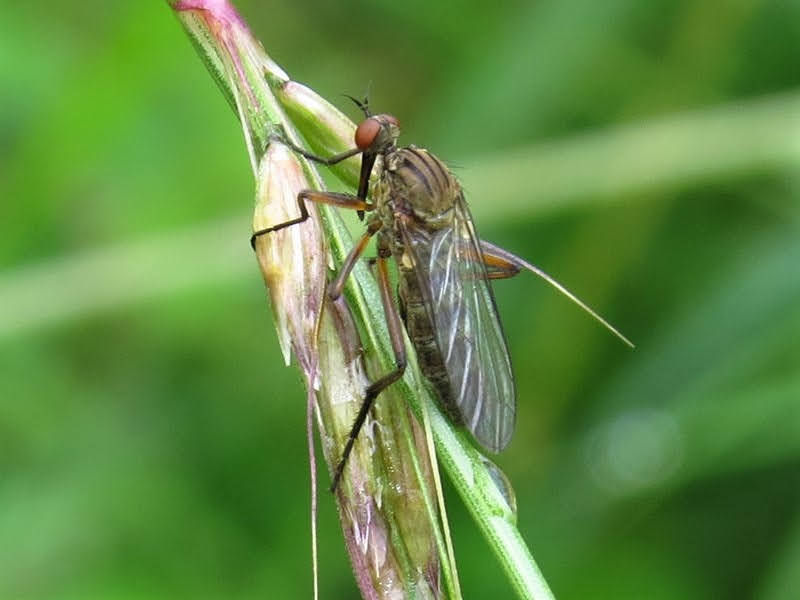
Today's 'exciting' fly. This looks like one of the Scathophagidae or Dung flies. I would not like to be drawn further.

I am presuming this is an Alder Leaf Beetle (Agelastica alni) as I have seen them sitting like this, partially exposing a yellow abdomen. I hesitate slightly because this looked somewhat larger than I recall and it is not on an Alder leaf​.

A Common Froghopper (Philaenus spumarius). These are the insects that cover plants with cuckoo-spit to protect their eggs.

One of the tiny (a tenth of an inch or 3mm) Cicadellidae group of Leafhoppers. Many of the species are very similar and "identification from photographs is virtually impossible" [eakringbirds.com web site].

The PlantNet app. said this was Scentless Mayweed (Matricaria perforata). Certainly there was no smell when I pinched the leaves.

This is rather confusing. The PlantNet app. suggested this is Greater Yellow Rattle but gave the scientific name Rhinanthus angustifolius that my Flora ascribes to Narrow-leaved Rattle. My Flora indicates it cannot be Greater Yellow Rattle because the undersides of the leaves of that species do not show dark lines. Short of getting callipers out to measure the leaves I cannot be certain but my vote is for the 'regular' Yellow Rattle (R. minor). The app. is not a panacea.

(Ed Wilson)

------------------------------------------------------------------------------------------------------

The Flash: 05:45 – 06:50

(148th visit of the year)

As a postscript to yesterday's arrival of three Common Sandpipers here I read that at the nearby Belvide Reservoir there were 15 (though a few birds had been present the previous day).

Bird notes:
- The two growing Mallard ducklings were again seen with their mother. Another brood of two smaller ducklings also noted. And the 'fully-grown' group was five-strong today. Are there perhaps two 'fully-grown' groups?
- The most recent brood of Coots was not counted as they were being sheltered in the nest by a parent.

Birds noted flying over here:
- 1 Jackdaw

Hirundines etc. noted:
None

Warblers noted (figures in brackets relate to singing birds):
- 6 (6) Chiffchaffs again
- 2 (1) Blackcap

Noted on / around the water:
- 211 Canada Geese
- 1 Canada x Greylag Goose
- 79 Greylag Geese again
- 7 + 4 (1 brood) Mute Swans
- *27 (20♂) + 4 (2 broods) Mallard
- 1 all-white duck (Aylesbury Duck)
- 11 (10♂) Tufted Duck
- 7 + 3 (2 broods) Moorhens
- 18 + 8 (4 broods) Coots
- 2 Great Crested Grebes

Noted on / around the street lamp poles or elsewhere
- 1 Garden Grass-veneer moth (Chrysoteuchia culmella)
- 1 caddis fly sp.

I hope you are good at counting! Luckily I had done my count before the person arrived with food. Such a melee would have been impossible to count.

 A record shot of the latest brood of two Mallard ducklings.

 Here are the two fast-growing ducklings and their mother that I have seen most mornings recently.

And all these five seem to be full-grown juveniles which I am now including in the 'adult' figures.

(Ed Wilson)

------------------------------------------------------------------------------------------------------

Between the lake and The Flash:

- One adult seen and juvenile Moorhen(s) heard at the upper pool
- Two adult and three juvenile Moorhens seen at the lower pool.
- No warblers seen or heard.

(Ed Wilson)

------------------------------------------------------------------------------------------------------

In the Priorslee Avenue tunnel:

- The usual few midges of various sizes.
- 1 Opilio canestrinii harvestman

(Ed Wilson)

------------------------------------------------------------------------------------------------------
On this day can be found via the yearly links in the right-hand column.

Sightings from previous years without links are below

2013
Priorslee Lake
Common Sandpiper
(Ed Wilson)

2012
Priorslee Lake
Common Sandpiper
(Ed Wilson)

2010
Priorslee Lake
Kingfisher
(Ed Wilson)

2006
Priorslee Lake
Drake Ruddy Duck
(Ed Wilson)