26 May 18

Priorslee Lake and The Flash

12.5°C > 13.5°C: Very low cloud producing a few spots drizzle in the air. Light N wind picking up from ENE. Poor visibility, becoming moderate as cloud lifted somewhat

Sunrise: 04:58 BST

Priorslee Lake: 05:30 – 06:35 // 07:30 – 08:45

(60th visit of the year)

Telford Sailing Club had their Safety Boat on the water at 08:30 – I thought they were only permitted after 09:30. Apparently testing a newly installed engine they were causing a wash all around the lake and could easily have flooded out the as yet-to-hatch Mute Swan nest as well as the Great Crested Grebe and Coot nests. I had a word with one of their members: whether it will have any effect ....

other notes from today:
- Tufted Ducks heard at 07:50 but nothing seen on the water until a pair apparently flushed from the reeds by the Safety Boat at 08:35
- single quite well-grown juvenile Coot in the NW area
- 3 Cormorants appeared in the cloud overhead: one landed; another did a low pass and moved off N; the third disappeared back in to the cloud
- I think there can be no juvenile Great Crested Grebes as yet: after five days I would have expected to have seen them in the water
- two rather late Common Sandpipers again: same birds as seen on Thursday (but not yesterday)?
- the same(?) two Common Terns present throughout
- a party of 14 large gulls circling high over: they all seemed to be Herring Gulls, mostly immatures. A few other large gulls identified
- 7 Barn Swallows flew N at 06:00. After 08:00 two low over the water
- at least 15 House Martins dipping in and out of the cloud base at 05:45. Later a few over the estate and later still over the lake perhaps additional birds
- I am now almost certain that there are only two Garden Warbler territories: the earlier overlapping territories seem to have been resolved
- similarly there seems to be just one Common Whitethroat territory remaining – the lowest number for many years
- at least 30 Starlings around the ‘football field’ with adults and newly-fledged juveniles on top the protective netting between the abandoned cricket strip and the academy. A few more birds noted flying out of the estate
- a male Pied Wagtail on the dam was my first for a while

and
- still nothing on the lamps
- a Yellow-faced Bell (Notocelia cynosbatella) moth flushed from the vegetation
- plenty of Common stretch-spiders (Tetragnatha extensa), mainly in the nettles
- an interestingly-marked spider, perhaps Larinioides cornutus
- still several Alder flies (likely Sialis lutaria) on the sluice entrance
- big hatch of damselflies with >70 newly emerged tenerals and exuvia seen on the sluice entrance

The following plant added to previous sightings this month
- White Clover (Trifolium repens)
- Bush Vetch (Vicia sepium) (tentative ID)

today’s bird totals

birds noted flying over / near the lake:
- 11 Canada Geese (2 parties)
- 2 Cormorants
- 2 Lesser Black-backed Gulls
- 15 Herring Gulls
- 2 Stock Doves
- 3 Wood Pigeons
- 4 Jackdaws

hirundines seen today
- >30 Common Swifts
- 2 Barn Swallows
- >15 House Martins

warblers noted: figure in brackets is singing birds (not all the males seen might have been singing)
- 6 (6) Chiffchaffs
- 12 (12) Blackcaps
- 2 (2) Garden Warblers again
- 1 (1) (Common) Whitethroat again
- 5 (5) Reed Warblers

the counts from the lake area
- 6 + 5 (1) Mute Swans remain
- 5 (5♂) Mallard
- 2 (1) Tufted Ducks
- 1 Cormorant
- 1 Grey Heron
- 3 Great Crested Grebes
- no Moorhens
- 17 + 1 (1 brood) Coots
- 2 Common Sandpipers again
- 2 Common Terns remain

the Telford Sailing Club testing their Safety Boat.

The wash here threatening the Mute Swan nest just visible in the reeds at the extreme right

the adult Cormorant that landed this morning. Has lost the white thigh-patch of breeding birds but still retains the head-shape from vestigial head plumes. In wing-moult.
as usual a tail-first landing.

Coots are inveterate nest-builders and cannot resist adding new material.

Another shot of one of the Common Terns showing the upper- and under-wing patterns. Note the white shafts on the upper side of the primaries.

Seven juvenile Starlings atop the grid separating the cricket strip on the football field from the windows of the academy.
Two of them closer-up.

A close-up of a rain-spattered Ox-eye daisy (Leucanthemum vulgare).

Not always easy to separate horsetail species but am pretty certain these are the sterile stems of Field Horsetail (Equisetum arvense), also rain-spattered.

On the football field I found my first White Clover (Trifolium repens).

I have previously recorded this as Tufted Vetch (Vicia cracca) but I am now uncertain. The lines on the ‘hooded’ leaf suggest Bush Vetch (Vicia sepium). The photos in Naturespot.org.uk suggest that species would be pinkish rather than bluish: my reference books do not! Perhaps both species are present?

Two days earlier than last year’s record here is a Yellow-faced Bell (Notocelia cynosbatella) moth.

A large emergence of damselflies today: this empty exuvia was my first indication of what I later found.

Some parts of the sluice platform were covered in exuvia and emergent damselflies.

We see one damselfly completely emerged while behind it one is still emerging. The emerged specimen looks like to be a female Azure Damselfly. It can take some hours after emergence before the adult colouration is obtained.

A rather better shot of the same putative female Azure Damselfly.

And a rather better shot of one struggling to emerge.

The stripe on the thorax of this specimen looks rather wide but I am of the opinion it is a Common Blue Damselfly.

Rather blown-up – it was over water so I could not get closer – is this spider. I think it is Larinioides cornutus – there is no vernacular name. It is noted as building its nest in grass alongside / over water which seemed to match.

A damaged shell on what seems to be a White-lipped Snail (Cepaea hortensis)

(Ed Wilson)

------------------------------------------------------------------------------------------------------

The Flash: 06:45 – 07:25

(44th visit of the year)

Two separate single over-flying Rooks were my first at this site this year, taking my year’s site bird total to 62 species

other notes from today
- the long-term Mute Swan Yellow 52F spent most of the time chasing the two first-year birds in the party of 4. Its mate, with a green ring, was around the island. No sign of any new cygnets
- no Mallard ducklings with the only duck seen
- initially 5 Tufted Ducks (3 drakes) on the water: later birds heard and seen in flight and these settled making a total of 9 birds (5 drakes) on the water
- 2 quite well-grown juvenile Coots seen along the E side
- a Great Spotted Woodpecker seen on the island was my first record here since 18 January!
- I noted an insect on the wing over the water and while trying to decide whether it was a moth or perhaps a mayfly sp. a Barn Swallow swooped it up
- House Martins heard, apparently to the W of the area but I could not locate them
- no sight or sound of Thursday’s Reed Warbler

birds noted flying over
- 2 Rooks as highlighted

hirundines etc. seen today
- 2 Swifts
- 1 Barn Swallow
- House Martins heard only

warblers noted: figures in brackets is singing birds (not all the males seen might have been singing)
- 1 (1) Chiffchaff
- 1 (1) Willow Warbler
- 3 (3) Blackcaps

the counts from the water
- 6 Mute Swans (see notes)
- 23 Canada Geese
- 10 (9♂) + 0 Mallard
- 9 (5♂) Tufted Ducks
- 2 Great Crested Grebes
- 3 Moorhens
- 19 + 2 (1 brood) Coots

Not the sharpest picture on a rather dull morning: one of the two juvenile Coots in the brood by one of the footbridges.

This is the Ivy bank between the water and primary academy which is where I look for insects in the autumn morning sun. This view suggests that it has suffered in the snow and frost and looks very burnt / dead in places, though seems to be recovering.

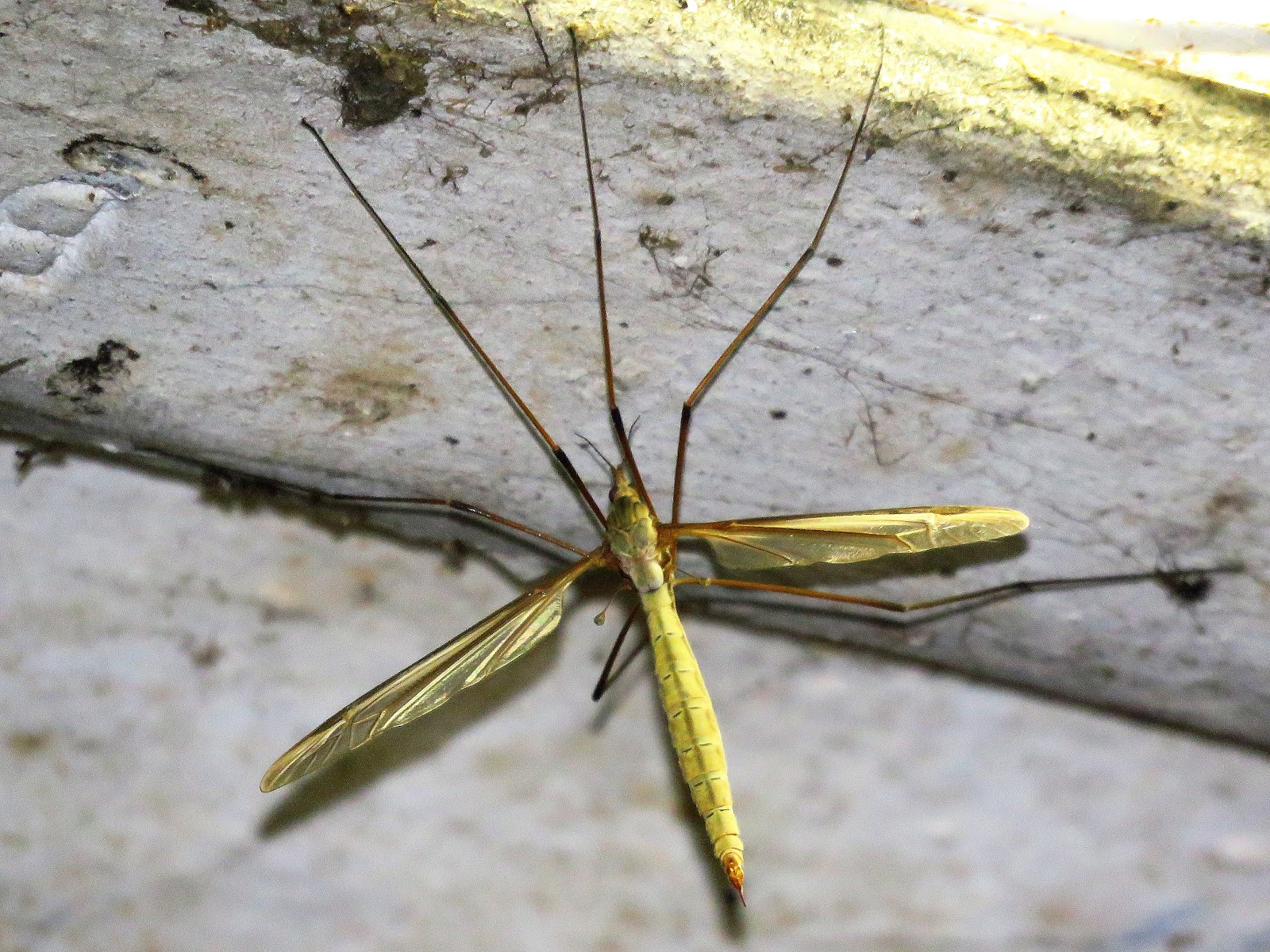
In the foot-tunnel under Priorslee Avenue I found this Common Crane-fly (Tipula oleracea) at rest.


Noted between the lake and The Flash
- a Moorhen on the lower pool
- a Grey Heron standing on a roof of a house alongside the path
- 2 (2) Blackcaps: 1 at the lower pool; 1 above the upper pool around the school ground
- and a Common Crane-fly (Tipula oleracea) in the tunnel under Priorslee Avenue

(Ed Wilson)

------------------------------------------------------------------------------------------------------
On this day..........
2016
Priorslee Lake
Today's Sightings Here

2015
Priorslee Lake
Today's Sightings Here

2014
Priorslee Lake
Today's Sightings Here

2009
Priorslee Lake
Oystercatcher
Common Sandpiper
2 Common Terns
(Ed Wilson)

2007
Priorslee Lake
Common Tern
(Ed Wilson)

25 May 18

Priorslee Lake only

12.0°C > 11.5°C: After early rain had cleared became dry for a while: more rain after 07:40. Light N wind. Poor visibility

Sunrise: 04:59 BST

Priorslee Lake: 06:35 – 08:45

(59th visit of the year)

My start was delayed by early rain and the visit cut short when the rain resumed. I hoped the cloud and rain might have brought some birds to feed over the lake: apart from the two recent Common Terns there was nothing – not even a single hirundine

Other notes from today:
- lots of flying about by the Mallard: possibly more birds involved
- a pair of Tufted Ducks flew E over Teece Drive at 06:35 but did not seem to stop
- still cannot determine whether one of the Great Crested Grebes is carrying juveniles on its back
- low numbers of Coots: some probably brooding on nests. However numbers do seem low this year
- the same(?) two Common Terns again. It appears one bird spends most of its time on one of the buoys whilst the other fishes and brings food to it
- a Green Woodpecker calling from the N-side copse
- Blackbirds, at least, seemed to be enjoying the rain: 13 of the 18 birds logged were noted singing
- the Mistle Thrush singing near the Teece Drive gate again
- female Reed Bunting seen carrying food

and
- nothing on the lamps again this morning
- a Silver-ground Carpet moth flushed from the vegetation
- the wet weather had brought the slugs and snails out in force

Today’s bird totals

Birds noted flying over / near the lake:
- 2 Greylag Geese
- 2 (1) Tufted Ducks
- 1 Common Buzzard
- 1 Jackdaw
- 1 Rook

Hirundines seen today
None

Warblers noted: figure in brackets is singing birds (not all the males seen might have been singing)
- 6 (5) Chiffchaffs
- 14 (14) Blackcaps
- 2 (2) Garden Warblers
- 1 (1) (Common) Whitethroat again
- 3 (3) Reed Warblers

The counts from the lake area
- 6 + 5 (1) Mute Swans again
- 10 (9♂) Mallard again
- 4 + ? Great Crested Grebes again
- 1 Moorhen
- 19 Coots only
- 2 Common Terns remain

Complete with a leaf covering its belly here is a Garden Warbler in full song.

A different view of the same bird: for a warbler the bill is rather thick but otherwise has little features to identify it – apart from its distinctive song. We can just about make out the grey extending from the nape on to a basically brown bird.

Here is a portion of a spider’s web on one of the lamps showing a range of insects trapped. We see plumed midge sps. (Chironomus plumosus) and crane-fly sp.

After the overnight rain the slugs and snails had emerged from cover. The striped ‘skirt’ on this slug identifies it as the red form of Black Slug (Arion Agg.) There are at least three species involved which can only be separated by genitalia examination. All exhibit a range of colour morphs.
Here is a close-up of the end that gardeners dislike.

This is another specimen of the same Black Slug complex.

Another species complex: this is a Golden Shelled Slug (Testacella scutulum agg.) with two grooves along the body that meet in a vestigial shell at the tail.
As well as slugs the rain brought out snails: this is one of the glass snails, likely Cellar Snail (Oxychilus cellarius). Apparently you have to poke glass snails to see whether they smell of garlic to aid identification!
This is what most people think of as a snail – it is a Garden Snail (Cornu aspersum aka Helix aspersa).

(Ed Wilson)

------------------------------------------------------------------------------------------------------
On this day..........
2016
Priorslee Lake
Today's Sightings Here

2015
Priorslee Lake
Today's Sightings Here

2014
Priorslee Lake
Today's Sightings Here

2012
Nedge Hill
2 Ravens mobbing Kestrel.
(John Isherwood)

2010
Priorslee Lake
Ringed Plover
(Ed Wilson)

2009
Priorslee Lake
Red Kite
(Ed Wilson)

24 May 18

Priorslee Lake and The Flash

9.0°C > 11.5°C: Mainly cloudy with a very few spots of rain. Moderate ENE wind. Moderate visibility.

Sunrise: 05:00 BST

Priorslee Lake: 12:30

2 Common Tern and also  > 50 Swift and dozens of hirundines

(John Isherwood)

Priorslee Lake: 05:40 – 06:15 // 07:15 – 08:55

(58th visit of the year)

Notes from today:
- the same ‘resident’ 6 Mute Swans: the long-term pair have 5 cygnets (not 4 as I logged yesterday). The pair in the NE area are still sitting but the cob seemed very agitated today chasing the 3rd pair
- a pair of Tufted Ducks was first noted at 08:00: they left 08:20. The birds seen earlier at The Flash?
- two rather late Common Sandpipers, presumably on passage
- the same(?) two Common Terns first noted 05:55 and present until they disappeared at 08:15
- big party of at least 60 Swifts overhead with at least 5 House Martins amongst them
- 13 Starlings noted on the now less than pristinely kept ‘football field’. This is a most unusual sighting and suggests they are still finding nest holes around the estate
- Mistle Thrush singing near the Teece Drive gate for a while: new location
- 2 Linnets seen leaving the dam-face were unusual at this date

and
- nothing on the lamps again this morning
- a Common Roller (Ancylis badiana) [a Tortrix moth] flushed from the vegetation
- many Common stretch-spiders (Tetragnatha extensa)
- several Alder flies (likely Sialis lutaria) still on the sluice entrance
- also on the sluice entrance were several damselfly exuvia
- several Common Crane-fly (Tipula oleracea)

The following plants in flower are in addition to the list I provided yesterday (in no particular order)
- Ribwort Plantain (Plantago lanceolata)
- Yellow Rocket (Barbarea vulgaris)
- Birds foot-trefoil or Bacon and Eggs (Lotus corniculatus)
- Broom (perhaps Cytisus scoparius)
- Broad-leaved dock (Rumex obtusifolius)
- Crab Apple (Malus sylvestris)
- Common or Stinging Nettle (Urtica dioica)

Today’s bird totals

Birds noted flying over / near the lake:
- 1 Black-headed Gull
- 3 Lesser Black-backed Gulls
- 1 Stock Dove
- 2 Wood Pigeons only

Hirundines seen today
- >60 Common Swifts
- 1 Barn Swallow
- >5 House Martins

Warblers noted: figure in brackets is singing birds (not all the males seen might have been singing)
- 4 (4) Chiffchaffs
- 13 (13) Blackcaps
- 3 (3) Garden Warblers
- 1 (1) (Common) Whitethroat
- 4 (4) Reed Warblers

The counts from the lake area
- 6 + 5 (1) Mute Swans
- 10 (9♂) Mallard
- 4 + ? Great Crested Grebes
- no Moorhens again
- 21 Coots
- 2 Common Sandpipers
- 2 Common Terns again

So the resident Mute Swans have 5 cygnets. Always possible they lost a few after hatching.

The rather unexpected Common Sandpiper – usually passed through by this date.

The Common Terns were still about so managed a few ‘update’ shots. One, tail-spread, about to drop on a fish.

My best fly-by.

Or perhaps this one?

Compare and contrast time and a very lucky shot. On the left a Common Wood Pigeon and on the right a Stock Dove. Juvenile Wood Pigeons lack the white neck-patch but always show white on the bend of the wing. The slightly more compact Stock Dove always shows black patches in the wing.

A Common Starling on the ‘football field’ grass. I have never seen them use it before but perhaps when it was maintained as a sports facility it was too short to provide food.

Eventually there were as many as 13 – here are 11 of them.

A Common stretch-spider (Tetragnatha extensa) gets to work on breakfast. Its prey is too wrapped for me to identify.

Not just in Autumn: here is a Common Crane-fly (Tipula oleracea).

A damselfly exuvia: no idea of the species.

This small micro moth is Common Roller (Ancylis badiana)

This is the very common Ribwort Plantain (Plantago lanceolata).

One of those plants with many vernacular names – Yellow Rocket (Barbarea vulgaris) also called bittercress, herb barbara, rocketcress, yellow rocketcress, winter rocket, and wound rocket.

Another plant with many vernacular names – about 70 local names are known. I’ll stick to Birds foot-trefoil or Bacon and Eggs (Lotus corniculatus).

Likely planted or an escape – Broom (perhaps Cytisus scoparius though there are many cultivars).

After my confusion over what turned out to be Common Sorrel (Rumex acetosa) yesterday here is Broad-leaved dock (Rumex obtusifolius).

Most of the flowers nor over (while I was away). Just a few left from this Crab Apple (Malus sylvestris).

Not sure whether I can count this as a ‘flower’ as they are almost invisible – it is the top of a Common or Stinging Nettle (Urtica dioica).

(Ed Wilson)

------------------------------------------------------------------------------------------------------

The Flash: 06:25 – 07:05

(43rd visit of the year)

A Reed Warbler that sang briefly from the scrub alongside Derwent Drive near the new fishing platform that destroyed the reeds found here was new for my site year-list which now stands at 60. This bird was probably provoked to sing by a passing party of Long-tailed Tits. I record this species here about one year in every two. As far as I know none has stayed to breed

Less unexpected were my first Swifts of the year here: species 61

Notes from today
- the long-term Mute Swan Yellow 52F was standing on the island: I could not see whether there was another bird on a nest somewhere. The 4 other birds were clustered in the NW area
- new brood of Mallard ducklings: at least 6 ducklings
- just 1 pair of Tufted Ducks: they seemed to disappear – see notes for the lake above
- only 1 Great Crested Grebe seen: with one of the large willows having collapsed under the snow and now in full leaf there is plenty of scope for a hidden nest
- no juvenile Coots seen again
- numbers of Swifts and House Martins hard to determine with birds wheeling overhead
also
- I do not note all the plant species here as there are many exotic garden escapes: just to note that the Yellow Flag irises are much more advanced than at the lake

Birds noted flying over
- 4 Lesser Black-backed Gulls
- 1 Herring Gull
- 1 Stock Dove

Hirundines etc. seen today
- >25 Swifts
- > 5 House Martins

Warblers noted: figures in brackets is singing birds (not all the males seen might have been singing)
- no Chiffchaffs
- 1 (1) Willow Warbler
- 3 (3) Blackcaps
- 1 (1) Reed Warbler

The counts from the water
- 5 Mute Swans (see notes)
- 13 Canada Geese
- 10 (9♂) + 6 (1 brood) Mallard
- 2 (1♂) Tufted Ducks
- 1 Great Crested Grebe
- 4 Moorhens
- 20 Coots

The ‘resident’ cob 52F stands on the island. I could not see a mate on a nest anywhere – he lost his original mate in March when she had to be put down after breaking a wing. He seemed unconcerned by ...

These four. Birds 1 and 3 have brighter more adult bills and birds 2 and 4 showed a hint of brown in the wing.

Rather distant: the brood of 6 Mallard ducklings with Mum.

Here the Yellow Flags (Iris pseudacorus) are more open. A bee sp. climbs along the markers to the nectar.

A Long-tailed Tit posed briefly.

Noted between the lake and The Flash
- a Moorhen heard calling from the upper pool
- 1 (1) Blackcap at the upper pool

(Ed Wilson)

------------------------------------------------------------------------------------------------------
On this day..........
2016
Priorslee Lake
Today's Sightings Here

2015
Priorslee Lake
Today's Sightings Here

2014
Priorslee Lake
Today's Sightings Here

2007
Priorslee Lake
Cuckoo
(Ed Wilson)