24 Oct 21

Priorslee Lake and The Flash

10.0°C: Mostly cloudy with some breaks and also some light rain at times. Excellent sunrise. Fresh S breeze. Excellent visibility.

Sunrise: 07:51 BST

*= a photo today

Priorslee Lake: 06:40 – 09:25

(239th visit of the year)

No Wood Pigeon migration seen today and very little local movement by them either. Significant gull movement and a few winter thrushes over.

Other bird notes:
- The Mute Swan family was present and correct at 07:00. At 07:55 they all went for a fly around heading away over the Priorslee estate. The pen soon returned, perhaps thought better of it and set off again, only to come back again possibly having lost contact with the others. Neither the cob nor any cygnets had returned by the time I left.
- Most of the early large gulls stopped off. Later there was a significant passage of large gulls heading S, mainly to the E of the lake. When it became light-enough for me to identify them they were all Lesser Black-backed Gulls with almost all of these being full adults.
- No Cetti's Warbler seen or heard: there was a Chiffchaff calling at the W end.
- While I was standing on the dam four Bullfinches flew out of one of the few remaining bushes along the E side of Castle Farm Way and climbed away to the SW, apparently crossing the M54. I do see this species in flight from time to time, not usually making such long forays.
- The only bird seen leaving a roost around the water was a lone Reed Bunting.

Overhead:
- 46 Wood Pigeons
- 83 Lesser Black-backed Gulls
- 171 unidentified large gulls
- 2 Cormorants: singles
- 1 Common Buzzard
- 263 Jackdaws
- 7 Rooks
- 1 Skylark
- 7 Starlings: single and two small groups
- 2 Fieldfares: singles
- 71 Redwings: two singles heard pre-dawn and seven small groups later
- 16 Pied Wagtails
- 4 Bullfinches: see notes
- 1 Greenfinch
- 15 Goldfinches: two groups
- 1 Siskin

Warblers noted:
- 1 Chiffchaff: no song

Count from the lake area:
- *2 + 3 (1 brood) Mute Swans initially: see notes
- 12 (8♂) Mallard
- 26 (>12♂) Tufted Duck
- 6 Moorhens
- 53 Coots
- 2 Little Grebes
- 1 Great Crested Grebe
- >175 Black-headed Gulls
- *8 Herring Gulls
- *1 possible Caspian Gull
- 62 Lesser Black-backed Gulls
- 61 large gulls
- 1 Grey Heron: departed

At / around the street lamps pre-dawn:

Moths:
- 1 November Moth agg. (Epirrita sp.).
with:
- *1 unidentified presumed female fly sp.
- 1 Clubiona sp. of spider
- 1 Larinioides sp. Orb-web spider)
- 1 Metellina sp. of spider
- 1 Tetragnatha sp. of Stretch spider
- 1 Dicranopalpus ramosus-type harvestman

Nothing noted later:

The early sunrise was rather an eerie colour – well it is coming up to Halloween.

A more spectacular tone later with the cob Mute Swan on 'photographic detail' as foreground.

The full extent of a rather spectacular sunrise.

Turn though 180 degrees and this proves it was raining.

And turn another 90 degrees and one for cloud fans.

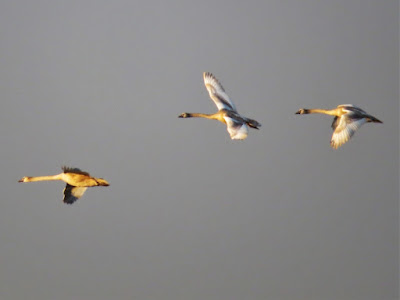
Two of 'our' Mute Swan cygnets circling to gain height as they follow the cob away to the north. Will this be my last photo of them?

The pen proving that she is not all that 'mute' a Mute Swan.

An interesting gull – if you like that sort of thing! A very clean head suggests an adult winter Yellow-legged Gull. But it isn't – firstly it is not an adult from the dark tip to the bill, the brown-marked secondaries just visible, and the tone of the back not being dark-enough. I think it is a second or third winter Caspian Gull – the rather parallel-sided bill and 'piggy-looking' eyes are pointers. The buoy is certainly well-used.

And was used again a few minutes later as I prepared to take more photos of the gull only for it to be replaced by a third winter Herring Gull.

I am at a loss to identify this. I thought it might be a wingless female Mottled Umber moth but the body is too elongated and the legs too long. In shape it is more akin to a dragonfly nymph but the head is too small. The shape is also good for a mayfly nymph but these would have 'tails'. I note that it has 'halteres' rather than hindwings so it must belong to the 'true flies'. I can say it is not a cranefly larva as they look like maggots. I cannot say anything else.

(Ed Wilson)

------------------------------------------------------------------------------------------------------

The Flash: 09:35 – 10:25

(216th visit of the year)

Bird notes:
- A pair of Teal seen by the island again.
- No Goosanders: too many fishermen? (some of whom were wading waist-deep in to the water)

Birds noted flying over here:
- 2 Jackdaws

Warblers noted.
None

On /around the water:
- 31 Canada Geese
- 3 + 2 (1 brood) Mute Swan
- 29 (19♂) Mallard
- 2 (1♂) Teal
- 43 (12+♂) Tufted Duck
- no Goosander
- 8 Moorhens
- 24 Coots again
- 2 + 3 (1 brood) Great Crested Grebes
- 42 Black-headed Gulls
- 1 Grey Herons

On a lamp pole:
- 1 Birch Shieldbug (Elasmostethus interstinctus)

Noted elsewhere:
- many Common Wasps (Paravespula vulgaris) on the Ivy flowers.
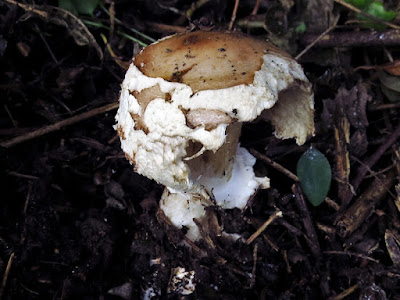
- unidentified fungus, just perhaps a Lepiota sp.

Well it was a long way up one of the taller lamp poles. This seems to be a Birch Shieldbug (Elasmostethus interstinctus) acquiring its darker winter colours.

Why do almost none of the fungus I find look like any of the illustrations in my books or any of the photos on the web sites I use? This one (of a trio lurking under a hedge) had been damaged.

This view shows a lot of the features that ought to help with identification.... ought. There are no obvious gills on the underside and it appears to have a moveable collar on its stem. Perhaps a Lepiota sp.?

(Ed Wilson)

------------------------------------------------------------------------------------------------------
On this day can be found via the yearly links in the right-hand column.

Sightings from previous years without links are below

2010
Priorslee Lake
733 Wood Pigeons
11 Skylarks
151 Fieldfare
20 Redwings
2 Brambling
2 Linnets
2 Redpolls
(Ed Wilson)

2009
Priorslee Lake
5 Wigeon
1 Little Grebe
(John Isherwood)

The Flash
1 Shoveler
1 Teal (female)
1 Common Gull
(John Isherwood)

23 Oct 21

Priorslee Lake and The Flash

8.0°C > 11.0°C: Cloudy with occasional breaks. Very light S wind, increasing moderate, even fresh later. Excellent visibility.

Sunrise: 07:49 BST

*= a photo today

Priorslee Lake: 06:10 – 09:25

(238th visit of the year)

A sighting that got away. At 09:10 a very large group (>150) of birds was seen a long, long way to the E. Some of these were forming in to 'V-shaped' lines suggesting Golden Plovers. Sadly rather too many were not. It could have been just a very distant group of Wood Pigeons. Otherwise there were fewer passage Wood Pigeons with only 355 noted. These were mainly in small groups until 08:50 when three large groups (>50 in each) flew over.

Other bird notes:
- At first light there were just two Mute Swan cygnets asleep with the adults. I later noted these as the cygnet with ring 7JVJ and the unringed bird. At 08:25 another cygnet flew in and after the adults set off with wings held in a threat pose they soon relaxed and I assume it was the missing cygnet returning from its adventure. I was unable to read its ring (which should have been 7JVI).
- Just a single drake Gadwall.
- All the early unidentified large gulls flew on after a few had circled and decided not to stop.
- A Cetti's Warbler was persistently calling from the base of the small copse at the S end of the dam at c.08:00. Later a single burst of song came from the S side reeds. I assume both these records come from the same bird that I noted on the previous two days.
- A Song Thrush was making a passable attempt at a song.

Overhead:
- 390+ Wood Pigeons: at least 355 of these in 12 groups heading S
- 47 Lesser Black-backed Gulls
- 29 unidentified large gulls
- 232 Jackdaws
- 3 Rooks only
- 5 Skylarks: together
- 20 Starlings: single and one group again
- 4 Redwings: two of these heard only pre-dawn
- 14 Pied Wagtails
- 7 Meadow Pipits
- 1 Chaffinch
- 1 Linnet
- 2 Siskins

Warblers noted:
- 1 Cetti's Warbler: see notes

Count from the lake area:
- 2 + 3 (1 brood) Mute Swans: see notes
- 1 (1♂) Gadwall
- 11 (7♂) Mallard
- *54 (>20♂) Tufted Duck
- 8 Moorhens
- 49 Coots
- 1 Little Grebe
- 1 Great Crested Grebe
- >150 Black-headed Gulls
- *3 Herring Gulls
- *1 Yellow-legged Gull
- 36 Lesser Black-backed Gulls
- 1 Grey Heron: arrived and departed

At / around the street lamps pre-dawn:

Moths:
- 3 November Moth agg. (Epirrita sp.).
- *1 Mottled Umber (Erranis defoliaria)
with:
- *1 Owl Midge Psychodidae sp.
- 1 Common European Earwig (Forficula dentata)
- 1 Clubiona species of spider
- 1 Dicranopalpus ramosus-type harvestman
- *1 male Leiobunum blackwalli harvestman
- 5 Paroligolophus agrestis harvestmen

Nothing noted later:

Thanks as ever to Nigel I can provide some updates to recent spider sightings:

- Back on 7th October I photographed a small spider trying to disappear down a mounting bolt hole on one of the street lights. The angle of the photo was not the best. Nigel suspects a Zygiella sp. of orb web spider but cannot be more specific.

- From yesterday he confirmed my provisional IDs as one Clubiona sp. and two Metellina sp., with no specific identification possible from photos. The other was almost certainly a larger, well-patterned member of the money spider group, most likely Neriene clathrata. This species is very common at this date. It makes a sheet web

Obviously a Tufted Duck but what age / sex? Some white feathers appearing in the flanks suggest this is a drake. The bill has no black on the tip so it is likely a first-winter.

A perky-looking drake Tufted Duck. This individual has much whiter flanks and an obvious black tip to its bill. For some reason it has almost no crest. My suggestion would be that this is also a first-winter bird, just one that is in some respects more advanced in becoming an adult drake.

I took a photo of what I thought were two first-winter Herring Gulls to show the variability. When I looked at the photo I realised that the variability is because they are different species. The bird on the left with the much whiter head and somewhat darker back is a first-winter Yellow-legged Gull. The bill is not long-enough to think about Caspian Gull.

A Mottled Umber moth (Erranis defoliaria). This is a male – the flightless females only have vestigial wings. The males are very variable in tone and markings, the ground-colour ranging from off-white to orange-brown. Most forms have a filled area between two wavy outer cross-lines. These forms usually show a black dot just ahead of that area. There are forms that lack any markings.

A reasonably good photo of yet another Owl Midge Psychodidae sp. A very poor photo of the spider, though I think the midge has nothing to worry about as the 'spider' looks like an exoskeleton of a spider that has burst out of its skin some while back.

This is a male Leiobunum blackwalli harvestman. While females of this genus are separable by the shape of the dark saddle on the abdomen this is not true of the unmarked males. These are separable by looking at the oculum surround (the eyes raised on the back). On male L. blackwalli harvestmen, as here, there is a pale surround – a 'white-wall tyre' effect.

(Ed Wilson)

------------------------------------------------------------------------------------------------------

The Flash: 09:30 – 10:35

(215th visit of the year)

Bird notes:
- A possible Chiffchaff seen flitting about, including perching momentarily on a guard rail alongside Derwent Drive before disappearing in to the island. Views too brief to be certain and no calls heard.

Birds noted flying over here:
- 1 Wood Pigeon
- 3 Lesser Black-backed Gulls
- 2 Siskins

Warblers noted
None. See notes

On /around the water:
- *27 Canada Geese
- 2 Greylag Geese
- 3 + 2 (1 brood) Mute Swan
- *23 (14♂) Mallard
- no Teal located
- 27 (7+♂) Tufted Duck
- *32 (1♂) Goosander
- 6 Moorhens again
- 24 Coots
- 2 + 3 (1 brood) Great Crested Grebes
- 61 Black-headed Gulls
- 2 Grey Herons

On a lamp pole:
- *1 Common Froghopper (Philaenus spumarius)
- 1 beetle sp. The photo I took of this from a great distance does not help identify it.
- 1 Dicranopalpus ramosus-type harvestman

Noted elsewhere:
- many Common Wasps (Paravespula vulgaris) on the Ivy flowers.
- Marmalade Hoverfly (Episyrphus balteatus)

One word for it: startling! A drake Mallard in breeding finery catches the light.

If this is the same Goosander as yesterday moulting in to drake plumage then it is progressing very quickly. I suspect it is a different individual.

While several brownheads share a joke.

A size comparison between a Canada Goose and a Goosander. Apart from Common Shelduck (which is not really a duck anyway) only Eider ducks are larger than Goosanders. Eiders are most unlikely to be seen inland.

A somewhat unexpected find on one of the lamp poles was this Common Froghopper (Philaenus spumarius).

(Ed Wilson)

------------------------------------------------------------------------------------------------------
On this day can be found via the yearly links in the right-hand column.

Sightings from previous years without links are below

2010
Priorslee Lake
Water Rail
9 Meadow Pipits
143 Fieldfare
8 Redwings
(Ed Wilson)

2009
Priorslee Lake
1 Yellow-legged Gull
2 Common Gull
6 Wigeon
(John Isherwood)

2006
Priorslee Lake
Female Blackcap
(John Isherwood)

22 Oct 21

Priorslee Lake and The Flash

9.0°C > 11.0°C: Broken cloud with a few light passing showers. Improving. Moderate./ fresh W wind. Excellent visibility.

Sunrise: 07:47 BST

*= a photo today

Priorslee Lake: 06:15 – 09:25

(237th visit of the year)

The Cetti's Warbler gave a single explosive song from near the Wesley Brook bridge. I neither saw it nor heard it after that.

Another large passage of Wood Pigeons with at least 2360 noted, all heading S.

Other bird notes:
- Two sub-adult Mute Swans flew in from the E c.08:30. It took a while for the residents to notice – they were asleep on the slipway. When they awoke the adults gave chase, the cygnets staying some way behind. The visitors soon decided to leave at which point the cygnets took flight and joined them as they flew back E. The cygnets did not return, leaving the resident adults childless!
- One pair of Gadwall back/new in.
- 11 Mallard present early, most flying off before it was light-enough to sex them.
- No immature Great Crested Grebe seen.
- A party of nine Lapwings arrived and flew around for a while before disappearing. About 10 minutes later 13 did the same thing. Were these all new birds or were they the originals with reinforcements? They did not land.
- Very few Black-headed Gulls made it to the lake. I did not visit the football/playing field area at gull arrival time so they may have been there in usual numbers. If so where did they go?
- More early large gulls than yesterday and today they all settled on the water for a while.

Overhead:
- 1 Canada Goose: single inbound
- 2 (2♂) Mallard
- 8 Stock Doves: at least four in with Wood Pigeon flocks: a separate group of four
- 13? Lapwings: see notes
- 2400+ Wood Pigeons: at least 2360 of these in 32 groups heading S
- 42 Lesser Black-backed Gulls
- 1 Sparrowhawk
- 1 Common Buzzard
- 180 Jackdaws
- 5 Rooks
- 7 Starlings: single and one group
- 3 Redwings: one of these heard only pre-dawn
- 15 Pied Wagtails again
- 2 Meadow Pipits
- 13 Siskins

Warblers noted:
- 1 Cetti's Warbler: as highlighted again
- 1 Chiffchaff: calls only

Birds noted leaving roosts around the lake: (I was not well-positioned to see these this morning)
- 9 Redwings
- 1 Reed Bunting

Count from the lake area:
- *4 + 3 (1 brood) Mute Swans: see notes
- 2 (1) Gadwall
- 11 (>3♂) Mallard
- 40 (>18♂) Tufted Duck
- 2 Moorhens
- 52 Coots again
- 2 Great Crested Grebes
- 35 Black-headed Gulls
- 3 Herring Gulls again
- 9 Lesser Black-backed Gulls
- 51 unidentified large gulls
- 1 Cormorant: arrived
- 1 Grey Heron

At / around the street lamps pre-dawn:

Moths:
- 2 November Moth agg. (Epirrita sp.).
with:
- *1 fly sp., possibly Phaonia rufiventris
- several 'winter gnats'
- *1 springtail
- 1 Common European Earwig (Forficula dentata)
- *1 possible Clubiona species of spider
- 1 Bridge Orb-web Spiders (Larinioides sclopetarius)
- *2 different(?) Metellina species of spiders
- *1 Nursery Web Spider (Pisaura mirabilis)
- *1 presumed Noble False Widow spider (Steatoda nobilis)
- 2 Paroligolophus agrestis harvestman

Nothing noted later:

Almost your last chance to see the cygnets. The two adult Mute Swans, the cob nearest, and two of the cygnets provide foreground interest for the morning's sunrise.

A passing shower produces a small rainbow.

The resident cob gives chase to one of the two sub-adults that flew in together. Sub-adults can be recognised as a sub-adult by the pale bill. Otherwise the plumage is as white as full adults.

One of 'our' cygnets flies with one of the strangers.

And here they go off together. Bye, bye cygnets?

This fly seems a good candidate to be a Phaonia rufiventris, a species of Muscid fly, most of which are rather hairy.

What I think is a Clubiona species of spider. Specific identification of this group is not possible from photos. Note the eye-shine in four of the eyes from the camera flash.

I suspect this spider is one of the Metellina group but the herring-bone marking on the abdomen looks different. I'll check.

This spider might well be in the same group. Unseen until I looked at the photo was the tiny springtail walking towards the right of the photo.

A spider I can identify on my own! It is a Nursery Web Spider (Pisaura mirabilis), characterised by the unusual head shape; the prominent pale stripe down both the thorax and abdomen; and the way the front two pairs of legs are held close to each other; often they will be held together.

I think this is a male Noble False Widow spider (Steatoda nobilis). I usually see individuals with a jet black abdomen but with similar white crescents at the side.

(Ed Wilson)

------------------------------------------------------------------------------------------------------

The Flash: 09:30 – 10:30

(214th visit of the year)

Bird notes:
- A pair of Teal found lurking below overhanging vegetation on the island. Did they ever leave?
- The fly-over Goosander seemed to be nothing to do with the group of 26 on the water. Several of these seemed to be acquiring drake plumage features.
- As always the Great Crested Grebes confuse by moving around all the time. I could only confirm two adults and one juvenile.
- A party of 18 Goldfinches flew high N and seemed to be entirely different from the c.20 in and around the trees on the island.
- At least three Siskins in trees on the island.

Birds noted flying over here:
- 1 (0♂) Goosander
- 6 Wood Pigeons
- 1 Herring Gull
- 30 Jackdaws
- 1 Rook
- 1 Pied Wagtail
- 18 Goldfinches

Warblers noted:
None

On /around the water:
- 17 Canada Geese
- 3 + 2 (1 brood) Mute Swan
- 29 (18♂) Mallard
- 2 (1♂) Teal
- 34 (14+♂) Tufted Duck
- *26 (0♂) Goosander
- 10 Moorhens again
- 24 Coots again
- 2 + 1 (1 brood) Great Crested Grebes
- 37 Black-headed Gulls
- 1 Lesser Black-backed Gull
- 2 Grey Herons

On a lamp pole:
- 1 November Moth agg. (Epirrita sp.).

Noted elsewhere:
- *many Common Wasps (Paravespula vulgaris) on the Ivy flowers.
- *more Shaggy Inkcap or Lawyer's Wig fungus (Coprinus comatus)

This erstwhile brownhead Goosander is starting to moult in to drake plumage. The brown and rather shaggy head has some darker area that will become bottle-green. More white is appearing in the wings. The flanks are as yet unchanged.

The ambient temperature was higher than yesterday but there was no sun on the ivy today. None of the flies or hoverflies appeared, leaving the way for the Common Wasps (Paravespula vulgaris) to raid the nectar. You can see here how hairy wasps are: you probably don't look that closely!

This view highlights the importance of wasps as pollinators – look at the ivy pollen stuck to those long hairs.

Every day at the moment there are new Shaggy Inkcap or Lawyer's Wig fungus (Coprinus comatus) appearing.

(Ed Wilson)

------------------------------------------------------------------------------------------------------
On this day can be found via the yearly links in the right-hand column.

Sightings from previous years without links are below

2013
Priorslee Lake
1 adult Yellow-legged Gull
1 adult Great Black-backed Gull
4 Gadwall
1 Teal
(John Isherwood)

Nedge Hill
A Raven tussling with Sparrowhawk
(John Isherwood)

2010
Priorslee Lake
389 Fieldfare
6 Redwings
(Ed Wilson)

2009
Priorslee Lake
15 Pochard
34 Tufted Duck
13 Moorhens
232 Coots
1 Redwing heard
(Ed Wilson)

2005
Priorslee Lake
A male Stonechat the west end
2 Gadwall
A drake Shoveler
14 Pochard
44 Tufted Duck
Siskin
Redpoll
C.350 Starlings in the roost
20 Redwings
209 Coot
Kingfisher
(Ed Wilson)

21 Oct 21

Priorslee Lake and The Flash

5.0°C > 8.0°C: Clearing after overnight light rain with good sunny spells. Initially fresh NW wind moderated quickly. Excellent visibility.

Sunrise: 07:46 BST

*= a photo today

Priorslee Lake: 06:10 – 09:30

(236th visit of the year)

Highlight this morning was a calling Cetti's Warbler along the N side. Giving acceptable views as it worked along the lakeside vegetation at 07:50. Too dark to attempt a photo at that time. When I revisited the area after 09:00 I could not relocate it. My previous record here was of a bird singing and calling in early October last year. My only other record here was of presumably one bird that stayed from late October 2015 until May 2016. It become bird species #110 for me here this year – a total that exceeds that of any previous year for me

Also notable was a passage of at least 1650 Wood Pigeons. There were probably many more. They almost all passed between 08:15 and 09:15 and were often in concurrent large groups flying at different heights and in slightly different directions.

Bird notes:
- Two Canada Geese flew off at 07:00.
- The adult Mute Swans too the cygnets for a long flight, high over the Priorslee Estate and then across the M54 and over Stafford Park before they all returned. Probably getting ready to leave.
- No Gadwall seen.
- 20 brownhead Goosanders flew W at 08:10.
- One of the Great Crested Grebes was an immature.
- The early large gulls were in very short supply, with almost as many flying over from the E as arriving from the usual N / NW direction. Just six settled on the lake at this time.
- A Grey Heron flew off W at 07:30. It, or another, flew off E at 08:45.
- Three parties of Siskins overhead, one of 17 birds.

Overhead:
- 3 Greylag Geese: single and duo outbound
- 2 (1♂) Mallard
- 20 Goosanders: all brownheads, together
- 1 Stock Dove
- 1700+ Wood Pigeons: at least 1650 of these in 33 groups heading S
- 1 Herring Gull
- 29 Lesser Black-backed Gulls
- 19 unidentified large gulls: see notes
- 2 Common Buzzards
- 195 Jackdaws
- 15 Rooks
- 6 Skylarks
- 8 Starlings: two groups
- 15 Pied Wagtails
- 1 Meadow Pipit
- 1 Linnet
- 22 Siskins

Warbler noted:
- 1 Cetti's Warbler: as highlighted
- 1 Chiffchaff: still calling intermittently

Birds noted leaving roosts around the lake:
- 7 Starlings
- 4 Redwings
- 9 Reed Buntings

Count from the lake area:
- 2 Canada Geese again: departed
- 2 + 3 (1 brood) Mute Swans
- no Gadwall
- 7 (5♂) Mallard
- 31 (>14♂) Tufted Duck
- 6 Moorhens
- 52 Coots only
- 1 Little Grebe
- 3 Great Crested Grebes
- c.125 Black-headed Gulls
- 3 Herring Gulls
- 12 Lesser Black-backed Gulls
- 6 unidentified large gulls only: see notes
- 1 or 2 Grey Herons: flew off

At / around the street lamps pre-dawn:

Moths:
- 1 November Moth agg. (Epirrita sp.).
with:
- 1 Pond Olive mayfly (Cloeon dipterum)
- 1 Larinioides cornutus Orb-web spider
- 1 Bridge Orb-web Spiders (Larinioides sclopetarius)
- 1 Paroligolophus agrestis harvestman
- 1 Anyphaena accentuta

Noted later:
- Grey Squirrel

The three cygnets in flight, now with much white in the wings. If the previous years are anything to go by the parents will soon take them away from home and show them elsewhere. In 2019 the cygnets stayed away. In 2020 they all retuned and the cygnets were finally chased away in February this year.

Not a very good photo: top right an immature Great Crested Grebe and in the foreground two duck Tufted Ducks. I have seen no juvenile Great Crested Grebes here since 26th September.

This is a male mayfly, presumably a Pond Olive (Cloeon dipterum). As a male it has 'turbinate' eyes, thought to be an aid to spotting females in a swarm. No swarms here. This was on a different lamp pole to the female seen a few days ago.

Aargh! This is the exoskeleton of an Araneid spider: species indeterminate. Having out-grown its 'skin' it has climbed out and the real spider will be hiding somewhere while its new skin hardens.

Info from the ever-helpful Nigel about yet another different-looking spider: this is a female buzzing spider (Anyphaena accentuta). It is called the buzzing spider because the male rapidly taps his abdomen up and down on a leaf producing a slow buzzing sound to attract a female.

A common-enough harvestman but this individual was sitting such that the identification features were clearly visible. On this species the second pair of legs is noticeably long – all harvestmen have the second leg the longest but this is especially so with this species. All the legs are noticeably thicker on the basal part. And there is a pale stripe down the middle of the abdomen.

(Ed Wilson)

------------------------------------------------------------------------------------------------------

The Flash: 09:35 – 10:35

(213th visit of the year)

Bird notes:
- Little Grebe not located.
- Again only two of the juvenile Great Crested Grebes noted.

Birds noted flying over here:
- 11 Wood Pigeons
- 1 Lesser Black-backed Gull
- 1 Sparrowhawk
- 1 Common Buzzard
- 3 Skylarks
- 1 Jackdaw

Warblers note:
- 1 Chiffchaff: still calling persistently, today from the island

On /around the water:
- 29 Canada Geese
- 6 Greylag Geese
- 3 + 2 (1 brood) Mute Swan
- 28 (18♂) Mallard
- 43 (11+♂) Tufted Duck
- 26 (0♂) Goosander
- 10 Moorhens
- 24 Coots
- 3 + 2 (1 brood) Great Crested Grebes again
- 58 Black-headed Gulls
- 2 Grey Herons

On the lamp poles:
Nothing found on any of them

Noted elsewhere:
- Red Admiral (Vanessa atalanta)
- Common Wasp (Paravespula vulgaris) on the Ivy flowers.
- Marmalade Hoverfly (Episyrphus balteatus)
- Common Drone Fly (Eristalis tenax)

A short video of the flock of Goosanders bobbing up and down on the waves – you may need to take Kwells before viewing this clip (other sea-sick remedies...). It is Black-headed Gulls that were photo-bombing the clip.

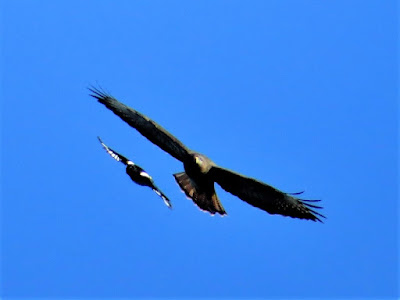
Formation flying! A Magpie appears to be pursuing a Common Buzzard

Or is it? The buzzard seems to be chasing the Magpie!

Despite the ambient temperature being below 10°C – generally recognised as the threshold needed for insects to fly – there was much activity on the Ivy which was in the sun and somewhat sheltered from the brisk wind. This Red Admiral (Vanessa atalanta) was the only butterfly among all the wasps and hoverflies.

Another view. For some reason my camera seems to want to convert this species in to Orange Admirals.

This is a Marmalade Hoverfly (Episyrphus balteatus). Strangely it is my first here this year. The last one I saw at the lake was on 15th September. Where have they been between times?

The subject of this rather sharper photo is a Common Drone Fly (Eristalis tenax). It is just possible to make out its tongue stuck in to an Ivy flower.

(Ed Wilson)

------------------------------------------------------------------------------------------------------
On this day can be found via the yearly links in the right-hand column.

Sightings from previous years without links are below

2010
Priorslee Lake
Little Grebe
5 Lapwings
1487 Fieldfare logged, mostly flying W. 7 of the flocks estimated at between 110 and 130 birds
25 Redwings
Raven
56 Goldfinch
(Ed Wilson)

2009
Priorslee Lake
62 Swans
5 Wigeon
14 Pochard
22 Tufted Ducks
231 Coots
Great Black-backed Gull
3 Buzzards
1 Kestrel
27 Redwings
Chiffchaff
c.250 Starlings
8 Siskins
c.15 Goldfinches
(Ed Wilson)

2006
Priorslee Lake
1 Cormorant
25 Pochard
72 Tufted Ducks
1 Kestrel
1 Kingfisher
20 Robins
17 Blackbirds
15 Song Thrushes
59 Redwing
3 Mistle Thrushes
1 Chiffchaff
1 Blackcap
5 Goldcrests
(Martin Adlam)