27 Jun 22

No Sightings in today.

------------------------------------------------------------------------------------------------------
On this day can be found via the yearly links in the right-hand column.

Sightings from previous years without links are below

2012
Priorslee Lake
Common Sandpiper
(Ed Wilson)

2009
Priorslee Lake
2 Redshank
(Ed Wilson)

2006
Priorslee Lake
2 Ruddy Duck
(Ed Wilson)

26 Jun 22

Priorslee Lake and The Flash

9.0°C > 14.0°C: Variable amounts of cloud. Fresh feeling and fresh SSE wind. Very good visibility.

Sunrise: 04:47

* = a photo today

Priorslee Lake: 04:40 – 05:40 // 06:40 – 08:15

(148th visit of the year)

Best today were three Gadwall that flushed off the SW grass at 05:00 – I had assumed they were the local Mallard that take little notice of me. An early date for this species to be returning here post-breeding. One was certainly a drake. I am not sure about the others, seen too briefly

Other bird notes:
- I did not hear the Cetti's Warbler again.
- After several weeks of relative quiet a Sedge Warbler was being noisy and doing its dancing display flight. Perhaps the prelude to another brood.
- In contrast the Reed Warblers were conspicuously quiet perhaps due to the wind blowing the reeds around.
- Common Whitethroats seen courtship feeding.

Birds noted flying over here:
- 1 Stock Dove
- 14 Wood Pigeons
- 2 Collared Doves: together
- 1 Herring Gull
- 3 Lesser Black-backed Gulls
- 2 Cormorants: singles
- 1 Common Buzzard
- 6 Jackdaws
- 14 Rooks

Hirundines etc. noted:
- 5 Swifts again
- 1 Barn Swallow
- 1 House Martin

Warblers noted (figures in brackets relate to singing birds):
- no Cetti's Warbler again
- 12 (10) Chiffchaffs
- 1 (1) Sedge Warbler
- 6 (5) Reed Warblers only: a bit breezy in the reeds
- 12 (10) Blackcaps
- 1 (1) Garden Warbler
- 2 (0) Common Whitethroats

Counts from the lake area:
- 2 + 4 (1 brood) Mute Swans
- 3 (1♂?) Gadwall: departed
- 7 (6♂) Mallard
- 2 Moorhens still
- 39 + 24 juvenile Coots
- 7 Great Crested Grebes
- no gulls
- no Grey Heron

Noted on / around the street lamp poles pre-dawn:
- 1 Uncertain / Rustic moth (Hoplodrina octogenaria/blanda)
- 1 Tetragnatha sp. stretch spider
- 1 Leiobunum rotundum harvestman: female

Noted later
Very little in cool and breezy conditions. I did not stay so long as usual.

New for this year:
Nothing

Repeat sightings:

Butterflies:
- Ringlet (Aphantopus hyperantus)

Moths:
- Common Marble (Celypha lacunana)
- Garden Grass-veneer (Chrysoteuchia culmella)

Bees, wasps etc.:
- Common Carder Bee (Bombus pascuorum)

Hoverflies:
- Tapered Dronefly (Eristalis pertinax)
- Common Spotted Field Syrph (Eupeodes luniger)

Other flies:
- Lucilia sp. greenbottle
- Black Snipefly (Chrysopilus cristatus)
- Grouse Wing caddis fly (Mystacides longicornis)
- Semaphore fly Poecilobothrus nobilitatus

Beetles:
- pollen beetles as usual.
- 7 Spot Ladybird (Coccinella 7-punctata): pupa only

I arrived slightly too late to see any colour in the sunrise. This was about as clear as the skies ever were.

Slightly fuzzy around the head as I was shooting this Common Whitethroat through waving grass stems. I suspected that had I moved it would have flown away.

I did reposition and its didn't fly away but, typically, it is now behind twigs. I had seen this bird being fed by another and I assumed that it was therefore a juvenile. The photo shows otherwise with no sign of immature plumage or a gape line.

The eye-colour indicates this is a female. Also a male would have a more obviously grey head. So it must have been courtship feeding.

A very grey-looking Garden Grass-veneer moth (Chrysoteuchia culmella) unusually pointing upwards. Features to note are the way the longitudinal line splits in to 'fingers' and also the just about discernible 'U-shaped' mark toward the wing tip.

Probably to stay out of the wind this Common Marble (Celypha lacunana) settled on the ground.

A typically rather scruffy Garden Bumblebee (Bombus hortorum). The white tail separates this species from the Common Carder Bee (Bombus pascuorum) that also has a ginger-haired thorax but pale ginger (often almost white) across the abdomen.

A 7 Spot Ladybird pupa (Coccinella 7-punctata).

All the creatures on the street lamp poles around dawn had the decency to stay put until the sun was up and they were better illuminated. It was not too much help here as this is one of the Uncertain / Rustic group of moths (Hoplodrina octogenaria/blanda). Unless an individual very fresh and cleanly marked these species can only be separated by dissection. The rather washed-out appearance points more to an Uncertain even though the Rustic moth has the scientific name 'blanda'. My 48th moth species here this year – whatever it is!

A well-displayed Tetragnatha sp. stretch spider

And the female Leiobunum rotundum harvestman (for those who like to be politically correct perhaps a 'harvestperson' – pah!). Only the males have almost circular bodies = 'rotundum'.

(Ed Wilson)

------------------------------------------------------------------------------------------------------

The Flash: 05:45 – 06:35

(144th visit of the year)

Best here today were apparently two Kingfishers that flew in quick succession from the overhanging trees at the top end. I was peering through a gap in the trees counting the geese on the opposite side when one bird shot past. It seemed to be carrying a fish. A few seconds later another did the same thing - I do not think the first bird had time for a circuit so I doubt it was the same bird passing again. All rather strange as there were three fishermen at the top end and this species is normally quite shy. Where might the nest be? They need a bank to burrow in to. Perhaps they have finished breeding and are now dispersing. But why would one be carrying a fish?

Other bird notes:
- The Peacock was again waking the neighbourhood at 05:45.
- A brood of two growing Mallard ducklings with an adult duck. Probably at least a week old and growing fast.
- The most recent brood of five juvenile Coots was not counted today – they were being brooded on the nest by a parent.

Birds noted flying over here:
- 2 Jackdaws: singles again

Hirundines etc. noted:
None

Warblers noted (figures in brackets relate to singing birds):
- 4 (4) Chiffchaffs again
- 2 (2) Blackcaps again

Noted on / around the water:
- 191 Canada Geese
- 1 Canada x Greylag Goose
- 50 Greylag Geese exactly
- 7 + 4 (1 brood) Mute Swans
- 25 (20♂) + 2 (1 brood) Mallard
- 1 all-white duck (Aylesbury Duck)
- 5 (4♂) Tufted Duck
- 6 + 6 (4 broods) Moorhens
- 18 + 6 (4 broods) Coots
- 2 Great Crested Grebes

On / around the street lamp poles or elsewhere
Nothing noted

(Ed Wilson)

------------------------------------------------------------------------------------------------------

Between the lake and The Flash:

- One adult and two juvenile Moorhens at the upper pool.
- One juvenile Moorhen on the grass beside the lower pool.
- One Blackcap singing by the lower pool.
The long-term Chiffchaff songster seems to have moved his territory in to the Ricoh copse across the other side of Priorslee Avenue.

(Ed Wilson)

------------------------------------------------------------------------------------------------------

In the Priorslee Avenue tunnel:

- just a few midges

(Ed Wilson)

------------------------------------------------------------------------------------------------------
On this day can be found via the yearly links in the right-hand column.

Sightings from previous years without links are below

2013
Priorslee Lake
Grasshopper Warbler
(Ed Wilson)

2012
Priorslee Lake
Special this morning was rather bizarre: an all-white, apparently albino, Budgerigar(!) sheltering in the copse between the football field and the playground!
(Ed Wilson)

2008
Priorslee Lake
Common Sandpiper
Another slight puzzle this morning. It sounded like a 'Blackcap with a difference' with an extended song with lots more variety than usual and many notes recalling Garden Warbler, Song Thrush and Blackbird. It was clearly NOT the bird from earlier but I was curious. It was always singing well above head-height (Acros tend to be below head-height) and never had the rhythm of an Acro but the long and flowing song was very strange (and very loud). In the end the bird gave itself up and proved to be what I thought - a 'Blackcap with a difference' - lots of testosterone? It proved my 'rule of thumb' - if you are not sure whether it is a Blackcap or a Garden Warbler it is a Blackcap.
(Ed Wilson)

25 Jun 22

No Sightings in today.

------------------------------------------------------------------------------------------------------
On this day can be found via the yearly links in the right-hand column.

Sightings from previous years without links are below

2013
Priorslee Lake
Willow Tits
(Ed Wilson)

2012
Priorslee Lake
Probable Grasshopper Warbler
(Ed Wilson)

Priorslee Flash
Peregrine Falcon
(Ed Wilson)

2007
Priorslee Lake
The water level was the highest I have seen it for many years and the rows of marker buoys just off the south bank had all disappeared under the water. The full effect of Wesley Brook downstream has been devastating for Shifnal, with so much water in the reservoir it was no surprise to hear that many premises alongside the brook were under 2 to 3 feet of water for the second time this month.
(Martin Adlam)

2006
Priorslee Lake
Ruddy Duck
(Ed Wilson)

24 Jun 22

Priorslee Lake and The Flash

13.0°C > 16.0°C: Some medium cloud early before a bank of mist rolled in from the East. This lifted only slowly and it remained overcast. Light winds, Moderate / good visibility.

Sunrise: 04:46 still

* = a photo today

Priorslee Lake: 04:40 – 05:40 // 06:50 – 09:25

(147th visit of the year)

Bird notes:
- An unsexed Tufted Duck flew West at 05:05. A duck Tufted Duck circled before settling in the water at 05:20: I did not see it again. A drake Tufted Duck flew West at 06:55.
- Back to nine Great Crested Grebes. For a while c.05:15 there appeared to be four pairs sitting close to each other in the middle of the water. Some chasing ensued as did some desultory display. It is difficult to be sure with this submarines species but they looked to be swapping partners at times. Later a ninth emerged.
- I accidentally flushed an Oystercatcher off the SW grass at 05:00. It is not as if they are well-camouflaged!
- After several days of only intermittent song I did not hear the Cetti's Warbler at all today.
- Two Garden Warblers heard singing: one of the regular songsters and one where I suspect breeding is taking place.
- Two juvenile Common Whitethroats were travelling together around their presumed natal site. A male still display-flighting.

Birds noted flying over here:
- 2 Tufted Ducks: singles – see notes
- 2 Stock Doves: singles
- 4 Wood Pigeons only
- 2 Collared Doves: singles
- 5 Herring Gulls again
- 13 Lesser Black-backed Gulls
- 1 Grey Heron
- 24 Jackdaws
- 4 Rooks again

Hirundines etc. noted:
- 5 Swifts
- 2 Barn Swallows
- 3 House Martins

Warblers noted (figures in brackets relate to singing birds):
- no Cetti's Warbler
- 7 (7) Chiffchaffs
- no Sedge Warbler
- 13 (10) Reed Warblers
- 10 (8) Blackcaps
- 2 (2) Garden Warblers
- 3 (1) Common Whitethroats

Counts from the lake area:
- 2 + 4 (1 brood) Mute Swans
- 12 (9♂) Mallard: also 1 (1♂) on a roof in Pitchford Drive
- 1 (0♂) Tufted Duck, briefly: see notes
- 2 Moorhens again
- 36 + 23 juvenile Coots
- *9 Great Crested Grebes
- 1 Oystercatcher: departed
- 2 Lesser Black-backed Gulls: immatures, separately, briefly
- 1 Grey Heron

Noted on / around the street lamp poles pre-dawn:
- *1 Straw Dot moth (Rivula sericealis)
- *1 Bridge Orb-web Spider (Larinioides sclopetarius)
- 1 Noble False Widow spider (Steatoda nobilis)
- 1 Tetragnatha sp. stretch spider

Noted later:

Things found new for this year:

Bugs:
- *Mirid bug Grypocoris stysi
- *possible lacewing larva

Flowers:
- *Creeping [or Common Field] Thistle (Cirsium arvense)
- *Greater Plantain (Plantago major)
- *Wood [or Red-veined] Dock (Rumex sanguineus)
- *Scentless Mayweed (Tripleurospermum inodorum)

Repeat sightings:

Butterflies:
- Ringlet (Aphantopus hyperantus)

Moths:
- Common Nettle-tap (Anthophila fabriciana)
- *Common Marble (Celypha lacunana)
- Garden Grass-veneer (Chrysoteuchia culmella)
Plus the usual unidentified moths flushed from the grass.

Bees, wasps etc.:
- Buff-tailed Bumblebee (Bombus terrestris)

Hoverflies:
- Marmalade Hoverfly (Episyrphus balteatus)
- Tapered Dronefly (Eristalis pertinax)
- Chequered Hoverfly (Melanostoma scalare)
- *Common Twist-tail (Sphaerophoria scripta) [was Long Hoverfly]

Other flies:
- Black Snipefly (Chrysopilus cristatus)
- *Dagger fly Empis tessellata

Beetles:
- pollen beetles everywhere adding Meadowsweet (Filipendula ulmaria) and Nipplewort (Lapsana communis) to their repertoire. Of course it is equally possible that different cryptic species are plant specific and I am seeing several different species.

Bugs:
- Common Froghopper (Philaenus spumarius)

Wednesday's unknown micro-moth has been identified as a well-marked example of a London Dowd (Blastobasis lacticolella). Thanks to the Shropshire micro-moth recorder for the help.

Just a few clouds at dawn though note in the distance the bank of low cloud and mist that soon rolled in.

Four pairs of Great Crested Grebes were on the water early on with some chasing and perfunctory display. A ninth bird watched from the side-lines. Much later this one pair decided to go the whole hog with display including a brief weed dance.

A Common Marble moth (Celypha lacunana). It is looking at me.

Another moth looking as if it doesn't trust me. It is a Garden Grass-veneer (Chrysoteuchia culmella) in a more normal setting than the one I photographed on a car door frame yesterday.

A rare photo of a Straw Dot moth (Rivula sericealis) the right way up (and covered in dew) [and no: I did not invert the image].

When I saw this small hoverfly land on the grass-head I assumed it was going to be a Chequered Hoverfly (Melanostoma scalare) - this group are called 'grass hoverflies'. Then I noticed the scutellum (the half moon-shaped area between the thorax and the abdomen) was yellow and the thorax had faint stripes. The abdomen pattern is hard to see but seems to have yellow bands. These features suggest this is a Common Twist-tail (Sphaerophoria scripta).

A fairly innocent-looking fly until...

..a side-view reveals its long sucking mouthparts identifying it as one of the dagger flies, in this instance Empis tessellata.

A smart Mirid bug Grypocoris stysi. Apparently a common bug. It is in my master file with no date so I either saw it many years ago or I forgot to add the date when I entered it.

Now this creature has me perplexed. I think it is drinking the dew from grass. My best guess would be a lacewing larva. I cannot find many illustration to help me with a better ID.

A Bridge Orb-web Spider (Larinioides sclopetarius) silhouetted against the sky at dawn.

As it moves off some of the web outliers that are supporting it become visible.

This is Creeping [or Common Field] Thistle (Cirsium arvense). The flowers are paler and less clustered than those of Marsh Thistle (Cirsium palustre). The leaves are not as vicious as Spear Thistle (Cirsium vulgare).

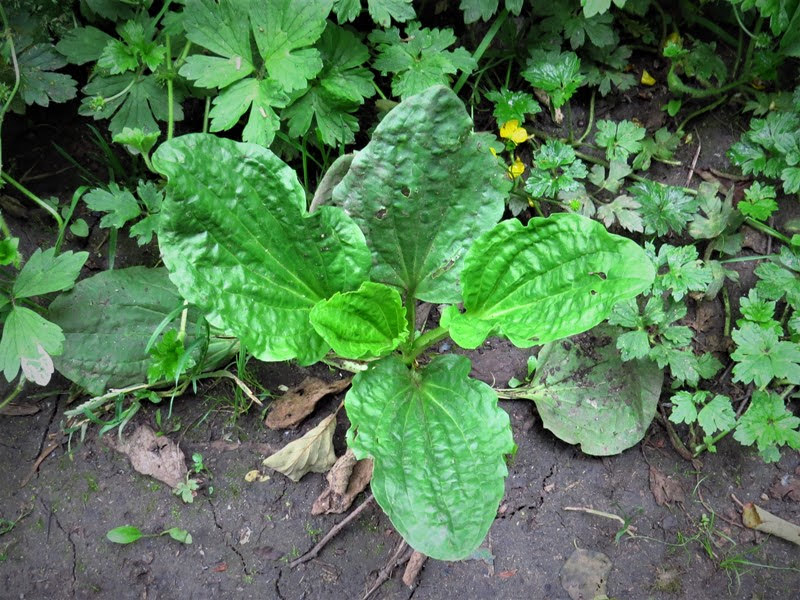
Not yet in what passes for flowers in this group of plants is a Greater Plantain (Plantago major).

In yesterday's text for the tiny flowers of I suggested that other plants in the genus Rumex (docks) did not show flowers. I was wrong. This is Wood [or Red-veined] Dock (Rumex sanguineus) with its tiny yellow flowers. Of course you can't have dock plants with masses of seeds unless there have been flowers to be pollinated. Basic biology lesson needed.

The App. gave me the options of Scentless Chamomile or False Mayweed that I found growing on the verge of Castle Farm Way in ground disturbed by the roadworks. Neither name is in my Flora but the scientific name given for the former, Tripleurospermum inodorum, translates to Scentless Mayweed which seems to match both photos on the web and my Flora. It was certainly scentless (as far as my rather insensitive nose tells me anyway).

Today's rather poor aircraft of the day on a morning with a low overcast. It is a Eurocopter built Aérospatiale AS 355NP Twin Squirrel (twin engined) operated by Cameron Charters LLP., Knutsford. There has been many more helicopters than usual today, probably in connection with the Glastonbury Festival. No doubt for the artists and not the punters.

(Ed Wilson)

------------------------------------------------------------------------------------------------------

The Flash: 05:45 – 06:45

(143rd visit of the year)

Bird notes:
- The Peacock was waking the neighbourhood at 05:45.
- At last: I have re-found the Canada Goose goslings.
- Did I see the two large ducklings? Two birds were loosely with a pair of adult Mallard and so well-grown they could almost have been adult ducks. Meanwhile five small ducklings were possibly yet another new brood.
- I reconfirmed there are five juvenile Coots in the second brood by one of the footbridges.

Birds noted flying over here:
- 2 Jackdaws: singles

Hirundines etc. noted:
- 1 House Martin only

Warblers noted (figures in brackets relate to singing birds):
- 4 (4) Chiffchaffs
- 2 (2) Blackcaps

Noted on / around the water:
- 217 + 8 (2 broods) Canada Geese
- no Canada x Greylag Goose seen
- 59 Greylag Geese
- 7 + 4 (1 brood) Mute Swans
- *21 (16♂) + 7 (2 broods) Mallard
- 1 all-white duck (Aylesbury Duck)
- 8 (6♂) Tufted Duck
- 12 + 7 (4 broods) Moorhens
- 17 + 9 (3 broods) Coots
- 3 Great Crested Grebes again
- no Grey Heron

Noted on / around the street lamp poles or elsewhere
- *1 Tetragnatha sp. stretch spider (with prey)

Noted elsewhere:
- *Great [Hairy] Willowherb (Epilobium hirsutum)
- *Honeysuckle (Lonicera periclymenum)

Yet another new brood of Mallard ducklings? Five here looking very small but happily tucking in to the weed.

At first sight this looked like a long-legged fly when in fact it is a Tetragnatha sp. stretch spider with prey. There seems to be at least three wings involved which suggests the spider caught a moth – flies only have two wings.

The flowers of Great Willowherb (Epilobium hirsutum), or as the App. calls it Great Hairy Willowherb.

I did not need the App. to identify this as Honeysuckle (Lonicera periclymenum).

(Ed Wilson)

------------------------------------------------------------------------------------------------------

Between the lake and The Flash:

- Two adult and five juvenile Moorhens at the lower pool with other juvenile calls heard.
- No warblers seen or heard

(Ed Wilson)

------------------------------------------------------------------------------------------------------

In the Priorslee Avenue tunnel:

- just a few midges

(Ed Wilson)

------------------------------------------------------------------------------------------------------
On this day can be found via the yearly links in the right-hand column.

Sightings from previous years without links are below

2011
Priorslee Lake
Common Sandpiper - First returning
(Ed Wilson)

2008
Priorslee Lake
Common Sandpiper - First returning
(Ed Wilson)

2006
Priorslee Lake
1 drake Ruddy Duck
1 Snipe
1 Common Sandpiper - First returning
At least 38 Swifts
(Ed Wilson)

23 Jun 22

Priorslee Lake and The Flash

13.0°C > 21.0°C: Mostly clear. Some cloud to the East and South later tended to fade away. Calm. Very good visibility though rather hazy later.

Sunrise: 04:46

* = a photo today

Priorslee Lake: 04:40 – 05:40 // 06:55 – 09:35

(146th visit of the year)

Bird notes:
- It was good to see the duck Mallard with two fast growing ducklings. I had not seen them for several days.
- While some broods of juvenile Coots are very new a few birds from the earliest broods are becoming a challenge to separate from adults when viewed from any distance. I may have to start reporting a single figure for both adults and juveniles. It seems to have been reasonably successful season for this species.
- A Grey Heron flew off West at 05:25 and was perhaps the bird noted at The Flash later. It, or another, was at the lake by 07:45.
- As has been the trend recently there were only one or two House Martins present most of the time. Suddenly there were many calls and eight were evident. They did not stay.
- Just one Garden Warbler heard singing this morning.

Birds noted flying over here:
- 5 Stock Doves: duo and trio
- 8 Wood Pigeons
- 3 Herring Gulls
- 6 Lesser Black-backed Gulls
- 4 Cormorants: together
- 1 Common Buzzard
- 21 Jackdaws
- 4 Rooks

Hirundines etc. noted:
- 4 Swifts
- 1 Barn Swallow
- 8 House Martins

Warblers noted (figures in brackets relate to singing birds):
- 1 (1) Cetti's Warbler: single song
- 10 (9) Chiffchaffs
- 1 (1) Sedge Warbler
- 10 (8) Reed Warblers
- 14 (11) Blackcaps
- 1 (1) Garden Warbler
- 1 (1) Common Whitethroat again

Counts from the lake area:
- 2 + 4 (1 brood) Mute Swans
- 10 (6♂) + 2 (1 brood) Mallard
- 2 Moorhens
- 34 + 25 juvenile Coots: see notes
- *5 Great Crested Grebes
- 1 or 2 Grey Herons: see notes
- 1 Kingfisher

On / around the street lamp poles pre-dawn:
Nothing noted

After a warm night I expected to find moths on the lamps. It was not to be

Noted later:

New Sightings
I concentrated on trying to find new sightings for the year with rather mixed results:

Moths:
- A burnet moth flew past me and disappeared: I have only previously recorded Narrow-bordered Five-spot Burnet (Zygaena lonicerae) here but Six-spot Burnet (Zygaena filipendulae) is also possible.

Bees, wasps etc.:
- *A mining bee (Andrena sp.) noted. A nightmare to specifically identify!
- *An unidentified ichneumon (aren't they all?)

Dragonfly:
- A large hawker-type dragonfly flew by. Would need to see it perched!

Beetle:
- *Spotted Longhorn beetle (Rutpela maculata): more luck with this though it did not stay.

Flowers:
- *Common Sorrel (Rumex acetosa): also known as Red Sorrel, Sheep's Sorrel, Field Sorrel and Sour Weed'

Repeat sightings:

Butterflies:
- Large Skipper (Ochlodes sylvanus)
- Speckled Wood (Pararge aegeria)
- Small Heath (Coenonympha pamphilus): second record here
- Ringlet (Aphantopus hyperantus)
- Small Tortoiseshell (Aglais urticae)

Moths:
- Common Nettle-tap (Anthophila fabriciana)
- Timothy Tortrix (Zelotherses paleana)
- Common Marble (Celypha lacunana)
- *Garden Grass-veneer (Chrysoteuchia culmella)
Plus many unidentified moths flushed from the grass.

Bees, wasps etc.:
- Common Carder Bee (Bombus pascuorum)

Hoverflies:
- Bumblebee Cheilosia (Cheilosia illustrata)
- Marmalade Hoverfly (Episyrphus balteatus)
- Tapered Dronefly (Eristalis pertinax)
- Common Spotted Field Syrph (Eupeodes luniger)
- Chequered Hoverfly (Melanostoma scalare)
- Pellucid Fly (Volucella pellucens) [Pied Plumehorn]

Damselflies:
- Common Blue Damselfly (Enallagma cyathigerum)
- Blue-tailed Damselfly (Ischnura elegans)

Other flies:
- Greenbottle Lucilia sp.
- Scorpion Fly Panorpa sp.
- Yellow Swarming Fly (Thaumatomyia notata)

Beetles:
- Swollen-thighed (Flower) Beetle (Oedemera nobilis)
- Harlequin Ladybird (Harmonia axyridis)
- pollen beetles on on both buttercups (Ranunculus sp.) and Common Hogweed (Heracleum sphondylium)

Mammals:
- Grey Squirrel

Flowers:
- *Marsh Thistle (Cirsium palustre)

Yesterday's unknown bug remains largely unknown. Keith Fowler tells me it is a nymph of an Anthocorid bug, (a family of minute pirate bugs). He notes "they all look the same at this stage".

A 'clear as a bell' dawn.

And calm later as well.

Only available at dawn was the duck Mallard and her two my now well-grown ducklings. Where do they hide away?

One of the variable number of Great Crested Grebes. Five today.

An unbelievably cooperative grass moth. Normally they flush away only to dive deep in to long grass never to be seen again. This individual decided that the place to hide was the door frame of one of the fisherman's car. It is a very fresh specimen showing how the longitudinal line splits. It also illustrates how the cross-line near the outer edge of the wing makes a 'U' shape. These are features of Garden Grass-veneer (Chrysoteuchia culmella). The pale blue (grey?) eyes on this group of moths always makes them looked surprised. The moth is less than 0.5" long – 11 mm for those of you who have the vaguest notion of metric measurements.

My unknown mining bee (Andrena sp.). To my eyes most of the 67 UK species look very similar, not helped by males and females of each species sometimes looking different. Only some of the species occur in our area and many of these are mainly on the wing in Spring. Frankly I have no idea but it is a smart-looking bee.

Yet another insect enjoying the plentiful supply of buttercup nectar is an unidentified ichneumon.

This Spotted Longhorn beetle (Rutpela maculata) paused just long-enough for me to grab this shot. It is on a Common Spotted-orchid (Dactylorhiza fuchsii). The beetle was formerly known as Strangalia maculata should you look it up in an older reference. I see it most years.

These tiny yellow flowers belong to Common Sorrel (Rumex acetosa). This plant looks a lot like a dock as it probably should as they share the Rumex genus. I have never noted flowers on the spikes any species of dock: they just look reddish brown. It seems male and female flowers occur on separate plants. I do not know which this is.

Now that the heads are open on this thistle I used the app. to confirm its identity as a Marsh Thistle (Cirsium palustre).

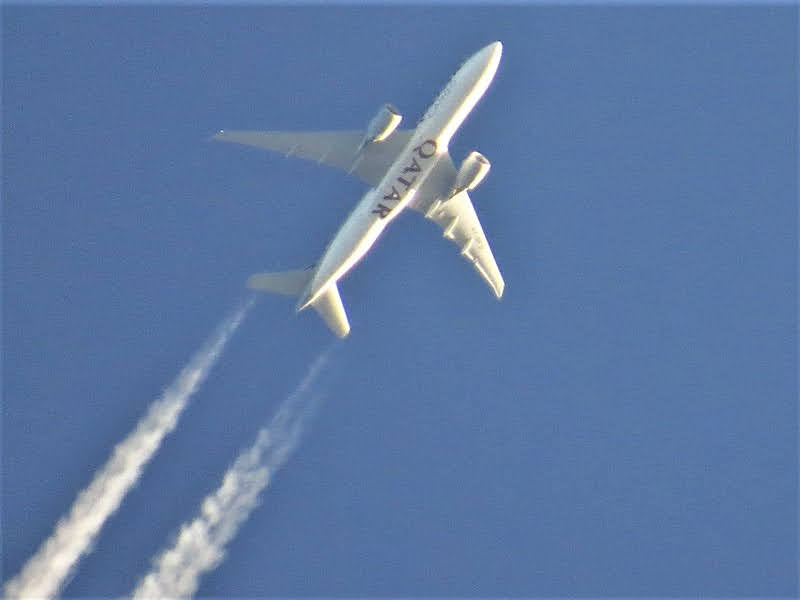
Today's aircraft. You can probably work out this belongs to Qatar Airways. What is not quite so obvious is that it belongs to their Crystal Cargo division. A7-BFD is a Boeing 777-200 Freighter and is en route from Los Angeles International Airport to Luxembourg Airport. Taken at 05:00. Later the atmosphere conditions changed and aircraft stopped leaving vapour trails and were hard to see through a haze layer.

(Ed Wilson)

------------------------------------------------------------------------------------------------------

The Flash: 05:45 – 06:50

(141st visit of the year)

Bird notes:
- Still no obvious Canada Goose goslings and rather fewer adults for no apparent reason. I doubt any can fly at the moment.
- The adult Mute Swan was 'upending' to bring up weed for the cygnets. A photo revealed just enough to show it had a green Darvic ring and hence confirm it is 'our' pen Mute Swan.
- Two large ducklings again with a duck Mallard. Also one small duckling with another duck Mallard – it almost looked small-enough to be a new brood.
- Of yesterday's second brood of at least five juvenile Coots today I could only see four being brooded under the adult. Two more new broods were evident, each of two juveniles. The lone well-grown juvenile completed the count of nine juveniles.

Birds noted flying over here:
- 1 Cormorant

Hirundines etc. noted:
- 2 Swifts
- House Martin(s) heard only

Warblers noted (figures in brackets relate to singing birds):
- 3 (3) Chiffchaffs still
- 2 (2) Blackcaps still

Noted on / around the water:
- 189 Canada Geese
- 1 Canada x Greylag Goose still
- 55 Greylag Geese
- *7 + 4 (1 brood) Mute Swans
- *21 (19♂) + 3 (2 broods) Mallard
- 1 all-white duck (Aylesbury Duck)
- 10 (7♂) Tufted Duck again
- 7 + 7 (3 broods) Moorhens
- 18 + 9 (4 broods) Coots
- 3 Great Crested Grebes
- 1 Grey Heron again

On / around the street lamp poles or elsewhere
Nothing noted

Noted elsewhere:
- *Tutsan (Hypericum androsaemum) flowers alongside squirrel alley
- *Nettle Rust Fungus (Puccinia urticata)

The camera wins again. On the left leg of the adult Mute Swan it is just possible to make out part of the green Darvic ring which is an 'out of county' ring and sported by the resident pen. I could not see this through my binoculars. It is the first time I have managed to confirm that the cygnets are hers.

This looks to me like the sole survivor of yet another brood of Mallard ducklings: it seems too small to be from any brood I have seen previously.

Catching up on last year when I photographed this flower, described it as a St. John's Wort and then realised I could not tell from that photo whether it was a Common (or Perforate) St. John's-wort (Hypericum perforatum) or an Imperforate St. John's-wort (H. maculatum). I then promptly forgot to look again and photograph the leaves to get a positive identification. A year later and guess what? I was wrong anyway. It is Tutsan (H. androsaemum).

This deformity of the leaf of Common or Stinging Nettle (Urtica dioica) is caused by Nettle Rust Fungus (Puccinia urticata). The myriad of small circles are the fruiting bodies of the fungus.

(Ed Wilson)

------------------------------------------------------------------------------------------------------

Between the lake and The Flash:

- Adult and juvenile Moorhens heard at both pools.
- No warblers seen or heard

also
- *Black Horehound (Ballota nigra) in flower beside the Wesley Brook.

I found this flower growing on the bank of the Wesley Brook just where it disappears under Priorslee Avenue. Out with the PlantNet app. It told me it is Black Horehound (Ballota nigra). "Never seen it before" I thought. Only to discover it is in my lake log from 2017!

(Ed Wilson)

------------------------------------------------------------------------------------------------------

In the Priorslee Avenue tunnel:

- just a few midges

(Ed Wilson)

------------------------------------------------------------------------------------------------------
On this day can be found via the yearly links in the right-hand column.

Sightings from previous years without links are below

2012
Priorslee Lake
Plover sp.
(Ed Wilson)

2008
Priorslee Lake

Marsh Warbler
Unlikely as it seems I am pretty convinced about this on the basis of the song alone
I was walking along the W end path at c.06:15 when a strange song caught my attention: there had been young Reed Warblers flitting about the area away from the reeds and it sound 'Acro-like'. But it was far too fast and I then assumed it was a Sedge Warbler (especially after my bird in the town centre last week). But the sound was all wrong with what seemed more like Garden Warbler tones, though with the characteristic Acro dynamics.
The bird was singing from a small patch of bushes growing in the fence at the W end of the yacht compound and I had the choice of a close view directly in to the bright sun; or going the 'other side' and trying to see between the yachts at some distance. I decided to stay where I was and in response to gentle phishing I got a good-enough glimpse to confirm it was a  Reed / Marsh and not Sedge Warbler and certainly an Acro.
The song continued to puzzle and included all manner of oddities, sounding at times like juvenile Great Tit begging, all while singing at full volume.
I decided that the best thing would be to try and record the bird so I dashed back to the car for my digital tape recorder. When I returned the bird was not singing and phishing produced only a Wren and a pair of Bullfinches!
Revisited the area twice more for some 15 minutes on each occasion without success: was not too surprised as it was a small and rather unlikely spot for the bird to stay in.
Worth rechecking - but I went all around the lake twice without hearing anything untoward.
Only my second-ever UK Marsh Warbler - the last was as long ago as when they bred in Worcestershire! But familiar with the birds abroad as recently as May in Poland where I heard maybe 20.
I really cannot see what else it might have been: I am not that confident to say it WAS a Marsh Warbler song, only that I have no idea what else it could have been and it fits the general pattern of song.
(Ed Wilson)

2007
Priorslee Village
A pair of Siskins
(Martin Adlam)

2006
Priorslee Lake
Common Tern
(Ed Wilson)

22 Jun 22

Priorslee Lake and The Flash

13.0°C > 19.0°C: Early mist and very low cloud started to lift c.06:00 but was after 08:00 before any substantial sunny intervals. Light NNW wind, gusting moderate early. Poor visibility to start, gradually becoming very good.

Sunrise: 04:46: mornings drawing in!

* = a photo today

Priorslee Lake: 04:40 – 05:35 // 06:40 – 09:30

(145th visit of the year)

Many numbers affected by early poor visibility

Bird notes:
- After two days with apparently only four Great Crested Grebes I noted seven today.
- One of the three Black-headed Gulls was an adult that flew West. The other two were circling high overhead and could not be aged.
- Dire numbers of Swifts, Swallows and House Martins. Singles of each only. Swifts seem to be in reasonable numbers locally but the other two species are well down even on recent years.

Birds noted flying over here:
- 2 Stock Doves: together
- 10 Wood Pigeons
- 3 Black-headed Gulls
- 3 Lesser Black-backed Gulls
- 1 Cormorant
- 8 Jackdaws
- 2 Rooks

Hirundines etc. noted:
- 1 Swift
- 1 Barn Swallow
- 1 House Martin

Warblers noted (figures in brackets relate to singing birds):
- 1 (1) Cetti's Warbler
- 14 (12) Chiffchaffs
- no Sedge Warblers
- 10 (6) Reed Warblers
- 14 (12) Blackcaps
- 2 (2) Garden Warblers
- 1 (1) Common Whitethroat

Counts from the lake area:
- 2 + 4 (1 brood) Mute Swans
- 11 (8♂) Mallard: also a pair on roof in Pitchford Avenue again
- 2 (1♂) Tufted Ducks: departed
- 3 Moorhens
- 38 + 23 juvenile Coots: see notes
- 7 Great Crested Grebes
- 1 Grey Heron: departed

On / around the street lamp poles pre-dawn:
Nothing noted

Noted later:

New sightings for the year:

Moths:
- *probable flat body-type micro moth

Bees, wasps etc.:
- *Wall Mason Wasp (Ancistrocerus parietinus)

Flies:
- *Owl midge Psychodidae sp

Bugs:
- *unidentified presumed Mirid (plant) bug

Fish:
- none identified but after the recent spawning activity there are at least five dead fish on the surface. Two or three is usual I am told: five rather unusual

Flowers:
- *Perennial [or Field] Sow-thistle (Sonchus arvensis)
- *Square-stalked St John's-wort (Hypericum tetrapterum)
- *Welted Thistle (Carduus crispus)

Repeat sightings:

Butterflies:
- *Large Skipper (Ochlodes sylvanus)
- Ringlet (Aphantopus hyperantus)

Moths:
- Common Nettle-tap (Anthophila fabriciana)
- Common Marble (Celypha lacunana)

Bees, wasps etc.:
- Common Carder Bee (Bombus pascuorum)
- Buff-tailed Bumblebee (Bombus terrestris)

Hoverflies:
- Two-banded Wasp Hoverfly (Chrysotoxum bicinctum)
- Marmalade Hoverfly (Episyrphus balteatus)
- Tapered Dronefly (Eristalis pertinax)
- *Chequered Hoverfly (Melanostoma scalare)
- Bumblebee Plume-horned Hoverfly (Volucella bombylans)
- *Pellucid Fly (Volucella pellucens) [Pied Plumehorn]

Damselflies:
- Common Blue Damselfly (Enallagma cyathigerum)
- Blue-tailed Damselfly (Ischnura elegans)

Other flies:
- *Black Snipefly (Chrysopilus cristatus)
- Greenbottle Lucilia sp.
- Grouse Wing caddis fly (Mystacides longicornis)
- Scorpion Fly Panorpa sp.
- *Semaphore fly Poecilobothrus nobilitatus

Beetles:
- Swollen-thighed (Flower) Beetle (Oedemera nobilis)
- 7 Spot Ladybird (Coccinella 7-punctata)
- pollen beetles on on both buttercups (Ranunculus sp.) and Common Hogweed (Heracleum sphondylium)

Bugs:
None

Slugs / snails:
- White-lipped Snail (Cepaea hortensis) as ever

Spiders:
- Tetragnatha sp. stretch spider

Hands up: dreadful photo. This male Blackbird with numerous white feathers only ever seems to appear around dawn and is much more wary than most of its brethren. It, or a similar bird, has been around for at least two years.

Great lighting on this male Large Skipper (Ochlodes sylvanus). I still have yet to see a female – without the scent gland in the forewing - this year.

What seems to be a new moth for me and as yet I do not have an ID. It looks to be one of the 'flat-body' group.

This wasp would not stay still and I managed just two rather poor photos. I think I can identify it as a female Wall Mason Wasp (Ancistrocerus parietinus). The abdomen shows a broad yellow band at the top and then three yellow bands toward the tip, the upper one being broader than the other two. To get an idea of its small size it is feeding from grass seed-heads.

This view shows it has two yellow spots at the base of the thorax and a yellow collar. The typical wasp antennae show better here. They do nest in walls – hence mason wasp - but more often in bramble and elder stems. I recorded my first here on 12 July 2021.

This hoverfly would not rest with its wings open to show the abdomen markings. I thought it was most likely a Chequered Hoverfly (Melanostoma scalare) and checking with Steven Falk's Flickr photos the leg pattern matches, with yellow 'knees' and yellow toward the end of the legs.

Another view. If you look at the shiny thorax you can see my reflection!

Yesterday a Pellucid Fly (Volucella pellucens) was flying above my head. Here is one at rest. Can we see that it is, as Steven Falk calls it, a Pied Plumehorn?

Enlarged as much as I dare I could just about convince myself the antennae are plumed.

This is the very common Black Snipefly (Chrysopilus cristatus). I took this photo as the way the light was shining through the wing made it look as if the wing was tinged bronze as well as showing the usual dark area along the edge. Thus I thought it might be one of other snipefly species. Not so.

Another trick of the light. I thought I had captured both male and female Semaphore flies Poecilobothrus nobilitatus, the male having the pale tip to his wings. Not so: on closer inspection these are two males.

And here is one of them illustrating how hairy the legs are and also the rather unusual antennae.

A furry, cuddly owl midge Psychodidae sp. This one looked about half the size of those I usually see.

I am sure this is a Mirid (or Plant) bug though which it might be I cannot trace.

I was sure I knew this flower but I wondered what the PlantNet app. would say. It said Field Sow-thistle but of course it also gave me the scientific name as Sonchus arvensis. From my Flora I knew it as Perennial Sow-thistle.

I tried the app. on this and it came up with Square-stalked St John's-wort (Hypericum tetrapterum). I checked it out at the time – it had a square stalk. Later I checked with my Flora and the general arrangement of the flowers atop the stems with narrow leaves checks out. Apologies about the drunken angle but I had to take a flash photo from below as there was too much confusing vegetation around the plant to isolate it from any other direction.

Another ID from the PlantNet app. is this yet-to-flower Welted Thistle (Carduus crispus).

(Ed Wilson)

------------------------------------------------------------------------------------------------------

The Flash: 05:40 – 06:35

(140th visit of the year)

Bird notes:
- Again no obvious Canada Goose goslings.
- Two large ducklings with a duck Mallard. Probably two of the recent group of four. I hope the other two have declared UDI and are happy on their own somewhere.
- Several of the juvenile Moorhens are sufficiently independent to be straying well away from 'home' and it is not easy to ascribe some individuals to a known brood.
- Just one of the six juvenile Coots was a more or less independent bird, the others being a very new second brood of at least five not noted previously.
- A family group of Goldcrests including at least two juveniles was seen at the bottom end of squirrel alley.

Bird noted flying over here:
None

Hirundines etc. noted:
- 3 Swifts

Warblers noted (figures in brackets relate to singing birds):
- 3 (3) Chiffchaffs again
- 2 (2) Blackcaps again

Noted on / around the water:
- 205 Canada Geese
- 1 Canada x Greylag Goose
- *42 Greylag Geese
- 7 + 4 (1 brood) Mute Swans
- 23 (19♂) + 2 (1 brood) Mallard
- 1 all-white duck (Aylesbury Duck)
- *8 (6♂) Tufted Duck again
- 7 + 7 (3? broods) Moorhens
- 18 + 6 (2 broods) Coots
- 2 Great Crested Grebes
- 1 Grey Heron

On / around the street lamp poles or elsewhere
Nothing noted

So where did yesterday's moths go?

Elsewhere:
Nothing noted

The Greylag Geese appear in fluctuating numbers yet this view suggests they won't be flying anywhere soon. Note how the still growing wing-feathers fall far short of the tail.

Two drake Tufted Ducks with the left-hand bird moulting in to winter plumage. In a few weeks they will become difficult to separate from ducks.

(Ed Wilson)

------------------------------------------------------------------------------------------------------

Between the lake and The Flash:

- Adult and juvenile Moorhens heard at the upper pool.
- Three juvenile Moorhens seen at the lower pool.
- One Chiffchaff singing intermittently near the lower pool.

(Ed Wilson)

------------------------------------------------------------------------------------------------------

In the Priorslee Avenue tunnel:

- *1 owl midge Psychodidae sp.
- very few other midges

Contrast this owl midge Psychodidae sp. with the one I photographed at the lake. It is larger, less hairy and with fewer markings on the wings. So that is two of the 99 species in the UK ticked-off. But which two?

(Ed Wilson)

------------------------------------------------------------------------------------------------------
On this day can be found via the yearly links in the right-hand column.

Sightings from previous years without links are below

2012
Priorslee Lake
Common Tern
(Ed Wilson)

2009
Priorslee Lake
Pochard
Nuthatch
Swarm of bees
(Ed Wilson)

2006
Priorslee Lake
Drake Ruddy Duck
(Ed Wilson)