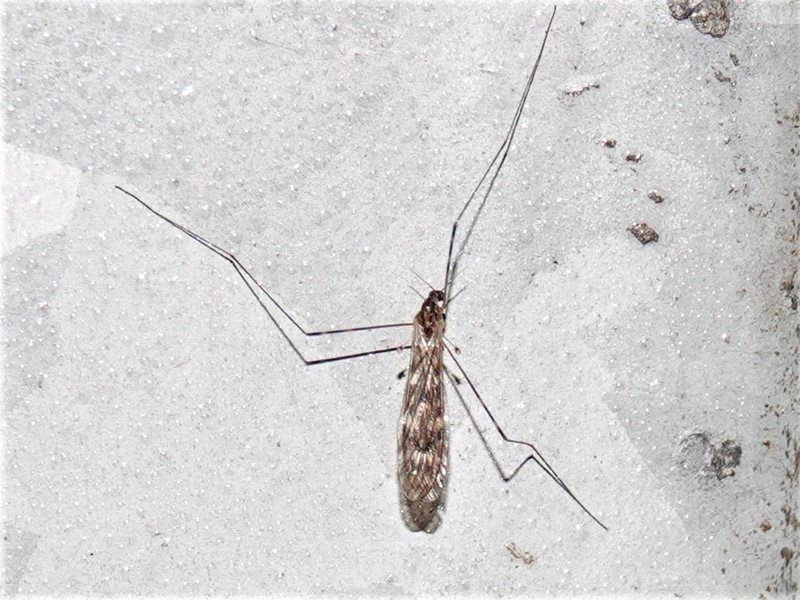
26 Aug 24

Priorslee Balancing Lake and The Flash

12.0°C > 15.0°C: Mostly clear though rather hazy. Light / moderate south-westerly breeze. Good visibility.

Sunrise: 06:11 BST

* = a species photographed today
! = a new species for me here this year
!! = a new species for me in Shropshire

Priorslee Balancing Lake: 05:10 – 06:35 // 07:40 – 09:00

(185th visit of the year)

Other things to do today so away earlier than usual. Mostly affected the insect numbers.

Bird notes:
- when I arrived there were 13 Canada Geese on the lake. These departed outbound in two groups. Later 81 arrived inbound in at least 11 groups. Whether these included any or all of the original 13 I cannot speculate.

Counts of birds noted flying over:
- 46 Canada Geese: 28 outbound as eight singles / small groups; 20 inbound in three groups
- 42 Greylag Geese: all outbound in three groups
- 24 Wood Pigeons
- 73 Lesser Black-backed Gulls
- 2 Cormorants: together
- 168 Jackdaws
- 11 Rooks

Hirundines etc. noted:
None

Warblers noted (the figure in brackets relates to birds heard singing):
- 9 (4) Chiffchaffs
- 1 (0) Reed Warbler
- 2 (0) Blackcaps
- 1 (0) Common Whitethroat
''nominal' warbler:
- no Goldcrests

Counts from the lake area:
- 81 Canada Geese: at least: see notes
- 2 Mute Swans
- 26 (?♂) Mallard: of these nine flew off together
- 6 adult and juvenile Moorhens
- 95 adult and juvenile Coots
- 4 + 1 (1 brood) Great Crested Grebes
- 9 Black-headed Gulls on the lake c.05:45: none on the football field at c.06:20 or later
- 10 Lesser Black-backed Gulls
- 2 Grey Heron: the second only briefly
- 1 Kingfisher

Noted on the street lamps poles pre-dawn:

Moths:
- *1 !!possible Spindle Ermine Yponomeuta cagnagella
- 1 Common Grass-moth Agriphila tristella [was Common Grass-veneer]
- *1 Square-spot Rustic Xestia xanthographa

Flies:
- *1 !!Minettia longipennis

Beetle:
- *1 Harlequin Ladybird Harmonia axyridis var. succinea

Spiders, harvestmen etc.
- *2 Bridge Orb-web Spiders Larinioides sclopetarius
- 1 Missing Sector Orb-web Spider Zygiella x-notata [Silver-sided Sector Spider]
- 2 harvestmen Dicranopalpus ramosus/caudatus

***thanks to Martin Adlam I am reminded that yesterday's frustrating small fly with two black and white bands on its wings which I photographed on a street lamp pole is the dance fly Tachydromia umbrarum. My previous record this year was August 10th. I also have a record of this species from 22 October 2022.

Sailing Club HQ
I again prowled around the outside of the sailing club HQ pre-dawn:

Moths:
- 3 Copper Underwing agg. Amphipyra pyramidea agg.: same place for five days but a third noted tucked up: perhaps there always has been?

Spiders:
- 2 Missing Sector Orb-web Spiders Zygiella x-notata [Silver-sided Sector Spider]

Noted later:

Butterflies:
- *Speckled Wood Pararge aegeria

Bees, wasps etc.:
- *Honey Bee Apis mellifera
- *Common Carder Bee Bombus pascuorum
- Buff-tailed Bumblebee Bombus terrestris

Hoverflies:
The first name is that used by Stephen Falk. The name in square brackets is that given by Obsidentify or other sources if different. Scientific names are normally common. The species are presented in alphabetic order of those scientific names.
- *Tapered Dronefly Eristalis pertinax
- *Common Dronefly Eristalis tenax
- Chequered Hoverfly Melanostoma scalare [Long-winged Duskyface]
- *Common Copperback Ferdinandea cuprea [Bronze Sap Hoverfly; Eurasian Copperback]
- *Pellucid Fly Volucella pellucens [Pied Plumehorn]

Damsel- / Dragon-flies:
- *Common Darter Sympetrum striolatum

Other flies:
- only unidentified flies

Beetles:
- none

Bugs:
- none

Spiders:
- none

Molluscs:
- White-lipped Snail Cepaea hortensis

It is really half-moon now. The moon really was canted at this angle – I checked the "spirit level" on the camera.

The hazy dawn.

A male Blackbird rooting about for food around a drain in Teece Drive.

A slightly battered Speckled Wood butterfly Pararge aegeria. Today I probably saw the largest number of butterflies I have noted on any one day this year. Pity they were all this species!

I cannot get a positive identification for this moth, high up a street lamp pole and at an awkward angle. I suspect it is a Spindle Ermine Yponomeuta cagnagella. The West Midlands Moths internet site shows that around this date it the most common of a number of very similar species. There are several Spindle-trees Euonymus europaea very close-by. If confirmed it would be a new species of moth for me.

A Square-spot Rustic moth Xestia xanthographa. Another individual without the typical dark 'square spot' between the oval and the kidney markings on each forewing.

There were a few Honey Bees Apis mellifera around.

Just one Common Carder Bee Bombus pascuorum today.

A Tapered Dronefly Eristalis pertinax.

A Common Dronefly Eristalis tenax feeds on one of the few buttercup flowers extant.

 My second Common Copperback hoverfly Ferdinandea cuprea of the year.

A Pellucid Fly Volucella pellucens. My first for some weeks. Several insects were using the few remnant Butterfly-bush flowers.

Almost succeeding in camouflaging itself on soil (actually a mole hill) is a male Common Darter Sympetrum striolatum.

An an immature male looking for prey visiting the Butterfly-bush.

A close-up of the head showing the jaws, capable of dealing with prey at least the size of the dragonfly.

The last thing a victim sees!

And here is a female – pale brown.

This fly is Minettia longipennis. The family it belongs to - the Lauxaniidae - does not have a generic description. The flies in the family are all small, they have wings significantly longer than their body and many have patterning in the wing. This species is characterised by the brown wings fading toward the tip and no spotting.

An unusual location, way up one of the taller street lamp poles pre-dawn, was this Harlequin Ladybird Harmonia axyridis var. succinea.

Yet another Bridge Orb-web Spiders Larinioides sclopetarius!

(Ed Wilson)

------------------------------------------------------------------------------------------------------

In the Priorslee Avenue tunnel:

Moths:
- none

Other things:
- 13 White-legged Snake Millipedes Tachypodoiulus niger

Spiders:
- *2 Missing Sector Orb-web Spider Zygiella x-notata [Silver-sided Sector Spider]

Molluscs:
- *1 !!Slippery Snail Cochlicopa lubrica [Slippery Moss Snail]

One of two Missing Sector Orb-web Spider Zygiella x-notata, clearly a male.

This is a Slippery Snail Cochlicopa lubrica, also known as a Slippery Moss Snail. Not a species I have seen before.

(Ed Wilson)

------------------------------------------------------------------------------------------------------

The Flash: 06:40 – 07:35

(188th visit of the year)

Bird notes:
- while searching for the distant calling House Martins I located a Swift with them. Upon checking my records I see I recorded my last for 2023 on this same date.

Bird(s) noted flying over here:
- 1 Jackdaw

Hirundines etc. noted:
- 1 Swift
- 2 House Martins

Warblers noted (the figure in brackets relates to birds heard singing):
- 6 (1) Chiffchaffs
'nominal' warbler:
- no Goldcrest

Noted on / around the water:
- 13 Canada Geese
- *42 Greylag Geese: 41 of these arrived in two groups
- 4 + 3 (1 brood) Mute Swan
- 25 (?♂) Mallard
- 46 (?♂) Tufted Duck
- 5 Moorhens
- 66 + 2 (1 dependent brood) Coots
- 3 Great Crested Grebes
- 42 Black-headed Gulls
- 1 Grey Heron

Noted elsewhere around The Flash:

Moths:
- *1 Brimstone Moth Opisthograptis luteolata

Beetles:
- 1 Alder Leaf Beetle Agelastica alni: adult

Spiders, harvestmen etc.
- 3 harvestmen Dicranopalpus ramosus/caudatus

I counted 32 Greylag Geese arriving: the camera begs to differ – 33. I need more toes to count with.

Unmistakeable: a Brimstone Moth Opisthograptis luteolata.

(Ed Wilson)

------------------------------------------------------------------------------------------------------

Sightings from previous years

2013
Priorslee Lake
Yellow Wagtail
(Ed Wilson)

25 Aug 24

Priorslee Balancing Lake and The Flash

9.0°C > 15.0°C: A clear start with the few clouds melting away. After 09:00 cloud from the West with the last of the sun c.09:30. Calm early with a moderate south-westerly breeze picking up. Very good visibility.

Sunrise: 06:10 BST

* = a species photographed today
! = a new species for me here this year
!! = a new species for me in Shropshire

Priorslee Balancing Lake: 05:10 – 06:35 // 07:40 – 09:50

(184th visit of the year)

Bird notes:
- no sign of yesterday's Tufted Duck.
- for the first time the juvenile Great Crested Grebe had ceased its incessant begging for food. I noted only one adult.
- with clear skies to the East and a bright start (the street lights went out 19 minutes earlier than yesterday) a sizeable roost dispersal passage by the Jackdaws and Rooks was noted.

Counts of birds noted flying over:
- 96 Canada Geese: 74 outbound in five groups; 22 inbound together
- 12 Greylag Geese: all outbound together
- 6 Feral Pigeons: together
- 62 Wood Pigeons
- 57 Lesser Black-backed Gulls
- 2 Cormorants: together
- 210 Jackdaws
- 98 Rooks

Hirundines etc. noted:
- 18 House Martins high over the estate c.06:25

Warblers noted (the figure in brackets relates to birds heard singing):
- 14 (3) Chiffchaffs
- no Reed Warblers
- 1 (0) Blackcap
- 1 (0) Common Whitethroat
''nominal' warbler:
- 2 (0) Goldcrests

Counts from the lake area:
- 111 Canada Geese: arrived inbound in many small groups
- 2 Mute Swans
- 26 (?♂) Mallard
- 6 adult and juvenile Moorhens
- 87 adult and juvenile Coots
- 1 + 1 (1 brood) Great Crested Grebes
- 8 Black-headed Gulls on the lake c.05:45: none on the football field c.06:20 or later
- 3 Herring Gulls
- *26 Lesser Black-backed Gulls
- *5 Cormorants: all immatures, arrived together; three of these departed together
- 1 Grey Heron
- 1 Kingfisher

Noted on the street lamps poles pre-dawn:

Moths:
- *1 Common Grass-moth Agriphila tristella [was Common Grass-veneer]
- *1 !Chevron Grass Moth Agriphila geniculea [was Elbow-stripe Grass-veneer]
- *1 Blood-vein Timandra comae

A word about naming micro-moths. Traditionally few micro moths had vernacular names and amongst "mothers" were always referred to by the second part of their scientific species name e.g. 'tristella' in the first instance above. These names are unique between all UK moths and butterflies and do not change if a species is reassigned to a different genus. A few years ago there was a move to give all the micro moths a vernacular name, with the various county web sites leading the way. Hence we arrived at 'Common Grass-veneer'. Not all parties agreed with the names given – some were not helpful (e.g. 'Wainscot Smudge'). Triggered by the production and widespread availability of the first comprehensive micro-moth field guide, the first edition of which was produced without these names, a new naming attempt has been made. These names are becoming widely adopted. Hence 'Common Grass-moth' (though I am not sure 'Tufted Scallop' is necessarily better than 'Wainscot Smudge'. Time will tell!)

Hoverflies:
- *1 Chequered Hoverfly Melanostoma scalare [Long-winged Duskyface]

Other flies:
- *1 cranefly Limonia nubeculosa

Springtails:
- 1 springtail Pogonognathellus longicornis-type

Spiders, harvestmen etc.
- *1 Bridge Orb-web Spider Larinioides sclopetarius
- 3 harvestmen Dicranopalpus ramosus/caudatus

Sailing Club HQ
I again prowled around the outside of the sailing club HQ pre-dawn:

Moths:
- 2 Copper Underwing agg. Amphipyra pyramidea agg.: same place for four days

Spiders:
- 1 Missing Sector Orb-web Spider Zygiella x-notata [Silver-sided Sector Spider]
- plus many unidentified small spiders.

Noted later:

Butterflies:
- *Speckled Wood Pararge aegeria

Bees, wasps etc.:
- *Honey Bee Apis mellifera
- Tree Bumblebee Bombus hypnorum
- *Common Carder Bee Bombus pascuorum

Hoverflies:
The first name is that used by Stephen Falk. The name in square brackets is that given by Obsidentify or other sources if different. Scientific names are normally common. The species are presented in alphabetic order of those scientific names.
- Parsley Blacklet Cheilosia pagana
- *Plain-faced Dronefly Eristalis arbustorum [Eurasian Drone Fly]
- *Stripe-faced Dronefly Eristalis nemorum [Stripe-faced Drone Fly]
- Tapered Dronefly Eristalis pertinax
- *Common Dronefly Eristalis tenax
- *Meadow Field Syrph Eupeodes latifasciatus [Broad-banded Aphideater]
- *Dead-head Hoverfly Myathropa florea [Common Batman Fly]

Damsel- / Dragon-flies:
- *Common Darter Sympetrum striolatum
- unidentified hawker-types

Other flies:
- *Thick-headed Fly Conops quadrifasciatus [Four-banded Beegrabber]
- *probably Awkward Clusterfly Pollenia rudis
- *other unidentified flies

Beetles:
- *!!leaf beetle Oulema duftschmidi/melanopus agg.

Bugs:
- *Common Green Shieldbug Palomena prasina : instar

Spiders:
- *Long-jawed Orb-web Spider Tetragnatha sp.

Molluscs:
- White-lipped Snail Cepaea hortensis

Where does the time go? Half-moon already.

The clear sunrise. Note how calm the water is. I have asked before with no response: "where does the wind go at night?"

Talk about scruffy. There are at least four new inner primary feathers growing: otherwise the feathers on the immature Lesser Black-backed Gull desperately need replacing to withstand the rigours of winter.

They almost fitted the frame! Four of the five Cormorants that arrived together. The pale bellies on these indicate they are immatures, probably not all of the same age as it takes at least four years before they are fully adult.

Not a bad attempt at a formation landing.

Two Starlings of interest. The one of the left seems to have a larger than usual bill. The bird on the right is an individual born this year moulting in to adult plumage.

They can look very strange when half-and-half.

The only butterfly of the morning: another Speckled Wood Pararge aegeria.

Reminder: this is what a Common Grass-moths Agriphila tristella looks like.

Whereas this is a Chevron Grass Moth A. geniculea. Reference to the "flying tonight" tab on the West Midlands Moths internet site suggests this is currently, by a small margin, the most abundant grass moth.

A Honey Bee Apis mellifera emerging from a Greater Bindweed flower.

There are not many flowers around now. This Common Carder Bee Bombus pascuorum has found a late bramble flower.

Covered in dew is a Blood-vein moth Timandra comae. 

It was a drone fly / Eristalis-fest this morning. The slightly smaller size of this one was the first clue it might be 'different'. It is a Plain-faced Dronefly Eristalis arbustorum.

This is a Stripe-faced Dronefly E. nemorum.

A Common Dronefly E. tenax.

Another despite having a stripe on its face. It does not show the white bands between the tergites of a Stripe-faced Dronefly.

This hoverfly is a Meadow Field Syrph Eupeodes latifasciatus or Broad-banded Aphideater. Many species of hoverflies will eat aphids. I have not seen many hoverflies in this group at all this year.

A Dead-head Hoverfly Myathropa florea.

I have remarked before that hoverflies have to sleep somewhere. I just don't expect to find them on street lamp poles as I did this Chequered Hoverfly Melanostoma scalare.

This Common Darter Sympetrum striolatum was sitting on the west-end footpath and was flushed off by Sunday joggers before I could get a better angle. It is a young male – adult males are orange-red becoming brown with age. Females are brown and never show pink tones.

A Thick-headed Fly Conops quadrifasciatus also known as Four-banded Beegrabber. I wonder where one finds four-banded bees?

Shadows from my torch ensures this cranefly Limonia nubeculosa has the requisite number of legs.

The golden(?) hairs on the thorax of this fly identify it as one of the Pollenia species, mostly likely an Awkward Clusterfly P. rudis.

I am frustrated about this fly. I am sure I identified it several weeks ago. Can I find that; or get Obsidentify to give me a sensible suggestion? Nope.

A small and hairy fly, species not determined.

Cropped and enlarged for maximum 'aargh'. Another fly I have not been able to identify.

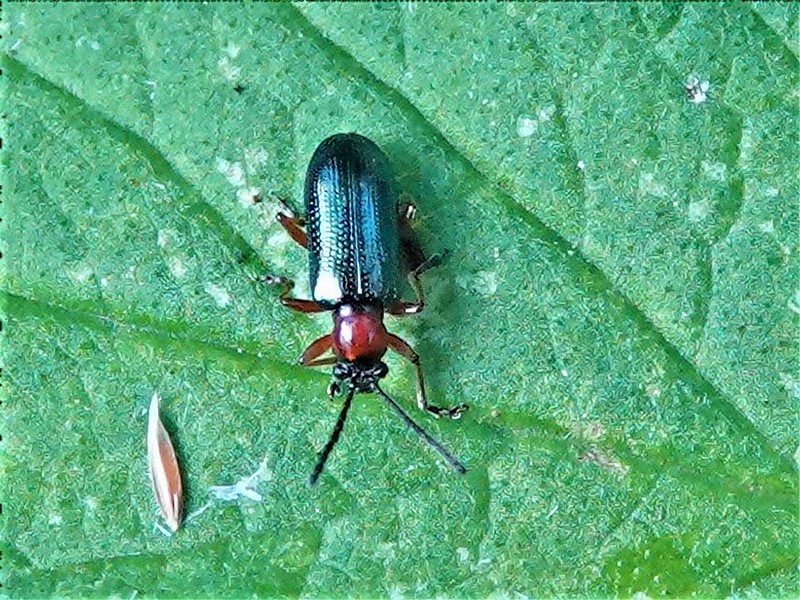
A new insect for me. It is a leaf beetle, either Oulema duftschmidi or O. melanopus. Individuals need microscopic examination to specifically identify.

A late instar of a Common Green Shieldbug Palomena prasina.

Do we really need another close-up of a Bridge Orb-web Spider Larinioides sclopetarius? Well probably not but this one was at the top of an unlit street lamp. The lamp failed at least 18 months ago. I did report it. Many weeks later a perfectly functioning street lamp was replaced. That new lamp has now stopped working. This latter failure is no big deal. The new lamp was much taller and shiny. Very few insects were ever within range.

A Long-jawed Orb-web Spider Tetragnatha sp. I initially though the pale 'bubbles' might indicate this is a female carrying eggs. But the 'bubbles' are hairy and I think just part of the spider's abdomen.

(Ed Wilson)
------------------------------------------------------------------------------------------------------

In the Priorslee Avenue tunnel:

Moths:
- none

Other things:
- 15 White-legged Snake Millipedes Tachypodoiulus niger

Spiders:
- 1 Missing Sector Orb-web Spider Zygiella x-notata [Silver-sided Sector Spider]

(Ed Wilson)

------------------------------------------------------------------------------------------------------

The Flash: 06:40 – 07:35

(187th visit of the year)

Bird notes:
- the single Greylag Goose was not on the East side grass, but alongside in the water. Again it did not seek to join the other Greylags when they flew in.

Bird(s) noted flying over here:
- 2 Jackdaws

Hirundines etc. noted:
None

Warblers noted (the figure in brackets relates to birds heard singing):
- 8 (1) Chiffchaffs
'nominal' warbler:
- 1 (0) Goldcrest

Noted on / around the water:
- 3 Canada Geese
- 39 Greylag Goose: 38 of these arrived as a single and then a party of 37
- 4 + 3 (1 brood) Mute Swan
- 26 (?♂) Mallard
- 52 (?♂) Tufted Duck
- 6 + 3 (3 broods) Moorhens
- 64 + 6 (3 broods) Coots
- 4 Great Crested Grebes
- 48 Black-headed Gulls

Noted elsewhere around The Flash:

Moths:
- 1 Common Grass-moths Agriphila tristella [was Common Grass-veneer]
- 1 Flame Carpet Xanthorhoe designata : the one seen yesterday was in a very different location
- *1 Green Carpet Colostygia pectinataria

Flies:
- 1 cranefly Tipula lateralis

Beetles:
- 1 Alder Leaf Beetle Agelastica alni : adult

Spiders, harvestmen etc.
- 2 harvestmen Dicranopalpus ramosus/caudatus

A Great Spotted Woodpecker. But what sex?

This does not help. A red crown indicates it is a juvenile and on this view it could be either sex.

An attractive moth: a Green Carpet Colostygia pectinataria. The green parts rapidly lose their colour as the scales wear off.

(Ed Wilson)

------------------------------------------------------------------------------------------------------

Sightings from previous years

2011
Nedge Hill
4 Yellow Wagtails
(John Isherwood)