27 Jul 25

Priorslee Balancing Lake and The Flash

15.0°C > 16.0°C: Mostly overcast at medium-high level; some occasional light rain c.07:15 and c.08:30. Mainly light north-westerly breeze. Very good visibility, less during rain.

Sunrise: 05:22 BST

* = a species photographed today
$ = my first sighting of the species for this year
$$ = my first ever recorded sighting of the species in the area

Priorslee Balancing Lake: 05:05 – 06:30 // 07:40 – 09:45

(183rd visit of the year)

Bird notes:
- today one Canada and one Greylag Goose stayed put with two Canadas and five Greylags departing as I was arriving. As the geese were returning from the East 16 Canada Geese flew on with eventually 66 Canada Geese and 14 Greylag Geese present.
- two quite small Mallard ducklings were noted without any obvious adult in attendance.
- the duck Pochard missing again.
- the same three juvenile Great Crested Grebes as yesterday were all that were found again .
- a lone Blackbird was heard to sing just once and briefly at c.08:00.
- at least two Cetti's Warblers was heard calling along the North side on my first lap only.
- several small groups of Reed Warblers were seen and heard away from the reeds. The calls of the juveniles were reported by Merlin as "Tree Sparrow". I wish.
- no Garden Warbler or Lesser Whitethroat were seen or heard.
- an adult male Common Whitethroat was at the West hedge between the footpath and the Ricoh ground. Its location suggests it might be a returning bird moving through rather than one of the breeding birds.
- yet I heard a tit call just twice. Ii might just have been the elusive Marsh Tit. I have again decided to "let it go".

Bird(s) noted flying over here:
- 24 Canada Geese: an octet outbound; 16 inbound together
- 8 Greylag Geese: a single and a septet outbound
- 104 Wood Pigeons
- 1 Herring Gull again
- 5 Lesser Black-baked Gulls
- 52 Jackdaws
- 48 Rooks

Counts from the lake area:
- 66 Canada Geese: see notes
- 14 Greylag Geese: see notes
- 2 Mute Swans
- 19 (?♂) + 2 (1 brood) Mallard: see notes
- 9+ 4 (2 dependent broods) Moorhens
- 111 Coots
- 7 + 3 (2 broods) Great Crested Grebes: see notes
- 11 Black-headed Gulls: no juveniles
- 2 Lesser Black-baked Gulls
- 1 Grey Heron

Hirundines etc. noted:
- 1 Barn Swallow
- 5 House Martins high to the north-east: where from and to?

Warblers recorded (the figure in brackets is birds noted singing):
- 2 (0) Cetti's Warblers
- 9 (0) Chiffchaffs
- 7 (1) Reed Warblers
- 3 (0) Blackcaps
- 1 (0) Common Whitethroat

Noted on the West end street lamp poles around-dawn:

Four-winged flies – Lacewings, Caddisflies etc.:
*1 Common Green Lacewing Chrysoperia carnea

Noted later:
Very little in cloudy weather

Butterflies:
Gatekeeper Pyronia tithonus

Moths
*9 Straw Grass-moth Agriphila straminella [was Straw Grass-veneer]
>15 unidentified grass moths, possibly all this species

Bees, wasps etc.:
Common Wasp Paravespula vulgaris
*Turnip Sawfly Athalia rosae

Hoverflies:
Marmalade Hoverfly Episyrphus balteatus
Chequered Hoverfly Melanostoma scalare [Long-winged Duskyface]

Dragon-/Damsel-flies:
*Common Blue Damselfly Enallagma cyathigerum [Common Bluet]

Four-winged flies – Lacewings, Caddisflies etc.:
none

Other flies:
*muscid fly Phaonia rufiventris
Grass Fly or Yellow Swarming Fly Thaumatomyia notata
otherwise only unidentified fly species

Bugs etc.:
*myrid bug Orthotylus sp.

Beetles:
*$$ probable Ragwort Flea Beetle Longitarsus jacobaeae
*Common Red Soldier Beetle Rhagonycha fulva

Amphibians:
None

Spiders, harvestmen etc.:
None

New plants for the year:
None

One of nine Straw Grass-moth Agriphila straminella of which I could confirm their identity. At least 15 more flew away before I could track them down and confirm which species of grass moth they were.

And another. You will be pleased to know I am not going to show the other seven!

Best photo to date of a Turnip Sawfly Athalia rosae showing the black "shoulder pads" and the black leading edge to the wings.

A male Common Blue Damselfly Enallagma cyathigerum.

And another – this one an immature with the blue colour not fully developed especially around the thorax.

Common Green Lacewing Chrysoperia carnea.

If only all flies were this easy! The muscid fly Phaonia rufiventris.

On my hand is one of the difficult to identify myrid bugs from the Orthotylus genus.

A tiny flea beetle also in my hand. As I had extracted it from a Common Ragwort Jacobaea vulgaris plant it is probably a Ragwort Flea Beetle Longitarsus jacobaeae. There are several beetles in this family that are impossible to separate from photos.

A well-posed Common Red Soldier Beetle Rhagonycha fulva.

(Ed Wilson)

------------------------------------------------------------------------------------------------------

In the Priorslee Avenue tunnel:

Moths: [34 species here before today; at least one addition]
*1 $ Dusky Pearl Udea prunalis
*1 Small Fan-footed Wave Idaea biselata
1 Single-dotted Wave Idaea dimidiata
1 moth still to be identified but possibly a Cloaked Minor Mesoligia furuncula

Flies:
*1 female Banded Mosquito Culiseta annulata
8 moth flies Psychodidae sp. [Drain Fly or Owl Fly]
22 midges of various species.

Arthropods:
2 White-legged Snake Millipedes Tachypodoiulus niger

Spiders, harvestmen etc.:
1 Missing Sector Orb-web Spider Zygiella x-notata [Silver-sided Sector Spider]

New for the year a Dusky Pearl moth Udea prunalis.

Small Fan-footed Wave moth Idaea biselata.

A moth still to be positively identified. It may be a Cloaked Minor Mesoligia furuncula. That would be a new species for me. However this specimen is worn and all species of "Minor" moth are known to be challenging and / or impossible to identify. I am taking further advice.

A female Banded Mosquito Culiseta annulata.

(Ed Wilson)

------------------------------------------------------------------------------------------------------

The Flash: 06:35 – 07:35

(179th visit of the year)

Bird notes:
- *a new brood of seven Mallard ducklings with a parent.
- another new brood (of just one) Coot juveniles. At least one other bird is still sitting, presumably on egg(s).
- the Great Crested Grebes continue to confuse. A pair at the top end still with no sign of the presumed juveniles in the water. A third bird at the top end sitting on what appeared to be a nesting platform. Meanwhile another pair were by the island with just two juveniles. One adult was swimming around trying to prevent the juveniles climbing aboard.

Bird(s) noted flying over here:
None

Noted on / around the water:
- 11 Canada Geese only
- 3 Greylag Geese only
- 6 Mute Swans
- *22 (?♂) + 7 (1 brood) Mallard
- 20 (?♂) Tufted Duck
- 6 Moorhens
- 82 + 10 (7 dependent broods) Coots:
- *5 + 2 (1 brood) Great Crested Grebes: see notes
- 2 Black-headed Gulls
- no Grey Heron

Hirundines etc. noted:
None

Warblers recorded (the figure in brackets is birds noted singing):
- 3 (1) Chiffchaffs
- 1 (0) Blackcap

Noted around the area:

Butterflies:
none

Moths [on street lamp poles and in the grass] [61 species here before today (another recount!): no additions]
1 Riband Wave Idaea aversata
1 Swallow Prominent Pheosia tremula: back at the top end today.

Bees, wasps etc.:
Buff-tailed Bumblebee Bombus terrestris

Hoverflies:
Chequered Hoverfly Melanostoma scalare [Long-winged Duskyface]

Dragon-/Damsel-flies:
none

Four-winged flies – Lacewings, Caddisflies etc.:
none

Other flies:
only unidentified fly species

Bugs etc.:
none

Beetles:
larvae of Alder Leaf Beetle Agelastica alni

Arthropods:
none

Fungus:
*Turkeytail Trametes versicolor

Spiders, harvestmen etc.:
5 harvestmen Dicranopalpus ramosus/caudatus
*3 harvestmen Opilio canestrinii

New plant for the year
*Early Goldenrod Solidago gigantea [Giant Goldenrod]
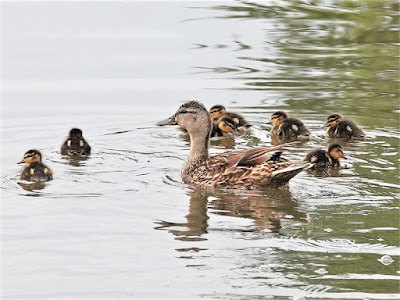
The new brood of seven Mallard ducklings with their mother.

I am sure there has to be one or more juvenile Great Crested Grebes on the right-most bird's back but...

Turkeytail fungus Trametes versicolor. A very common fungus on dead wood.

A male harvestmen Opilio canestrinii.

And a female.

What NatureSpot calls Early Goldenrod Solidago gigantea and Obsidentify calls Giant Goldenrod. For some reason I have never logged this plant here before. Since I had a Golden-rod Pug Eupithecia virgaureata in the Priorslee Avenue tunnel yesterday there had to be some of the plant about.

(Ed Wilson)

------------------------------------------------------------------------------------------------------

2006
Priorslee Lake
Redshank
(Ed Wilson)

26 Jul 25

Priorslee Balancing Lake and The Flash

17.0°C: A few early breaks in the cloud; then a spell of drizzle between 07:00 and 08:15. A very few bursts of sun as I was about to leave. Light north-westerly breeze. Very good visibility except in drizzle when poor.

Sunrise: 05:20 BST

* = a species photographed today
$ = my first sighting of the species for this year
$$ = my first ever recorded sighting of the species in the area

Priorslee Balancing Lake: 05:05 – 06:25 // 07:35 – 10:00

(182nd visit of the year)

Bird notes:
- apart from one Greylag Goose that stayed put and one Canada Goose that soon departed any other overnighting geese had left before I arrived. Upon my return from The Flash geese were still arriving with eventually 68 Canada Geese and 10 Greylag Geese present.
- two groups of four well-grown Mallard ducklings seen. I may have logged these previously with the adults as had they been on the grass I doubt I could have recognised them as anything other than adults.
- the duck Pochard still here.
- only three juvenile Great Crested Grebes found during the poor visibility. One full-grown juvenile from the second brood: and just two of the trio from the third brood.
- a lone Blackbird still singing away.
- early on a Cetti's Warbler was calling along the South side with a bird simultaneously heard singing along the North side. This was the first song I have heard since 10 July. Later two birds were calling along the North side.
- two Garden Warblers were heard calling and seen in flight along the South side. I presume from a second brood of a nesting pair here.
- *a Lesser Whitethroat was seen at the West end with two birds, probably of this species, heard calling close-by. It suggests this skulking species stayed to breed even though I have neither seen nor heard it since mid-April.
- during my attempt to find the calling warblers I heard a tit calling just twice. I was using the Merlin app to see whether it could confirm the warblers' identity (it couldn't) and it thought the tit was a Willow Tit. I am fairly sure it wasn't and I suspect it was a Marsh Tit. I have decided to "let it go".

Bird(s) noted flying over here:
- 4 Canada Geese: two duos outbound
- 6 Greylag Geese: outbound together
- 99(!) Wood Pigeons
- 1 Herring Gull
- 10 Lesser Black-baked Gulls
- 75 Jackdaws
- 37 Rooks

Counts from the lake area:
- 68 Canada Geese: see notes
- 10 Greylag Geese: see notes
- 2 Mute Swans
- 28 (?♂) + 8 (2 broods) Mallard: see notes
- 9+ 3 (2 dependent broods) Moorhens
- 107 Coots
- 5 + 3 (2 broods) Great Crested Grebes: see notes
- 14 Black-headed Gulls only: no juveniles
- 5 Lesser Black-baked Gulls
- *2 Grey Herons

Hirundines etc. noted:
- House Martin(s) heard high overhead at 05:10: nothing seen

Warblers recorded (the figure in brackets is birds noted singing):
- 3? (1) Cetti's Warblers: see notes
- 10 (0) Chiffchaffs
- 3 (0) Reed Warblers
- 6 (0) Blackcaps
- 2 (0) Garden Warblers: see notes
- *3? (0) Lesser Whitethroats: see notes

Noted on the West end street lamp poles around-dawn:
Nothing at all

Noted later:
A few things starting to emerge as the sun broke through briefly

Butterflies:
Large White Pieris brassicae
*Speckled Wood Pararge aegeria
Gatekeeper Pyronia tithonus

Moths
*8 Horse-chestnut Leaf-miner Cameraria ohridella
*7 Straw Grass-moth Agriphila straminella [was Straw Grass-veneer]
10+ unidentified grass moths, possibly all this species
1 Pale Straw Pearl Udea lutealis
*1 Shaded Broad-bar Scotopteryx chenopodiata : very faded

Bees, wasps etc.:
*Common Wasp Paravespula vulgaris

Hoverflies:
Common Twist-tail Sphaerophoria scripta [Long Hoverfly; Common Globetail]

Dragon-/Damsel-flies:
*Blue-tailed Damselfly Ischnura elegans [Common Bluetail]

Four-winged flies – Lacewings, Caddisflies etc.:
none

Other flies:
only unidentified fly species

Bugs etc.:
*Dock Bug Coreus marginatus
*planthopper, probably Eupteryx urticae
Red-legged Shieldbug Pentatoma rufipes

Beetles:
7 Spot Ladybird Coccinella 7-punctata

Amphibians:
none

Spiders, harvestmen etc.:
none

New plants for the year
None

Little and large. A juvenile Moorhen and two Canada Geese. Note the size of the foot on the Moorhen. How does that fit in to the egg?

Definitely my photo of the day. It is not often a Lesser Whitethroat will pop out of cover for a photo. Most probably because the calls I could hear nearby were juveniles wanting to be fed.

Expressing surprise at the camera perhaps?

A clever trick if you can do it – a Grey Heron has managed to land on one of the buoys. When I first saw this from a distance in the drizzle I assumed it was an immature Cormorant.

Not many butterflies around this morning: a Speckled Wood Pararge aegeria at ease.

Perhaps a better attempt at a photo of a Horse-chestnut Leaf-miner moth Cameraria ohridella.

A photo to give some idea of scale with a Straw Grass-moth Agriphila straminella trying to hide on a flower bud of Common Knapweed Centaurea nigra.

A very faded Shaded Broad-bar moth Scotopteryx chenopodiata right at the end of this species' flight period.

I was berated if I ate my food with my mouth open. No-one has told this Common Wasp Paravespula vulgaris.

This Blue-tailed Damselfly Ischnura elegans was the only damselfly I noted. The blue tail was almost glowing in the vegetation.

The distinctively-shaped Dock Bug Coreus marginatus

A tiny planthopper, probably Eupteryx urticae. There are several similar species and it is difficult to get a photo that shows the precise pattern of the markings.

Plane of the day: this is an American-registered SOCATA TB.20 Trinidad, a French designed and built four-seater. Some countries, America among them, do not require the aircraft registration to be painted under the wing. Most American-registered aircraft based overseas are registered to a trustee company: this one is unusual in that its Ruislip owner appears on the Federal Aviation database. Despite that address it was here flying from a small airstrip near Kingston-Upon-Hull to Shobdon Airfield in Herefordshire. It flew back later.

(Ed Wilson)

------------------------------------------------------------------------------------------------------

In the Priorslee Avenue tunnel:

Moths: [33 species here before today; one addition]
*1 White-spotted Pug Eupithecia tripuntaria : as yesterday
*1 $ Golden-rod Pug Eupithecia virgaureata
3 Single-dotted Waves Idaea dimidiata

Four-winged flies – Lacewings, Caddisflies etc.:
*1 $$ caddisfly Stenophylax permistus

Flies:
8 moth flies Psychodidae sp. [Drain Fly or Owl Fly]
8 midges of various species.

Arthropods:
3 White-legged Snake Millipede Tachypodoiulus niger

Spiders, harvestmen etc.:
2 Missing Sector Orb-web Spiders Zygiella x-notata [Silver-sided Sector Spider]
1 harvestman Leiobunum blackwalli / rotundum

Another and better(?) view of presumably the same White-spotted Pug moth Eupithecia tripuntaria as yesterday.

Not such a crisp photo. Obsidentify was 100% sure this is a Golden-rod Pug Eupithecia virgaureata. Most pug moths look the same to me: it is the subtle difference in wing shape as well as markings that helps identification.

A new species for me. A large orange-toned caddisfly covered in light speckling identifies it as a Stenophylax permistus.

(Ed Wilson)

------------------------------------------------------------------------------------------------------

The Flash: 06:30 – 07:30

(178th visit of the year)

Bird notes:
- all six Mute Swans present and correct. How could I have overlooked one?
- *another sighting of a single Mallard duckling with a parent. At least half-grown and probably seen before.
- 15 Tufted Duck counted on the water. As I arrived a group of six was flying around and then a lone bird looked like it might be flying away. The island was blocking my view of most of the water and any or all of these may have landed-back.
- only two juvenile Great Crested Grebes seen with one of the parents from the brood by the island. Perhaps the other juvenile was with the other adult – wherever that was? The pair at the top end still had any young unseen on the back of one of the adults.

Bird(s) noted flying over here:
- 1 Jackdaw

Noted on / around the water:
- 32 Canada Geese
- 6 Greylag Geese
- 6 Mute Swans
- *21 (?♂) + 1 (i brood) Mallard
- 15 (?♂) Tufted Duck: see notes
- 7 Moorhens
- 87 + 8 (6 dependent broods) Coots:
- 3 + 2 (1 brood) Great Crested Grebes: see notes
- 6 Black-headed Gulls: no juveniles
- 1 Grey Heron

Hirundines etc. noted:
None

Warblers recorded (the figure in brackets is birds noted singing):
- 3 (0) Chiffchaffs
- 2 (0) Blackcaps

Noted around the area:

Butterflies:
none

Moths [on street lamp poles and in the grass] [60 species here before today: no additions]
1 Straw Grass-moth Agriphila straminella [was Straw Grass-veneer]
1 Single-dotted Wave Idaea dimidiata
*1 Swallow Prominent Pheosia tremula

Bees, wasps etc.:
none

Hoverflies:
none

Dragon-/Damsel-flies:
none

Four-winged flies – Lacewings, Caddisflies etc.:
none

Other flies:
*$$ fruit fly Anomoia purmunda (also also known as Phagocarpus purmundus)
only unidentified fly species

Bugs etc.:
none

Beetles:
none

Arthropods:
none

Slugs / snails etc.:
*1 White-lipped Snail Cepaea hortensis

Spiders, harvestmen etc.:
8 harvestmen Dicranopalpus ramosus/caudatus
1 harvestman Leiobunum blackwalli / rotundum
*2 harvestmen Opilio canestrinii

The duck Mallard with her lone duckling.

After several days with Swallow Prominent moths Pheosia tremula on street lamp poles at the top end I found none yesterday. Today this one was at the South end near the Medical Practice.

I can certainly agree with Obsidentify here: "unknown moth species". The spider that has entrapped it is also unknown.

Another new species for me. This a mating pair of fruit flies Anomoia purmunda. The female lays her eggs in unripe haws (hawthorn berries). Strangely the larger fly on top, which I therefore assume is the male, has its eyes more widely separated than those of the female. This is opposite to that found on hoverflies.

A White-lipped Snail Cepaea hortensis

A harvestman Opilio canestrinii

(Ed Wilson)

------------------------------------------------------------------------------------------------------

2013
Priorslee Lake
Willow Tit
(Ed Wilson)

2006
Priorslee Lake
Common Sandpiper
(Ed Wilson)

25 Jul 25

Priorslee Balancing Lake and The Flash

11.0°C > 19.0°C: A few early high clouds soon dispersed then sunny. A calm start with a very light south-westerly breeze developing. Moderate to good visibility and hazy.

Sunrise: 05:19 BST

* = a species photographed today
$ = my first sighting of the species for this year
$$ = my first ever recorded sighting of the species in the area

Priorslee Balancing Lake: 05:00 – 06:20 // 07:30 – 09:45

(181st visit of the year)

Bird notes:
- apart from one Greylag Goose any overnighting geese had left before I arrived. Upon my return from The Flash geese were still arriving with eventually 66 Canada Geese and 14 Greylag Geese present.
- no obvious Mallard ducklings seen
- the duck Pochard was found again.
- a Tufted Duck, sex undetermined, briefly visited before flying off East.
- all seven juvenile Great Crested Grebes found. At least 10 adults noted.
- two Common Sandpipers noted
- a lone Blackbird still singing away.
- *at least four Cetti's Warblers were seen and heard along the North side. Proof of successful breeding here.
- a Common Whitethroat was heard alarm calling.

Bird(s) noted flying over here:
- 3 Canada Geese: outbound together
- 7 Greylag Geese: outbound together
- 1 Feral Pigeon: an all-white bird flew high East
- 81 Wood Pigeons
- 2 Lesser Black-baked Gulls
- 1 Grey Heron: as well as the two at the lake for a while
- 161 Jackdaws
- 70 Rooks

Counts from the lake area:
- 66 Canada Geese: see notes
- 14 Greylag Geese: see notes
- 2 Mute Swans
- 22 (?♂) Mallard: see notes
- 11+ 3 (2 dependent broods) Moorhens
- 104 Coots
- 10 + 7 (4 broods) Great Crested Grebes: see notes
- 2 Common Sandpipers
- 6 Black-headed Gulls only: no juveniles
- 2 Herring Gulls
- 3 Lesser Black-baked Gulls
- 2 Grey Herons: one chased away

Hirundines etc. noted:
- 3 Barn Swallows
- 1 House Martin

Warblers recorded (the figure in brackets is birds noted singing):
- *4 (0) Cetti's Warblers
- 11 (1) Chiffchaffs
- 4 (1) Reed Warblers
- 3 (0) Blackcaps
- 1 (0) Common Whitethroat

Noted on the West end street lamp poles around-dawn:

Moths:
none

Flies:
*1 long-legged fly Dolichopus sp., likely D. wahlbergi
*1 Tachinid fly Gastrolepta anthracina

Spiders, harvestmen etc.:
1 harvestman Dicranopalpus ramosus/caudatus

Noted later:
Considering the sunny weather it seemed quiet for insects. Most flowers are now over so perhaps that is why:

Butterflies:
Large White Pieris brassicae
Small White Pieris rapae
Green-veined White Pieris napi
Speckled Wood Pararge aegeria
Gatekeeper Pyronia tithonus
Common Blue Polyommatus icarus

Moths
3 Straw Grass-moth Agriphila straminella [was Straw Grass-veneer]
5 unidentified grass moths, possibly all this species
*1 Mother of Pearl Patania ruralis [was Pleuroptya ruralis]

Bees, wasps etc.:
Red-tailed Bumblebee Bombus lapidarius
Common Carder Bee Bombus pascuorum
Buff-tailed Bumblebee Bombus terrestris
Common Wasp Paravespula vulgaris
*unidentified Crabonid wasp sp.
*Turnip Sawfly Athalia rosae

Hoverflies:
Bumblebee Blacklet Cheilosia illustrata
*Parsley Blacklet Cheilosia pagana
Marmalade Hoverfly Episyrphus balteatus
*$ Plain-faced Dronefly Eristalis arbustorum [Eurasian Drone Fly]
*Furry Dronefly Eristalis intricaria
Tapered Dronefly Eristalis pertinax
*Common Dronefly Eristalis tenax
Meadow Field Syrph Eupeodes latifasciatus [Broad-banded Aphideater]
Chequered Hoverfly Melanostoma scalare [Long-winged Duskyface]
Dead-head Hoverfly Myathropa florea [Common Batman Fly]
Syrphus sp. S. ribesii / S. vitripennis

Dragon-/Damsel-flies:
Common Blue Damselfly Enallagma cyathigerum [Common Bluet]
*$ Common Darter Sympetrum striolatum
Hawker sp.

Four-winged flies – Lacewings, Caddisflies etc.:
none

Other flies:
*$ Tachinid fly Phasia hemiptera
otherwise only unidentified fly species

Bugs etc.:
none

Beetles:
7 Spot Ladybird Coccinella 7-punctata
Common Red Soldier Beetle Rhagonycha fulva

Amphibians:
none

Spiders, harvestmen etc.:
money spider Erigone sp.
Zebra Spider Salticus scenicus

New plants for the year:
*Lords & Ladies Arum maculatum [Cuckoo Pint]

My highlight of the day. One of three visible Cetti's Warblers with another calling nearby. These were, I am sure, a family group. I suspect this is a juvenile as although I cannot see a gape-line the bill is paler than it would be on an adult.

It did not help when this Wren appeared among the warblers.

A different Cetti's.

 The same calling quietly. (I didn't know they did anything quietly)

Is it calling for food from a preening adult?

Last one. None of the other birds in the group would oblige.

A typical view of a Mother of Pearl moth Patania ruralis. They do not like anyone standing behind them and quickly reposition.

This is one of the Crabonid group of wasps. They cannot be specifically identified from photos.

This is a Turnip Sawfly Athalia rosae. Note the dark leading edge of the wings. It does not much like the one I photographed on Tuesday which was a brighter red. However that one also had the black shoulder-pads which are also a feature of this species.

A Parsley Blacklet hoverfly Cheilosia pagana

The extensive white bands (of hairs) between the body-segments (tergites) help identify this hoverfly as a Plain-faced Dronefly Eristalis arbustorum which Obsidentify calls a Eurasian Drone Fly.

Not a bee (it has very short antennae) but a Furry Dronefly Eristalis intricaria. I have not seen any of these for some weeks. All those I saw earlier I recall as having rufous "tails". Apparently males can have rufous or white "tails" while females, as here, all have white "tails".

I noted a few days ago that I had not seen many Common Droneflies Eristalis tenax recently. Here is one!

My first Common Darter Sympetrum striolatum of the year. This could be a teneral (immature) male or a female. When adult males are red

On a street lamp pole around dawn was this long-legged fly from the Dolichopus genus, likely D. wahlbergi . This is a male with, as NatureSpot motes, "[its] mid tarsus modified into black pennate extensions, looking like a thick feather."

There were only two flies on the street lamp poles around dawn and this is the other. It seems to be the Tachinid fly Gastrolepta anthracina.

Another Tachinid fly this time Phasia hemiptera identified primarily by the orange hairs on the side of the thorax as well as its generally tubby shape.

Exposed by the mowing regime of the local council were these fruits of Lords & Ladies Arum maculatum also known as Cuckoo Pint. Do not eat the berries (or any other part of the plant either)! Highly toxic.

Aircraft of the day: this Robinson R44 Raven II is owned by Greenwood Louvre Ltd. of Pontyclun who, according to the internet, "promote healthy buildings through ventilation, smoke control and architectural louvres and solar shading". So there. It was flying South: the trace on FlightRadar24 is very intermittent due to its low altitude so I have no more information.

(Ed Wilson)

------------------------------------------------------------------------------------------------------

In the Priorslee Avenue tunnel:

Moths: [32 species here before today; cc confirmed addition]
*1 possible Tawny Grey Eudonia lacustrata [was Little Grey]
*1 White-spotted Pug Eupithecia tripuntaria : now confirmed
1 Single-dotted Wave Idaea dimidiata

Four-winged flies – Lacewings, Caddisflies etc.:
none

Flies:
4 moth flies Psychodidae sp. [Drain Fly or Owl Fly]
11 midges of various species.

Arthropods:
4 White-legged Snake Millipede Tachypodoiulus niger

Spiders, harvestmen etc.:
2 Missing Sector Orb-web Spiders Zygiella x-notata [Silver-sided Sector Spider]

This moth is likely a Tawny Grey Eudonia lacustrata, a species that used to be known as Little Grey which was certainly a misnomer as without measuring it looks the same size and all the other species in this confusing group. I am not adding it to the confirmed sightings.

A better photo today and I am now happy with Obsidentify's suggestion of White-spotted Pug Eupithecia tripuntaria.

(Ed Wilson)

------------------------------------------------------------------------------------------------------

The Flash: 06:25 – 07:25

(177th visit of the year)

Bird notes:
- a dead Greylag Goose noted alongside the path. I could see no obvious sign of any injury.
- only five Mute Swans noted. A blue Darvic ring noted on one of them: hard to read at the distance - '7JXY' perhaps?'
- three juvenile Great Crested Grebes seen from the brood by the island. *The pair at the top end still had any young unseen on the back of one of the adults.
- two Grey Herons standing in trees at the top end
- my first Willow Warbler of the Autumn was heard singing, albeit briefly, at the top end.

Bird(s) noted flying over here:
- 1 Sparrowhawk
- 2 Jackdaws

Noted on / around the water:
- 29 Canada Geese
- 6 Greylag Geese: also a dead bird – see notes
- 6 Mute Swans
- 15 (?♂) Mallard
- 16 (?♂) Tufted Duck
- 8 Moorhens
- 104 + 8 (8 dependent broods) Coots: bright light to see those around the island
- *4 + >3 (2 broods) Great Crested Grebes: see notes
- 1 Black-headed Gull: juvenile arrived
- 2 Lesser Black-backed Gull: adults: one departed; another(?) visited briefly
- 2 Grey Herons

Hirundines etc. noted:
None

Warblers recorded (the figure in brackets is birds noted singing):
- 1 (1) Willow Warbler
- 4 (2) Chiffchaffs
- 1 (1) Blackcap

Noted around the area:

Butterflies:
none

Moths [on street lamp poles and in the grass] [60 species here before today: no additions]
none

Bees, wasps etc.:
none

Hoverflies:
none

Dragon-/Damsel-flies:
none

Four-winged flies – Lacewings, Caddisflies etc.:
Grouse Wing caddis fly Mystacides longicornis

Other flies:
only unidentified fly species

Bugs etc.:
none

Beetles:
none

Arthropods:
none

Spiders, harvestmen etc.:
2 harvestmen Dicranopalpus ramosus/caudatus

New flowers for the year:
None

The pair of Great Crested Grebes from the top end. I am sure the bird on the right is harbouring juveniles under its raised back feathers. But how many?

(Ed Wilson)

------------------------------------------------------------------------------------------------------

A5 Telford Way Tunnel

I made another visit to the tunnel at the top end which passes under the A5 Telford Way. Not worth going today!:

Moths:
1 probably the same probable Maple Pug! Eupithecia inturbata

(Ed Wilson)

------------------------------------------------------------------------------------------------------

2007
Priorslee Lake
Oystercatcher
300+ Lesser Black-backed Gulls
3 Herring Gulls
1 Yellow-legged Gull
1 Reed Warbler
3 Blackcaps
4 Chiffchaffs
4 Sand Martins
(Ed Wilson)

2006
Priorslee Lake
3 Great Crested Grebes
3 Herons
3 Greylag Geese
17 Tufted Ducks
1 Kestrel
6 Stock Doves
303 Wood Pigeons
12 Swifts
1 Kingfisher
4 Sand Martins
7 Swallows
6 House Martins
2 Grey Wagtails
8 Reed Warblers
2 Lesser Whitethroats
1 Common Whitethroat
1 Garden Warbler
9 Blackcaps
6 Chiffchaffs
2 Willow Warblers
3 Willow Tits
1 Jay
248 Jackdaws
485 Rooks
205 Greenfinches
3 Bullfinches
8 Reed Buntings
(Ed Wilson)